Table of contents
- Why is conversion marketing important?
- What is Conversion Marketing?
- What different types of conversions are there?
- How do you optimize your Conversion rate?
- Best practices in Conversion Marketing
- a lot of persuasion is needed
- suitable budget is set aside for this.
- Fazit: Geringere Kosten und mehr Umsatz - Wenn die Datenbasis & der Prozess stimmen
What intention did you have when you accessed this page? You want to find out what Conversion Marketing is and how you can implement it, right? But surely, you didn't come to this page to carry out action during this visit that has an entrepreneurial value to the OMR-Reviews or perhaps you did? Conversion Marketing is all about this - guiding users who enter the site with a specific intention to a suitable action for them that is valuable for the company. What these are and how to approach these optimizations, you will find out in this article.
Recommended conversion optimization tools
On our comparison platform OMR Reviews you can find more recommended conversion optimization tools. We present over 140 solutions that are specifically tailored to the needs of companies and brands that want to improve their conversion rates. This conversion optimization software offers comprehensive support in all aspects of conversion optimization. Take this opportunity to compare the different software solutions, drawing on authentic and verified user reviews:
Why is conversion marketing important?
How many visitors does your website have per month and how many of these visitors actually make a purchase? In reality, only a small percentage of visitors make a purchase, as the decision-making process and the associated customer journey is complex. In search of the best offer, users visit multiple sites, like those of your competitors, to compare offers. Often, potential customers also need to deal with finding the right solution to their problem.
However, you spend your marketing budget on all the visitors to your website and if only a few visitors actually make a purchase, then these purchases must finance the visits without a purchase. Conversion marketing aims to convert the number of visitors to a website into paying customers. Optimization of the website for conversions allows a company to generate more revenue without having to make additional marketing expenses. This leads to a higher profitability and a better return on investment (ROI).
Overall,
Conversion Optimization is important because it helps you
get the most out of your existing resources and achieve your goals more effectively.
Conversion Optimization allows you to convert your website visitors into paying customers, thereby increasing the success of your online marketing activities. Especially in times of inflation, when purchasing power is decreasing and the prices for traffic are rising sharply,
it is important to offer users a appealing and efficient website . Otherwise, the budget is literally burned.
What is Conversion Marketing?
The term "
Conversion" refers to the process in which a visitor to your website
performs a certain action that is considered valuable by your company. The purchase of a product, the filling out of a contact form or the subscription of a newsletter represent a special value for your company for example.
The goal is to maximize the Conversion-Rate. The percentage of website visitors who actually perform a desired action should be increased because most website users do not perform a valuable interaction with the website.
To improve the conversion rate various techniques can be used, such as the optimization of the UX and UI of the website, improving the offer or pricing, adding customer reviews or testing different versions of promotional materials. Psychological effects are often used in the conversion rate-optimization to simplify decisions for users or to boost purchase motivation. If the conversion rate is increased, the effectiveness of marketing campaigns increases, as more revenue is generated with the same advertising expenditure . User feedback testing is also an important measure to optimize the website from the user's point of view.
What different types of conversions are there?
The primary aim of conversion-optimization is to increase sales and reduce costs to achieve a better ROI . To achieve this overall target, the measures in conversion marketing must be broken down into tactical subgoals to prioritize them better in the optimization process . Depending on the business model and the length of the decision-making process and the sales funnel, it makes sense to weight different targets for optimization. As a rule, a distinction is made in the conversion rate-optimization between micro- and macro conversions:
- Micro Conversions are actions that visitors can perform on your website that do not lead directly to a purchase or another main conversion, but are still valuable for the success of the website and the company. They are an indicator of how successful your website is in acquiring visitors.
- Micro conversions could for example be:
- Filling out a contact form
- Downloading an E-Book or Whitepaper
- Subscribing to the newsletter
- Signing up for a webinar or a demo
- Viewing multiple pages on the website
- Adding an article to the shopping cart
- Clicking on a button to share content on social media
- But also, the click-through rate (CTR) or the increase in customer reviews to create a social proof can be counted as micro conversions.
- Macro Conversions are the primary goals of your website, which contribute directly to fulfill the business goals of your website. Macro conversions are the actions a visitor should take to become a paying customer, like for instance:
- Making a purchase
- Concluding a subscription
- Booking a service
- Performing a registration
- Creating a customer account
Conversion rate optimization is mostly about online conversions. However, in some business areas, it makes sense to also think about offline conversions. In furniture retailing, for example, attempts are made to entice users into a store, to avoid expensive returns. There, for example, better consultations or alternative products can be sold. If e.g. an offline conversion is to be achieved through online measures, it makes sense to offer a consultation appointment in your store or a click & collect option. You can also distinguish between soft and hard conversions:
- Soft Conversion: Examples of a soft conversion can be an increased brand, product or service affinity, positive engagement and shares in social media or increased signups for an email list. A soft conversion often takes place before a hard conversion and focuses on promoting the company or the product itself. These conversions are commonly assigned to the awareness- and consideration-phase in the Sales-Funnel.
- Hard Conversion: Hard conversions have the clearest path to purchase and directly affect the financial targets. These are often seen as "traditional" conversions and can be identified as form submissions (setting up a demo or making an appointment for consultation), purchase (E-Commerce) or phone calls. Hard conversions demonstrate a clear intent. Registrations and logins can also be labelled as hard conversions.
A
special challenge is conversion marketing
in the B2B sector as decisions are usually made by several people
and the decision-making process can therefore take longer overall. Initially, a lead is generated which is then led to the sale through lead nurturing measures. To generate the initial lead, a lead magnet, such as a free white paper download is offered. These leads are then later
converted into sales-qualified-leads through different content.
How do you optimize your Conversion rate?
To optimize the conversion rate, you have to master many different disciplines. Companies that assign a high priority to CRO and experimenting usually have dedicated resources for each of these disciplines. It is important to possess strong analytical skills but also to be creative in developing new solutions. Essentially, the CRO process goes through the following phases: Analysis, conception and planning, data collection & measurement, evaluation & implementation. The CRO process is a cycle since each optimization is followed by further optimizations that build on the generated learnings.
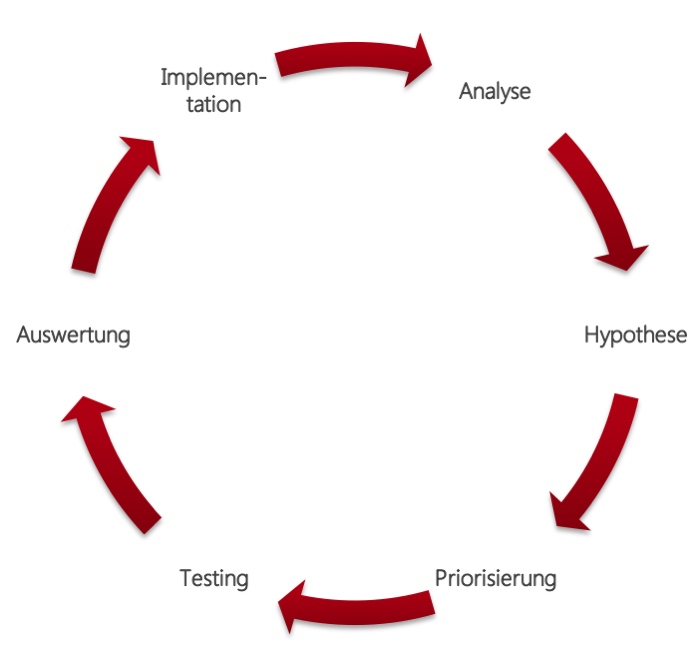
- Analysis: The first phase in the CRO process is the analysis phase. In this phase, it is defined where the website needs to be optimized and what needs to be optimized. To define where an optimization needs to take place, a web analysis of the website data will be carried out to identify the bottlenecks of the site. For this step, comprehensive Conversion Tracking is essential. All important metrics for the company as well as the user paths and funnels must be collected, so that a good prioritization of the bottlenecks can take place.
1.1 In the web analysis the entire customer journey is analyzed. All online marketing measures, such as marketing campaigns or e-mail marketing are examined for their effectiveness and evaluated. Based on the data, a prioritization of the revenue levers is then carried out. The biggest bottlenecks or revenue levers are then analyzed in more depth in a qualitative analysis. The targets and metrics for the optimization are now set.
1.2. The qualitative analysis consists of target group analysis, heatmap analysis and heuristic evaluation. In the target group analysis, it is defined which users visit the site and which purchase motives and intentions they have when visiting the website. The site is viewed from the user's point of view in order to derive optimizations. Once these parameters are defined, the behavior of the users on the site is analyzed. For this, heatmap data, i.e. click and scroll behavior, is analyzed. It is also possible to evaluate the behavior of the users on the website through session recordings. This analysis clearly shows why users have a bad user experience (UX). In the heuristic evaluation, the site is checked according to UX best practices. A common framework is, for example, the 10 Usability Heuristics by Nielsen. Hypotheses for optimization are then formed from these insights. - Conception & Planning: After the bottlenecks or revenue levers and optimization hypotheses have been created, they are prioritized next to the assumed impact and also according to the implementation effort. The hypotheses that have the lowest effort and the biggest impact are implemented first. Based on the traffic data, it is determined how many test variants or how many tests can be carried out in which period of time. Text concepts are then created first, which are then converted into wireframes and design concepts. Based on these, coordination rounds with the stakeholders can take place. Once the design is approved, the implementation of the optimizations can begin.
- The Data Collection: As a rule, every optimization should be tested or the impact measured. If a page has too little traffic to run tests, then a sequential comparison can provide insight into the performance of the optimization. In the planning phase it was defined how many tests can be carried out. Now, the test targeting must be defined. There are simple metrics on which a test can be played out. But if comprehensive combinations of metrics are set up in the targeting, then this is called personalization. As a rule, one should first start with simple A/B tests before getting into complicated tests. It is important to ensure the following aspects during testing to make a reliable statement about the result:
- Sample size compliance: If the sample size is too small,
this can lead to the results not being statistically significant. It is important to ensure that the sample size is large enough to deliver accurate results. - Selection bias: A selection bias can occur when the participants of the test are not randomly selected. If the participants are not representative of the target group, the results can be distorted. That's why it's important to use a good testing tool.
- Test duration: If the test does not run long enough, the results may be inaccurate. It's important to let the test run for a sufficient period of time to get accurate results.
- Variability: It is important to ensure that variability is minimized in the data. If variability is too high, results may be inaccurate. The test variants therefore need to be randomized.
- Confidence level: Another important factor in A/B testing is the confidence level. If the confidence level is too low, this can lead to errors. It is important to carefully choose the confidence level to get accurate results.
Once reliable data has been collected in the test and the result is reliable, the test can be evaluated.
Various metrics should be tracked that provide insight into user behaviour to derive good follow-up tests. Through segmentation of data and by
re-evaluating the heatmaps new insights can be gained, which are important for further optimizations. Therefore, it is important to document the results well to get an ever better understanding of user behaviour. Once the first tests have been conducted, then further challenging tests can follow. In the Webinar of the Testing-Tool provider, Kameleoon, learn how to start with
A/B testing tools and how you can evolve your testing program.
Recommended editorial content
At this point you will find external content from YouTube that complements the article. You can display it with one click.
I consent to external content being displayed to me. This allows personal data to be transmitted to third-party platforms. Read more about our privacy policy.
Video: Bring your in-house CRO program to the next level (Source: YouTube)
Best practices in Conversion Marketing
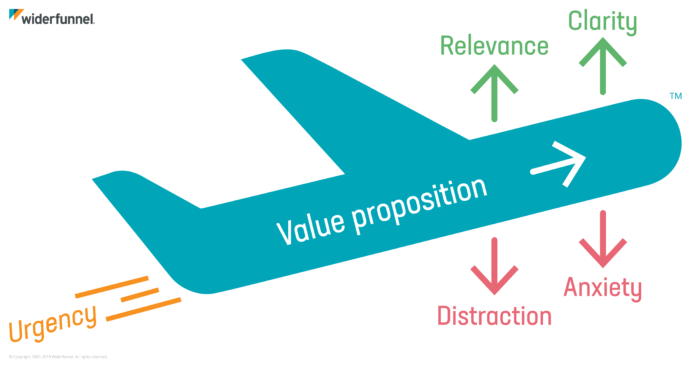
The most important rule in Conversion-Rate-Optimization is that all optimizations must be tested. Even if a competitor has already implemented a possible optimization or if it is an apparent “Best Practice", this does not necessarily mean that this implementation will work for your target group, your product, your CI or your site structure. To establish optimization approaches, or best practices, you can, for example, use the LIFT model by WiderFunnel
, the most popular Conversion-Optimization-Framework. The Acronym LIFT stands for the six elements that the model describes.Value Proposition: The value propositions that a company offers its customers should be clear and appealing in order to achieve a higher conversion rate.
- Relevance: The relevance of the provided products or services for the target group is a decisive factor for a higher conversion rate.
- Clarity: The message should be conveyed clearly and simply to achieve a better understanding and a higher conversion rate.
- Anxiety: Any fears and insecurities that customers might have during the purchase decision should be minimized to achieve a higher conversion rate.
- Distraction: Distractions that could divert the customers' attention from the conversion should be minimized to achieve a higher conversion rate.
- Urgency: A sense of urgency should be created to motivate customers to take immediate action and achieve a higher conversion rate.
- Image: LIFT model by WiderFunnel
a lot of persuasion is needed
to make stakeholders agree to a test. If the test then shows that the apparent obvious optimization does not perform as expected, the data base is questioned. Therefore, a good data base and a plausible evaluation of the optimizations is the most important aspect in order to establish trust in the test results. It must be ensured e.g. a universal understanding of the required sample size must be created, so that there are no discussions about the data base, but about the test results.Since so many stakeholders have an opinion on the subject, it also becomes more and more difficult to really put yourselves in the shoes of the target group and its needs 100%, and to derive optimizations from the perspective of the users.
Management, the CRO Manager, the Marketing & Product Team all have information about the company. This information distorts the perception in the implementation. One can hardly put oneself in the user's position, who do not have this information. User tests are therefore indispensable.What tools do you need to support Conversion Marketing?To operate Conversion-Rate-Optimization efficiently and effectively, you have to think carefully about which data base you have to use. Additionally, it is also important that a
suitable budget is set aside for this.
These aspects are often forgotten at the start of the Conversion-Rate-Optimization and then turn out to be process blockers during the optimization. We have some
interesting tools for you that will help you with the optimization. If you're just starting out and just getting into Conversion-Rate-Optimization, then you should have the following basic setup for your tool stack. For the basis you need an
Analytics Tool (e.g. Google Analytics
), a
Heat- & Clickmap Tool (e.g.
CrazyEgg, Hotjar or Mouseflow ), to evaluate user behaviour and a
Testing Tool (e.g. Kameleoon or VWO ), to test your hypotheses.
You can then expand your basic tool stack in the next step with tools that allow you to generate better insights along the entire customer journey. It could for example make sense to conduct market analyses
Fazit: Geringere Kosten und mehr Umsatz - Wenn die Datenbasis & der Prozess stimmen
Zusammenfassend ist Conversion Marketing und die Conversion-Optimierung essenziell, um einen besseren Return-on-Investment des Marketingbudgets zu erzielen. Es gibt jedoch einige Herausforderungen in der Umsetzung. Fang daher schlank an. Geh in die Analyse und ändere erstmal eine Headline oder ein Bild in einem Seitenbereich, den viele Nutzer*innen sehen und messbar den Impact optimieren. Steigere dich, wenn du eine Datenbasis und erste Learnings hast. Plane aber von Anfang an genügend Budget für die passenden Tools ein.


