Table of contents
- These are the most important tips for choosing your e-commerce platform
- How to consider your customers when choosing an e-commerce platform
- how to choose even more customer-specific cross-channel solutions and what to watch out for when growing in online trading.
- Squarespace
E-commerce is booming! By now, you can buy almost anything on the Internet, from clothing to printer paper to cleaning machines. It's no wonder that more and more retailers are turning to e-commerce platforms in their business models.
If you've been in the e-commerce business for a while, you probably find yourself wondering from time to time whether your
E-commerce platforms, for example
Salesforce Commerce Cloud still meets current standards. Increasing demands, such as headless commerce or the importance of customer engagement, are being added and new focal points are being opened up.
If you're not sure yet which e-commerce platform is right for you or if you're about to change platforms, this article is just for you. We'll show you what to look for when choosing an e-commerce platform and what criteria work best for this. We'll also present some software options that might be suitable for you.
Recommended E-Commerce-Platforms & Shopsystems
On our comparison platform OMR Reviews you can find more recommended e-commerce platforms & store systems.
We present over 230 solutions that are specifically tailored to the needs of small and medium-sized companies, start-ups and large corporations. Our platform offers comprehensive support in all areas of online commerce, from product presentation to customer management. Take the opportunity to compare different e-commerce solutions, taking into account real user reviews, to find the perfect system for your individual business needs:
Before you decide on an e-commerce solution for your business, there are a few points to consider. We'll now show you the key issues to keep in mind when choosing.
SaaS vs. On-Premise solution
As early as the software selection process, you have several options. With an on-premise solution, your data is hosted by customers, while with Software-as-a-Service models, it is stored by the software provider.
Front-end design
From the get-go, think about what the front-end of your e-commerce platform should look like in general. Do you want to use templates, declarative tools (drag & drop), or a headless architecture? Each format has its pros and cons, and many companies choose a platform that supports any kind of architecture.
API Support
Thoroughly examine whether the platform of your choice has all the features you need now and in the future, such as the ability to support foreign currencies and multiple languages.
Data and integration strategy
Among the data you should definitely consider on an e-commerce platform are customer and product data.
- Customer data across all channels: Always remember to take your customer data into account beyond e-commerce. You should keep an eye on data from various channels and from service and marketing sectors. This way, you can consolidate the data across departments and understand the behavior of your customers even better.
- Product data: Some companies already use PIM software (Product Information Management) for this. But you can also take a segmented approach and build your product data into your new e-commerce solution little by little. But before you choose an e-commerce platform, it's important to think about which approach you're going to use.
Merchandising and Marketing
At this point, reflect on how your merchandising and marketing teams have worked on your products so far and how you might involve them more:
IT Development
You should also keep your IT development in mind when choosing a new e-commerce platform. Here too, you can consider how to involve the relevant teams and developers in the implementation and further development of an e-commerce solution.
In all areas, you should never lose sight of your customers because any change or switch will have an impact on them and their experiences. So let's take a closer look at how to succeed in this.
The basic prerequisites for the right choice of an e-commerce platform are not solely your technology or marketing. The success also significantly depends on how you can implement the customer loyalty. The following points can assist in customer retention.
Meeting customer expectations
Customers, according to the 2019 Report
"2019 State of the Connected Customer" expect cross-departmental communication during brand interaction. "The entire customer journey should be shaped by the use of new technologies and the pursuit of simplified, intuitive, and smarter customer experiences," says Ravi Arora, Global Salesforce Commerce Leader at IBM. In the minds of customers, a service employee, for example, should know about a recently signed purchase contract or the details of a recently executed e-commerce transaction and react accordingly.
The key to this is a holistic e-commerce platform that is networked across all channels and can meet these expectations.
Trust
The issue of trust is very far-reaching in e-commerce and includes data security, reliability of services, data protection, and transparency:
- Where are your customers' data located?
- How many steps do they go through, and where are there obstacles that make it difficult to keep track and access?
All customer interaction channels (e-commerce, marketing, service, etc.) must be available and accessible at all times across all channels.
Product
The functionality of your e-commerce platform plays a major role in successful customer loyalty. For this reason, it is advisable to test your selected platform in advance on real users in marketing, sales, and service. This way, you can directly test how the system can be implemented across departments. Additionally, your colleagues from other departments can understand how customers will use the system.
Handling data
From the outset, look out for e-commerce platforms that offer you actionable data integration. That is, the customer data set in the service department should ideally have the same data set as in e-commerce. This is crucial for streamlining business processes, because if data is available at fewer places, it is easier to pass the right analyses on to the right people.
Growth
As new employees grow, so do the skills within a company. So it's worth ensuring that your (new) e-commerce platform includes a range of learning tools. If your employees can be promoted and grow with the selected e-commerce tool, then they can also pass on this growth and new knowledge to your customers.
how to choose even more customer-specific cross-channel solutions and what to watch out for when growing in online trading.
These platforms support you in e-commerce
After you've thought about what expectations you have for e-commerce software and how you can increase your customer loyalty with it, we'll now introduce you to some software options that might be suitable for you.
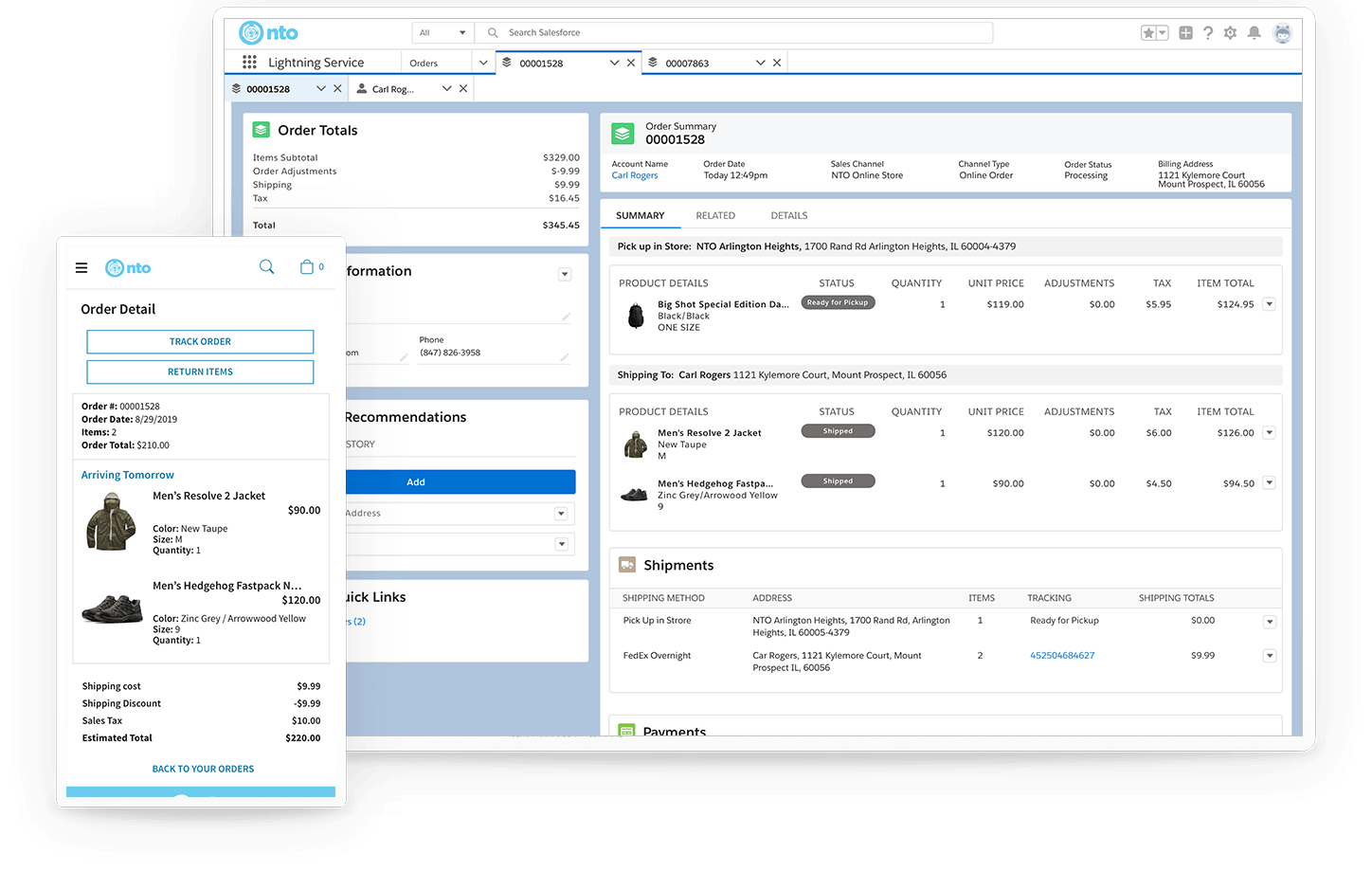
users can network with potential buyers both online and offline. This reportedly allows for better cross-channel shopping experiences, managing any number of brands and conquering new markets at the same time. Salesforce Commerce Cloud is available in the Starter, Growth, and Plus versions. You can request an individual offer on the website.
A glimpse into the e-commerce solution from Salesforce.
- These are the advantages of the Salesforce Commerce CloudReuse of technology:
- Commerce Cloud allows customers to connect and reuse Salesforce products, features, and data. Shared and distributed architectures for components such as catalogs, customer lists, promotions, campaigns, and content libraries can be scaled across multiple locations. Order management, payments, and AI functions and data are natively connected and can be reused in B2B and B2C. Salesforce supports a common platform architecture with reusable components and a common data model for commerce, sales, service, and marketing applications, so you're equipped for expansion and connectivity across customer touchpoints.Global capabilities and scaling:
- Commerce Cloud is based on a multi-tenant SaaS infrastructure that gives you global scalability, currently supported by a customer base in over 84 countries, and offers a global availability with an uptime of 99.99%. Integrated localization features support over 100 currencies and languages. Salesforce's global presence also includes Japan and a partnership with Alibaba to host and sell Salesforce Commerce products in China to help you unify data in your Chinese storefront and provide integrations with key local systems.Robust ecosystem:
Salesforce Commerce's core features can be extended by over 2,500 partner applications and more than 260 ISV partners with pre-built, certified integrations in over 35 technology categories such as subscriptions, PIM, fulfillment, fraud, and security. Customers can expand their Salesforce capabilities and investments by compiling the stack that is best for their business, by selecting integrations by industry, solution, or implementation type (such as headless), and integrating them via the front-end, API, or back-end.
Want to learn more about Salesforce's services? All tools and helpful articles about the products can be found on Squarespace
Conclusion: what to consider when choosing the right e-commerce platform


