Table of contents
- What is an online sales platform?
- Why should you use an online sales platform?
- 5 providers to sell software online
- Conclusion: How to find the right platform to sell software
Selling needs to be learned - this applies offline as well as online. The great thing about digital commerce is that there are now numerous sales platforms that support you. Gone are the days when you had to painstakingly acquire technical knowledge and programming skills if you wanted to launch an online store. If you are one of the entrepreneurs who are still looking for the right tool to sell digital products like software, then this article is for you! We present five sales platforms and compare features, application areas and prices for you.
Recommended online sales platforms
You can find more recommended online sales platforms on our comparison platform OMR Reviews. There we have listed over 10 sales platforms for small and medium-sized companies, start-ups and large corporations, these all-in-one platforms offer the possibility to sell physical products as well as digital products such as presentations and online courses. So take a look and compare the software with the help of authentic and verified user reviews:
Online sales platforms are tools that enable companies to market their products and services via the internet. They cater to both B2C and B2B businesses.
The most obvious function of such a platform is to give you easy and hassle-free access to a global market. In addition, most platforms include features such as setting up various payment options, intuitively creating extensive product catalogs, tracking order status, and automating invoice processes.
This makes online sales platforms similar to so-called
shop systems like
Shopify or
Spryker. However, in contrast to these, most platforms see themselves as all-in-one solutions, which are particularly quick to set up. In addition, online sales platforms offer the possibility to market digital products in addition to physical ones. Examples include online courses or the option to sell software.
Depending on the provider, you can choose between two pricing models. Some providers offer a traditional subscription where you have to pay a fixed monthly fee. Other providers, on the other hand, offer their sales platform without a basic fee, but participate in your sales with a certain percentage.
Online sales platforms offer a number of advantages over traditional sales paths. By using such platforms, companies can offer their product or service more efficiently, faster and more reliably. This is particularly advantageous for smaller companies, as they can reach customers as easily as possible.
Another advantage of these platforms is the ability to observe the market in real time, so adjustments can be made to increase software sales. In addition, an online store also maps customer data, which can help make better decisions about marketing strategies and products. This makes it easier for you to address potential customers and ultimately generate more sales. In addition, you save time and effort in advertising the product, as you can market it directly online - this is particularly interesting for start-ups.
But it doesn't work without knowledge and planning. For instance, it is necessary to correctly set up the various payment methods and the security of the shop. Specifically with regard to the GDPR, you should also pay very close attention to the observance of regulations and legal requirements.
In addition, entrepreneurs also need a basic understanding of marketing strategies and techniques in order to successfully increase the shop's turnover. Overall, however, the use of online sales platforms offers enormous advantages compared to the traditional way of selling. This is because it is much easier to realize special offers and discounts that attract customers.
5 providers to sell software online
Elopage
Elopage is an online platform that allows you to create, manage and sell digital products like e-books, online courses, coaching programs and the like. Even though the focus at first glance seems to be on webinars, the platform also offers the possibility to sell download products like software. The tool is aimed at solo entrepreneurs, coaches, trainers, consultants and other knowledge workers who offer digital products.
Some of the functions and features of elopage are:
Payment options: elopage supports all common payment methods like invoice, credit card and PayPal.
Product hosting: The platform allows you to offer digital products like online courses, e-books and download software.
Invoice automation: Invoicing, clearing and reminders can all be automated in the software.
Access management: Paying customers can automatically get access to your content.
Elopage Prices
You can test elopage for 14 days free of charge. After that, a total of four price options are available. These mainly differ with regard to the quota of customers and media assets that you can integrate on your site. The cheapest package 'Essential' costs you 29 € per month. This includes, among other things, 100 customers and 10 videos.
In the Advanced version, you pay 49 € per month, but receive an unlimited amount of customers and 300 videos. The 'Professional' package costs 99 € per month, including an unlimited number of videos. The premium edition for 279 € per month also includes 15,000 live stream minutes.
More information about the
Elopage prices can be found on OMR Reviews.
Digistore24
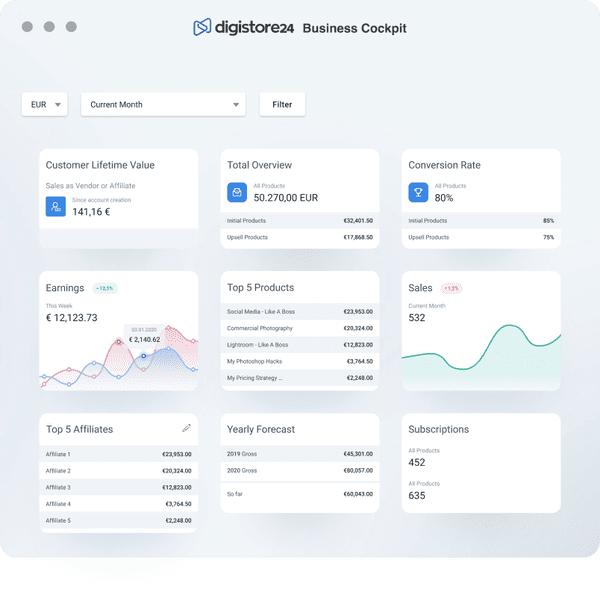
Digistore24 is a digital sales platform with which you can promote and market products like coaching, software, and events. Moreover, the platform provides access to its own affiliate network. Digistore24 targets, among others, coaches, software developers, startups, event organizers, analysts, and marketing managers. Key features include:
Automated sales: Once set up, the sales process with Digistore24 runs automatically.
Large affiliate network: With Digistore24, you have access to a network of professional affiliates who can additionally market your products.
Data insight: Extensive analytics and statistics give insight into the success of your sales measures.
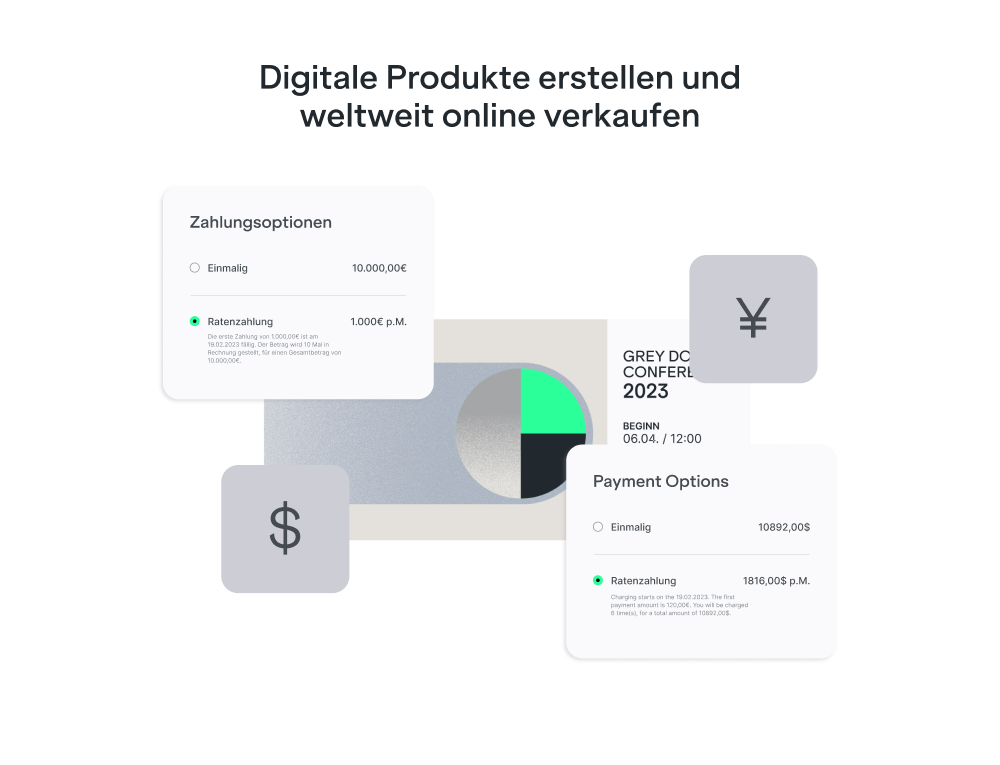
Flexible payment plans:The platform allows various payment options, such as one-time payments, installment payments, subscriptions, or minimum terms.
Conversion tools: Digistore24 offers different tools to optimize your conversions, for example, one-click upsells and order bumps.
Digistore24 Prices
Digistore24 is among the providers that do not require a basic fee from you. In return, the platform participates in every sale with a certain percentage of your turnover. For an amount of up to 400 € per transaction, 7.9% + 1 € goes to the provider. The amount that exceeds these 400 € is calculated at 4.9%. For payment in advance and by immediate transfer, this share is reduced to 2.9%.
CopeCart
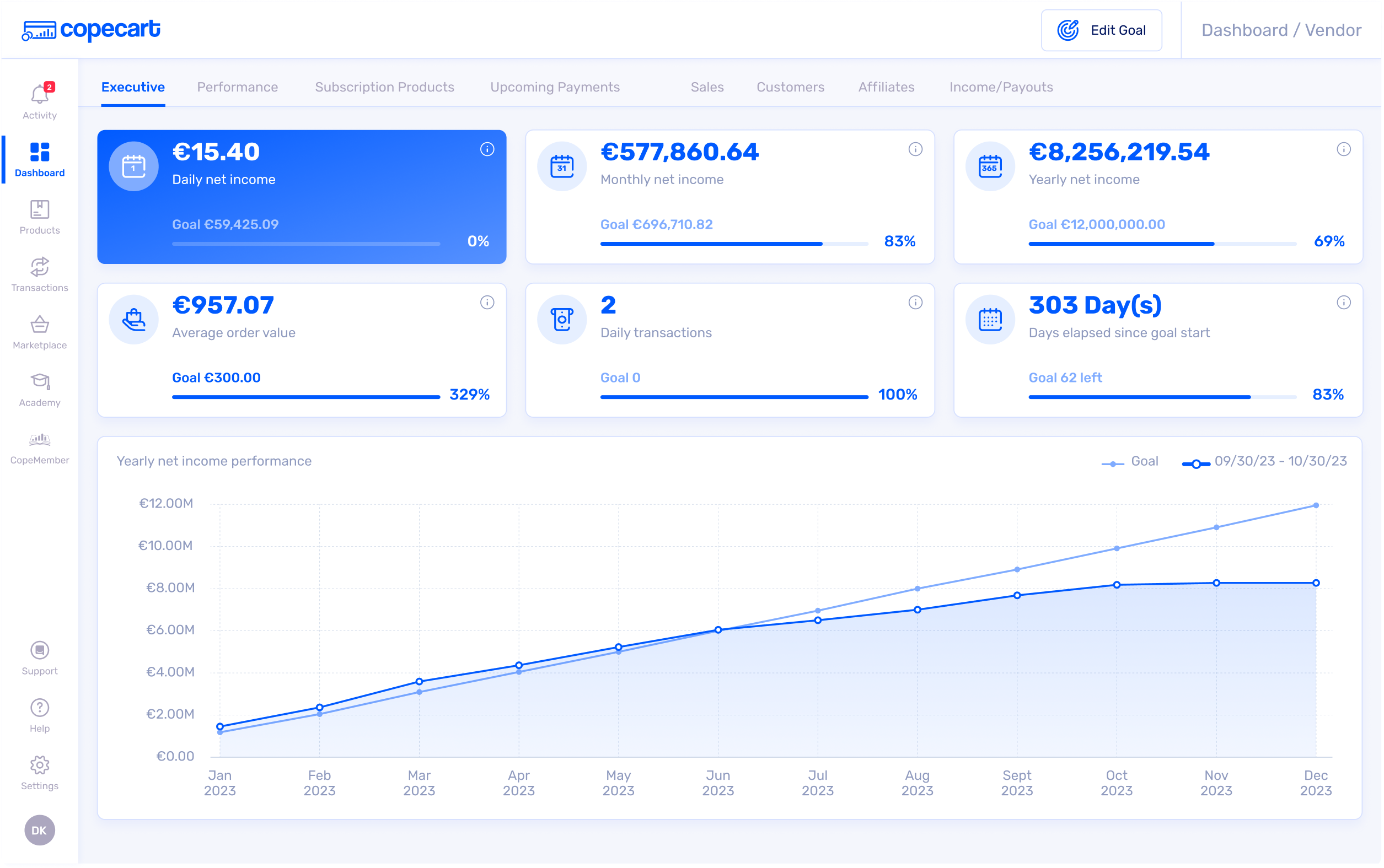
CopeCart is a provider that advertises enabling digital sales in a quick and easy manner. The products marketed via the platform include digital goods like online courses, audiobooks, and coaching sessions. However, physical products and services such as books, merchandise, web design, and software are also sold. The platform targets entrepreneurs, sales teams, influencers, affiliates, startups, and joint venture partners. Key features include:
Automatic invoice dispatch: Invoices and payment reminders are created and sent automatically.
Conversion-optimized checkouts: With the integration of upsells and order bumps, you can optimize your conversions.
Security: All interactions are secured by different encryption techniques.
CopeCart Prices
Like Digistore24, CopeCart also charges no basic fees for using the platform. However, the provider participates in each sale with 4.9% + 1 € of your turnover. If you have a six-figure monthly transaction volume, you also have the option to choose an enterprise model for sales with individual participation conditions.
FunnelCockpit
FunnelCockpit perceives itself as an all-in-one solution that combines all relevant marketing tools to set up an online business with which you can sell software. A major focus here, as the name already suggests, is on the creation of an effective and optimized funnel. No programming knowledge is necessary for this. The platform targets both sales starters and marketers and businesses. Key features and functions of FunnelCockpit include:
Domain connection: You can either integrate your own domain for using the platform or use a subdomain provided by FunnelCockpit.
Responsive design: All websites created with FunnelCockpit are automatically optimized for mobile.
Bounce tools: The platform offers its own tools with which you can minimize your bounce rate.
Custom CSS: With the integration of custom CSS, you can customize your website exactly as you wish.
SEO Tools: FunnelCockpit provides various tools and SEO functions with which you can optimize your website for Google and Co.
FunnelCockpit Prices
FunnelCockpit is available in three price variants: Lite, Standard, and Business. All offers can be tested free of charge for 14 days. After that, the cheapest Lite package costs € 47 per month. This includes, among other things, the FunnelBuilder, various page templates and your own blog.
FunnelCockpit charges € 97 per month for the next larger Standard package. For this, you get access to additional functions like your own CRM system and the ability to create forms and webinars. The biggest Business variant costs € 297 per month and includes additional functions like mouse tracking, the bounce tool mentioned at the beginning, and team functions for collaborative work.
ClickFunnels
Like FunnelCockpit, ClickFunnels places great emphasis on the optimized creation of a strong sales funnel. The goal is to maintain a steady flow of customers, simplify the purchasing process, and ultimately increase the turnover of your online shop in software sales. For this, the platform offers many different possibilities. The most important features and functions include:
Simple creation: Websites, shops, funnels, and blogs can be implemented using the drag-and-drop editor without any programming or technical knowledge.
Membership sites: For paying customers, you can create membership pages with their own login area.
A/B-Testing: ClickFunnels offers the possibility to test different versions of pages with the help of A/B testing.
ClickFunnels Prices
ClickFunnels is available in three price variants: Basic, Pro, and Funnel Hacker. In the cheapest Basic version, the use of the platform costs $ 127 per month. This includes, among other things, one website, 20 funnels, and one admin user.
In the next larger Pro version, the tool costs $ 157 per month. In return, you already get 100 funnels, access for 5 admin users, and 3 included domains for selling your software. In the most comprehensive Funnel Hacker package, ClickFunnels costs $ 208 per month and includes, among other things, 3 websites, an unlimited number of funnels, and 9 domains.
Which platform is the right one for you to sell software depends on various factors and your individual requirements and knowledge. Some of the shop platforms mentioned here, for example, require more familiarization time than others. Moreover, you should always consider what additional functions are offered, for example, in the areas of affiliate marketing, customer relationship management or search engine optimization.
The pricing models should also not be neglected: for some users, a fixed monthly basic fee offers security, while others prefer to pay on a commission basis.