Table of contents
- Why you need employer branding on LinkedIn
- Why LinkedIn employer branding is so important nowadays
- The foundation for successful E-Recruiting is employer branding
- With these two types, you can boost your employer branding on LinkedIn
- How to build an authentic profile
- Who should do employer branding on LinkedIn
- Example 1: Sharing company benefits
- So it can be summarized that a lot runs “subliminally” with employer branding on LinkedIn. Instead of putting the company and its profile in the foreground, a higher authenticity is generated through the employees or the CEOs.
The skilled labor crisis poses a growth risk to the German economy. Companies complain about too few qualified applications, a long time-to-hire and complicated demands from employees.
Our guest author, Line Hübner, is responsible for employer branding and employee acquisition. In this article she explains why LinkedIn employer branding is so important and how to best implement it.
Her prognosis? It won't get better anytime soon! The CEO of StepStone recently wrote a book titled “The Great Unemployment”. There will be a decrease in the current number of 45 million workers in Germany due to demographic changes as well as inadequate labor migration.
Why you need employer branding on LinkedIn
What is the cause of the shortage? Are there really too few skilled workers in Germany? How can we protect against this? And how does LinkedIn help?
With currently nearly three million students enrolled in the winter semester 2021/2022, I can't imagine that this is the origin of the problem. After all, over 150% more students are enrolled than was the case in 2003, without taking into account enrollments in technical colleges.
The range of studies has almost doubled within almost 15 years. Shouldn't that result in highly specialized professionals? To me, it rather sounds like arguments against than for a skilled labor shortage.
So how can it be that companies cannot find suitable candidates? In my opinion, the blame should not or not only be sought on the applicant side.
Why LinkedIn employer branding is so important nowadays
For a long time there were enough qualified applications. The HR department was busy placing job ads, sometimes in newspapers. There was no reason for decades for companies to reassess their application management or their recruiting measures.
But the generational change brings fresh wind into the working world: The needs and values of the workforce have changed.
In addition, the employer market has grown increasingly stronger over the last few decades. This increases the competitive pressure between different companies. It is no longer enough to just wait for incoming applications. Companies have realized that they must increasingly proactively engage talent and apply to them.
New ways must be found to receive qualified applications. A promising method is mobile recruiting or
E-Recruiting. LinkedIn, in particular, is a suitable business platform.
But how do you best approach this?
The foundation for successful E-Recruiting is employer branding
Before recruiting individuals, a company should ask what it can offer its members and what differentiates them from other employers. It's about building an
Employer Brand,- an employer brand.
The employer brand of a company is its unique selling proposition on the employer side. It is like a fingerprint. Every company has its own individual fingerprint. This consists of specific characteristics, such as the working atmosphere, team spirit,or the individual pool of benefits that make the company unique. But unfortunately, most companies wear a bulky old leather glove. Approachability and a contemporary appearance are often missing here.
Recommended social media software
On our comparison platform OMR Reviews you can find more recommended social media software.
We present over 100 solutions that are perfectly tailored to the needs of SMEs, start-ups and large corporations. Our platform supports you in all areas of social media management. Take the opportunity to compare different software and consult real user reviews to find the ideal solution for your requirements:
With these two types, you can boost your employer branding on LinkedIn
LinkedIn is the most important platform to make this fingerprint visible. Unlike employer review platforms like Kununu, talents can get a diverse impression of the company here.
Those who present themselves authentically generate qualified applications. However, the Employer-Branding-Strategy must first be defined. The company then has two options:
- It can use the official business profile. Through this, they can share insights from their work life and engage with their network.
- In the second option, the company establishes transparency by having the activities take place through the personal profiles of the employees.
Both options have their individual advantages and disadvantages and do not exclude each other. However, to find suitable specialists, there are clear trends pointing to one of the two options.
Business profiles vs. personal profiles.
To understand whether a business or personal profile is more promising, one needs to grapple with the basic concepts of social media. Almost every social media platform is about building a virtual network to interact with people from all over the world and friends from the analog world.
Looking back at the first social media channels, there were only personal profiles - no business profiles. Only later did companies discover the added value in social media and extended their marketing to these touchpoints.
Even later, companies discovered the principle of influencers for themselves. This gave a personal face to the product and company, creating more approachability and authenticity. The success of this strategy proves that people prefer to follow humans, not logos. It can form a more intense emotional connection than with a company.
The question now is how appropriate approachability and personal content is in the “largest professional network in the world”. After all, the basic idea of LinkedIn is to make its “members (...) more productive and successful.” - a contradiction to other social media platforms, which primarily serve to entertain. Or is it not?
It is a mistake to believe that personal and professional content are incompatible. Many associate personal content with private content and rightly view it critically to share private events. But private and personal are not the same.
Examples of business and personal profiles in employer branding
To explain what is meant by personal content and to what extent it is appropriate and beneficial on LinkedIn, I want to refer to the following example: Let's say a company has optimized its onboarding processes and wants to share this success on LinkedIn. There is the possibility to share this news via the business profile. The business profile represents the interests of the entire company and therefore offers little room for personal storytelling. The focus is on the transfer of information.
In the second option, an employee communicates about the optimization of onboarding. This contribution can be linked to a personal anecdote. A recruiter could report, for example, how he/she came up with the idea to optimize the onboarding processes or what challenges and successes he/she experienced on the way. Through a personal success story, users can identify with the content and it becomes more vibrant. Stronger emotions are created than with the mere transfer of information.
If a company subsequently asks whether LinkedIn posts perform better on the business profile or personal profile, this can be clearly answered with the personal profile.
Now we have established that the focus should be on the personal profile. But how do you build a wide-ranging and authentic, personal LinkedIn profile?
How to build an authentic profile
The decisive factor lies in the word “construction”. It's not about employees randomly starting to post. To be truly successful on LinkedIn, employees should follow a proven process.
For this, we look at the CLB5 process. With five steps, users can build a strong personal brand on LinkedIn. The following figure illustrates the process:
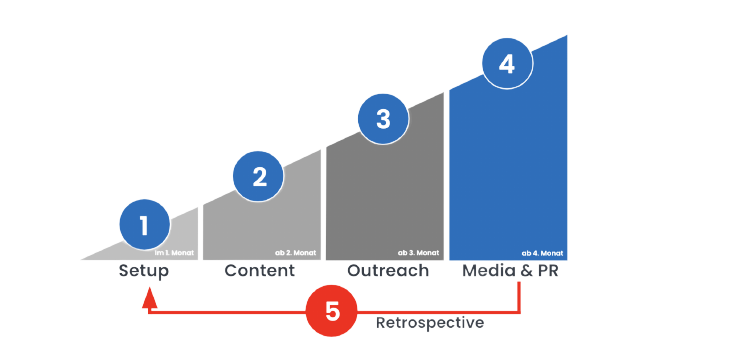
Figure 1: The steps of the CLB5 process.
1. The setup.
Before it comes to sharing posts, a strategy for LinkedIn activity must be defined in the setup. In HR, this is usually positioning as a sympathetic company with the objective of generating qualified candidates.
In the same step, the profile (e.g., profile picture, banner, information section, etc.) is updated. It makes sense to communicate the benefits and characteristics of the employer brand in the banner and refer to the career page. A LinkedIn banner can be seen as a kind of modern advertising pillar. News, exhibitions and job advertisements find their place here.
The slogan should emphasize that the company is currently looking for professionals. To establish a personal connection, it is also suitable to talk about the passion of the personal brand.
The info and professional sections should be formulated in the first-person perspective. Unlike the business profile, the person is in the foreground, so feel free to include personal anecdotes or storytelling in the text to strengthen trust.
2. Content creation
The next step is to create and share content. Successful content follows a clear strategy that was already defined in step one. But what needs to be considered in order to create wide-ranging and authentic posts that contribute positively to the employer brand? Since I would like to cover this question in more detail, I will first go into the remaining process steps and then give tips on content optimization.
3. Generating Outreach
The third step, “Outreach”, involves networking and initiating exchanges, as well as running
Social Media Recruiting. This is also the point at which engaging with exciting personalities can be initiated to recruit them for your company.
The CLB5 process makes it clear that recruiting can only be approached once the previous steps have been successfully completed. Imagine being contacted by a recruiter with an empty banner and incomplete profile. At the same time, you receive a message request from a recruiter with several thousand followers, a professional profile and exciting posts, which provide information about the company culture. Which request do you find more exciting?
LinkedIn has developed the solution of the “LinkedIn Recruiter” for professionally addressing candidates. (Further below, you´ll find an illustrative insight into the dashboard of LinkedIn recruiters.) This allows you to e.g. write to people who are not in your network. The message request is emphasized in the news feed.
With the Recruiter, you can also actively search for candidates. The tool uses specialized search criteria to find the people who suit their position.
Another way to meet exciting people is to engage with your profile visitors and engagers and actively address them. Subsequently, candidates can be transferred into the company’s
Applicant Management Software. In this way, you keep the candidate data clear and collect it transparently in one place.
These software include for example:
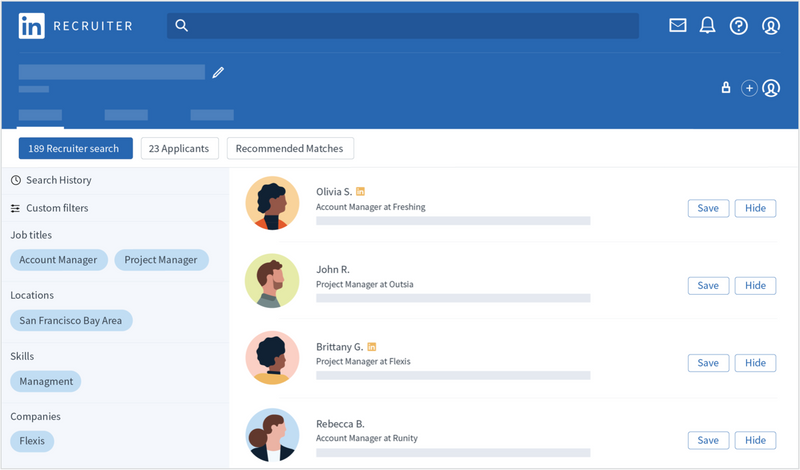
Figure 2: Dashboard LinkedIn Recruiter.
4. Media and PR
Step four involves securing appearances in media that are relevant to your target group. With digital visibility, you can become an intriguing thought leader more easily than without it. It’s important to keep in mind which platforms or media your target audience spends time on.
5. Looking back
The fifth step includes the retrospective to derive recommendations for action and optimize your personal brand. Part of this is to review your content for outstanding engagement in order to adapt your contributions to the interests of the community.
Who should do employer branding on LinkedIn
To now bridge to my question from earlier: What should someone who wants to successfully practice employer branding on LinkedIn post? And which person from the company is suitable for this?
Essentially, anyone from the team is eligible. It also does not matter how high the reach is at the start. The reach will grow on its own if you follow the CLB5 process and practice personal branding.
Recruiters are particularly destined, as they also deal with the topic internally and are thus authentic experts in the field. In addition, the applicants have a direct contact person, making it less intimidating for them to apply. However, since HR professionals are associated with employer branding, some users might question the credibility of the posts. It is all the more important for HR professionals to apply storytelling and share personal content to gain the network's trust. It is also advisable to talk about failures and share learnings to strengthen authenticity. It is important to share a personal opinion and not act as a pure mouthpiece of the company.
Examples of what you can post on LinkedIn
Example 1: Sharing company benefits
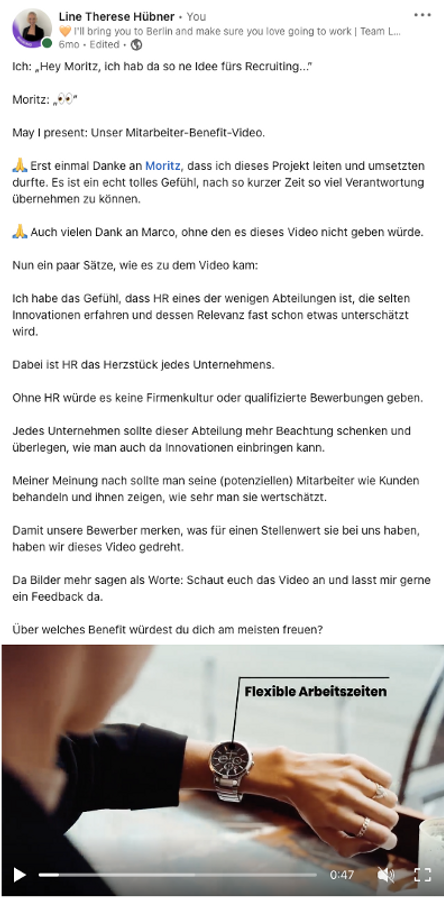
The following post is an example of how you can substantiate the professional interest with a personal story. This was about communicating the benefits of a company in the form of a video. However, the personal success story of being able to implement this project is also at the forefront of the contribution.
The following figures are LinkedIn posts that contribute positively to the employer brand by implicitly seizing the values and benefits of the company.
Figure 3: Sample LinkedIn content for Employer BrandingContent.
Example 2: Insights from founders
Also,
CEOs, founders or people from the management board are ideally suitable as a personal brand for employer branding. Due to their status in the analog world, these usually already have a high reach or build it up quickly. Through their communication, they give a face to the employer brand and generate trust. They can congratulate certain employees on their promotion through the profile or share personal insights into team events. They can talk about the founding story and why the company's values are important to them.
It is important to personalize all contributions through a personal speech style, pictures and videos that the personal brand shares about themselves.
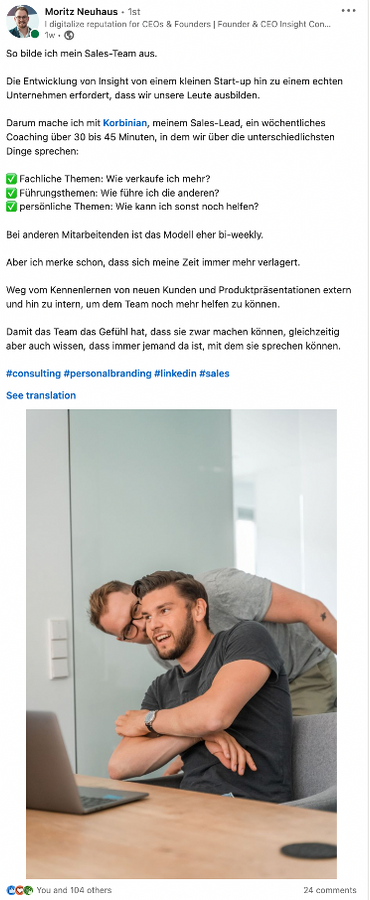
The following figure shows a LinkedIn post from the Co-Founder and CEO of Insight Consulting GmbH. In this post, he discusses further education opportunities and benefits and thus strengthens the positioning of the employer. The visual language also provides insights into the team culture.
Figure 4: Sample Employer Branding Post from a CEO
.
Example 3: Team leads as a personal brand
Other suitable personal brands are
Heads of’s or Team Leads. They can share department-specific content and thereby provide insights into everyday work and the range of tasks. A Team Lead is not directly associated with employer branding, which strengthens the authenticity of the LinkedIn appearance. Candidates also have a direct contact person for technical questions, making it easy to build up a personal bond. As content, it is a good idea to give an insight into everyday work and talk about ongoing projects and successes. Here too, it is important to combine the professional context with a personal concern.
The more the person shares insights into their own thoughts and opinions, the more identification opportunities they create – and, the more they distinguish themselves from other personal brands and the company profile.
The following figure shows a contribution from a Team Lead from Insight Consulting. In this, an insight into the feedback structure is given. This contributes positively to the employer brand without obviously selling it as employer branding.
Figure 5: Sample Employer Branding Post from a Team Lead.
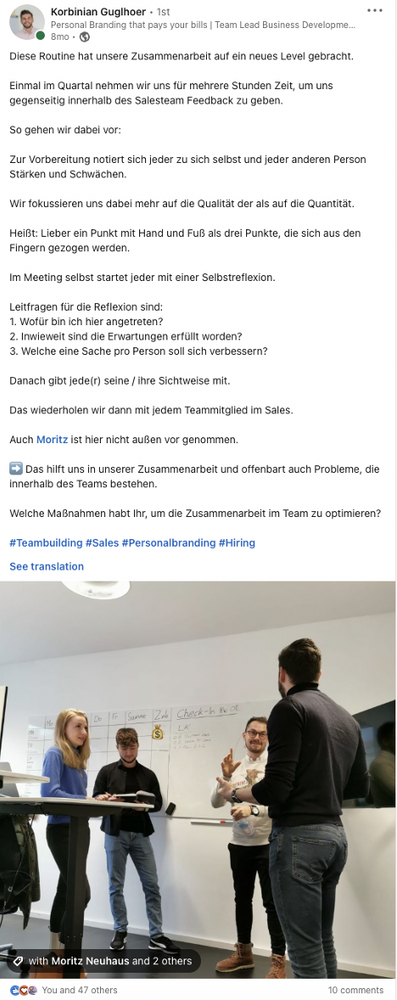
Through a meaningful visual language, valuable insights into the company culture can be subtly given, which additionally strengthens the employer brand. For example, dress style can reveal something about the dress code or the people depicted can provide information about diversity.
Why you should bet on employer branding on LinkedIn
So it can be summarized that a lot runs “subliminally” with employer branding on LinkedIn. Instead of putting the company and its profile in the foreground, a higher authenticity is generated through the employees or the CEOs.
It makes sense that various personalities from the company dedicate themselves to the topic of employer branding on LinkedIn. The important thing is that the topic is approached strategically. First, the profile must be professionally set up before content sharing starts.
In addition, it is important to create approachability to increase trust in the personal brand. Therefore, when creating content, the person should rely on storytelling and try to underscore professional content with personal stories.
Last but not least, regular account routines should be implemented and active job hunting should begin. This way, you won't lose any exciting candidates.
If you approach the topic strategically and boldly, not only can you generate more applications through LinkedIn - more importantly, you can strengthen the entire image of the company! The company is perceived by users as modern and attractive employer brand.
Geht Ihr das Thema strategisch und mutig an, lassen sich über LinkedIn nicht nur vermehrt Bewerbungen generieren – vielmehr kann das gesamte Image der Company gestärkt werden! Das Unternehmen wird bei den Usern als modern und attraktive Arbeitgebermarke wahrgenommen.


