Table of contents
- Wake up? This is how you identify ad fatigue in your target group
- Creative Fatigue: It's also about what you see
- This is how you avoid ad fatigue
- Tackling ad fatigue with Hunch and Creative Automation
- How to also avoid ad fatigue on Black Friday
- Nobody likes endlessly repeating ads – and nobody likes ad fatigue. Ad fatigue is a problem that should be understandable for all marketers. Because we all move on the user side as well and know how annoying ads can be. However, going against ad fatigue can be associated with some effort and requires a lot of perseverance: producing new, appealing creatives round the clock takes a lot of effort and can cost a lot of money.
Imagine you're scrolling through Instagram and there it is again: The advertisement for that cream you bought long ago – and still regularly appears in your feed for weeks. Annoying. We see so many ads every day that we might (sub)consciously scroll past one or another. And only in 2022 has Instagram increased the
share of ads on the platform. What quickly sets in? An ad fatigue that helps us users to block out the annoying.
Now let's switch to your role as a marketer: Perhaps you have also noticed that some of your ads simply do not perform. The reasons for this can be many. A particularly important reason: The so-called ad fatigue, against which you should absolutely proceed. This not only helps your business in the long run, but also ensures that more relevant content is played for you again while private scrolling – provided that as many marketers as possible read this article and take care of their ad game.
Recommended social media software
On our comparison platform OMR Reviews you can find more recommended social media software.
We present over 100 solutions that are perfectly tailored to the needs of SMEs, start-ups and large corporations. Our platform supports you in all areas of social media management. Take the opportunity to compare different software and consult real user reviews to find the ideal solution for your requirements:
Wake up? This is how you identify ad fatigue in your target group
Je suis fatigué – I am tired. What we usually associate with a hard week or a slightly too short weekend can also be relevant for the marketing world. The so-called ad fatigue, that is, advertisement fatigue, occurs when we are increasingly annoyed by the same ads over and over again. With particularly tenacious advertising, companies rarely reach their goal. Certainly not with such demanding target groups as are now on the internet. Rather, customers wish for all-round special experiences – and they do not only start with the visit to the online shop, but run through the entire
Customer Journey with all its touchpoints.
To find out whether your target group still tolerates your ads, you don't need to go to a sleep lab. Instead, you need a close look at the performance of your
Social Media Creatives and the signals that users send you. These are primarily KPIs such as click or conversion rates. If they decrease, you can assume that your ads are no longer arousing the desired interest. Therefore, analyze your advertising campaigns regularly and ensure that you always deliver particularly appealing ads.
In addition to click and conversion rates, you should also keep an eye on the following points. They too can be an indication of ad fatigue:
- High bounce rates: If users leave the website or target page quickly after clicking on the ad, this can be an indication of a lack of relevance of your ads.
- Negative feedback: On platforms like Instagram, users can comment on advertisements. Keep an eye on comments, but also ratings or even complaints about your ads.
- Decreasing engagement: If the interactions with your ads decrease, this can also indicate that your target group no longer finds your ads relevant.
- Decreasing Impressions: If the impressions of your ads decrease, this can be a sign of ad fatigue. Algorithms ensure that users are shown as relevant content as possible. If they have not interacted enough with your ads until now, these are classified as less relevant and shown less often.
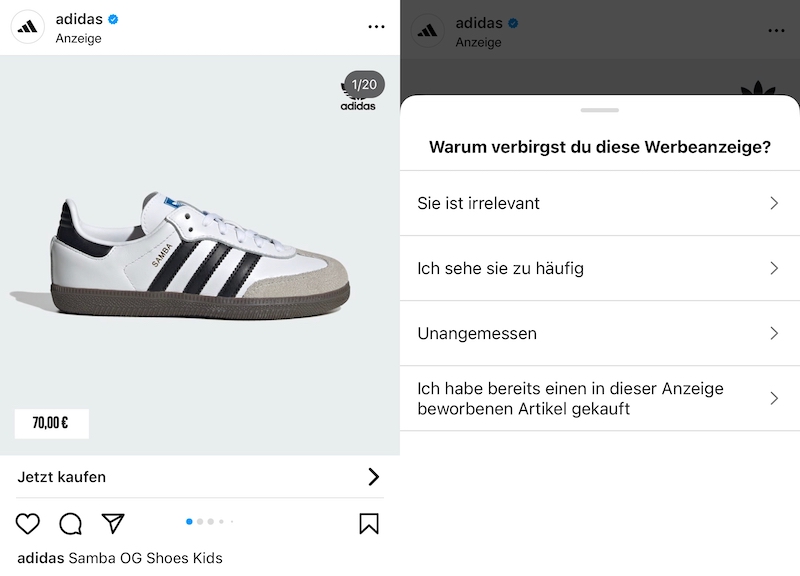
Imagine that you bought these shoes a few weeks ago and they are still shown in your Instagram feed
Creative Fatigue: It's also about what you see
In addition to ad fatigue, you should also have creative fatigue on your radar. If your target group sees the same creatives again and again, they will eventually become dull against your ads and your brand. Ultimately, this has similar effects as ad fatigue. However, the focus in creative fatigue is exclusively on the visual elements of an ad. So make sure that you offer your target group as much visual variation as possible.
By the way, when ad fatigue and creative fatigue set in is very individual. If you have a small marketing budget and rarely play out your ads over a longer period of time, fatigue symptoms often only appear later. For large campaigns, it already looks different: Here, ad or creative fatigue can come after three or four days. This is when your ads are played out very frequently to the same people over a short period of time.
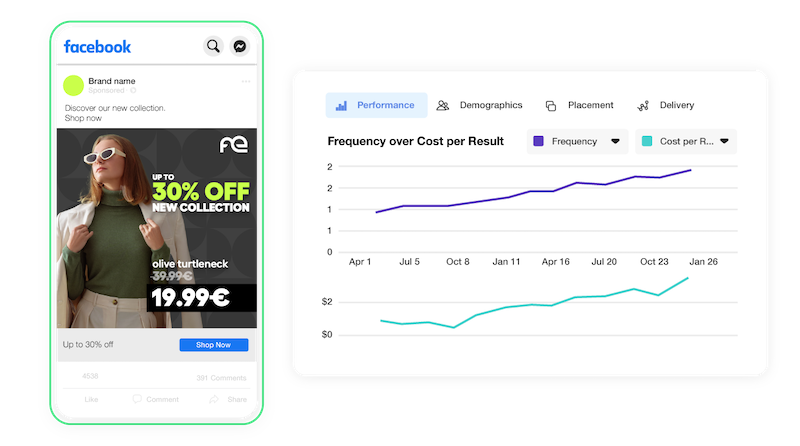
If you constantly play the same assets to your target group, they will eventually dull. And this in turn affects your ad spend. Picture: Hunch
This is how you avoid ad fatigue
A lot of money and work often go into advertising campaigns. If their effect wears off quickly, it can be disappointing at first. While you can only fight creative fatigue with the production of new assets and content – sometimes it can be enough to recolor the background – there are other helpful means against ad fatigue. If it is not obvious that the decreasing advertising effect is due to creative fatigue, you should turn the following knobs:
- Rely on a targeted segmentationand reach relevant target groups
- Ensure a solid data baseand personalize your ads– giving users what they are potentially interested in
- Play your ads dynamically and reach for example users who have already shown interest in your products or offer
- Offer your target group more variety with the help of Dynamic Creative Optimization (DCO): by adjusting ads to the user profile in real time, you create more personal experiences for your target group
- Set limitsand determine how often your ads are displayed to users
The most effective means against ad fatigue is therefore to set up your campaigns differently. This can be tedious – especially if you don't know where the problem lies exactly. Thankfully, there are, in addition to helpful hints in the meta ad manager, practical tools for optimal ad game. Get more out of your ads with tools like
Hunch. Hunch helps you optimize your ads and deliver them to the right people. For this, the tool not only offers seamless campaign management for Facebook, Instagram and Snapchat, but also a handy creative studio for creating appealing visuals.
Tackling ad fatigue with Hunch and Creative Automation
Hunch has some features that allow you to produce, play out and manage your ads optimally. To make sure your campaigns reach the right users, you can link the tool with various data sources, create new data, or add it via API, for example. This ensures that your ads on Facebook, Instagram and Snapchat are displayed specifically and offer users the necessary relevance.
The Creative Studio lets you create appealing and versatile creatives directly in the tool. Helpful automations allow you to create ads according to your brand guidelines in numerous different formats – after all, there are many relevant formats for various platforms. So that your design team doesn't have to create each asset individually, you can equip your creatives in Hunch with dynamic fields. Based on your data, the information relevant to the respective users is automatically displayed in these. This allows you to create thousands of appealing ads in no time and at the same time saves your designers annoying repetitive tasks.
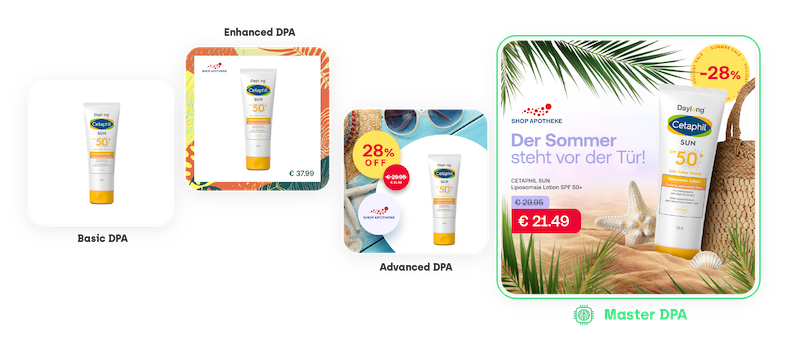
Hunch offers you a complete Creative Studio for creating and optimizing your ads. Use e.g. use the AI background remover to get more out of your product images. Image: Hunch
Hunch also offers you these features to combat ad fatigue:
- In addition to ads for Facebook, Instagram and Snapchat, you can also create assets for platforms like TikTok, Pinterest and YouTubein the Creative Studio and use them for your ads.
- Especially for online traders, the background remover should be interesting: With the AI feature you can easily remove the background from your product photos and put your products in the spotlight in an appealing and varied way.
- Adapt your campaigns in real timeand provide them with dynamic data, e.g. appropriate to the location of your users. This ensures even more personalization and offers the necessary variety.
Moreover, Hunch supports you as a dynamic platform in creative management and combines the performance of AI and automation for media and creative workflows. Hunch enables brands to meet creative requirements by automating creative production and fulfillment and solving resource shortages for creative testing.
Therefore, you do not need to limit your creativity, because Hunch offers you an
automated and optimized solution, to create image and video creations and use them on various platforms. For your campaign management, you add automatically produced designs to existing campaigns on Meta and Snapchat or you create them directly in Hunch and save a lot of time.
How to also avoid ad fatigue on Black Friday
The holiday season is approaching and one thing is clear: as contemplative as it seems, the time for marketers is not. On action days like Black Friday, this year is also about the best offers and reaching as many customers as possible with them. However, the way people decide on and buy products will change due to the current global economic situation. You can count on your customers to control their spending even more closely.
- Customers are looking for more meaningful savings
- Buyers are open to learning more about new brandsUsers still expect
- highly relevant advertisingHunch has dealt very carefully with these results of the study and offers you support with its tool.
With these functions you are ideally prepared for Black Friday and the holiday season:
Video formats for more engagement:
- One of the best ways to get more attention from your customers is the video format. With the Hunch Creative Video Studio, you can adapt your messages flexibly to any target group or reactivate buyers. In addition, you will find a link to Google Analytics to see and promote the best-selling products. Bring customers to faster purchasing decisions:
- Hunch offers you a large creative scope for your creatives and brings dynamic product ads to a new level. In addition, with the help of the analytic tools, you have the opportunity to have the color and size selection of your creatives analyzed and thus make the most of your creatives. Implement simple campaign setup:
- The simpler, the better – that's also what Meta recommends for ads. Therefore, use a predefined structure and creative templates that Hunch offers you in the tool. Analytics for a better performance overview:
- With Hunch you get a simple overview of your ad performance by connecting to Meta and third party analytics like Google Analytics. You can view all data in one view, manage campaigns and automate campaign updates for each metric. In this video the Hunch team goes into more detail on the benefits of the mentioned functions and shows you how to implement them using demo videos:
After Black Friday and Christmas, by the way, is before the next peak. Many people use the
This article is complemented by <strong>external content</strong> from <strong></strong>.
components.ConsentLayer.text
I consent to external content being displayed to me. This allows personal data to be transmitted to third-party platforms. Privacy policy
time after the holidays, to buy gifts that were sold out before or could not be delivered in time. In addition, products that help with New Year's resolutions have a particularly high priority among consumers. So also plan this time for new offers and campaigns. Ad fatigue doesn't have to be
Nobody likes endlessly repeating ads – and nobody likes ad fatigue. Ad fatigue is a problem that should be understandable for all marketers. Because we all move on the user side as well and know how annoying ads can be. However, going against ad fatigue can be associated with some effort and requires a lot of perseverance: producing new, appealing creatives round the clock takes a lot of effort and can cost a lot of money.
But it does not have to: with helpful tools for your ad management you can ensure that your ads always perform properly and are played out to the right target groups. Tools like
