Table of contents
- Quick Check: What is User Generated Content?
- Why User Generated Content is so important
- Best of both worlds: User Generated Content through Influencer Marketing
- What are the benefits of Influencer Generated Content for your company?
- Influencer Generated Content vs. User Generated Content: A brief overview
- From influencers to users: How to use Influencer-Marketing for User Generated Content
- How to increase the quality of your Influencer-Marketing generated UGC
- Success measurement of Influencer-Campaigns and generated UGC
- Particularly helpful: Tools & Platforms for Influencer-Marketing and UGC
- #BMWRepost
- Long story short
Unbeatably good pictures, entertaining reels, funny TikToks and compelling texts that encourage reflection – Social Media lives off content. But how do you manage to set your own content apart from all the others? It's quite simple! Your content meets the following requirements: It is versatile, addresses the interests of your target group, reflects your brand and provides such good entertainment within a few seconds that users don't just scroll on.
Okay, maybe all of this is not so easy. But don't worry! In the wide world of marketing, there are special strategies to avoid standing completely alone with content production: User Generated Content.
Quick Check: What is User Generated Content?
User Generated Content (UGC), User-Driven-Content or Consumer-Generated Content refers to content on social media and the World Wide Web that is created by external people and users – not by companies themselves. User Generated Content includes all types of user-generated content such as texts, pictures or videos and can thus take place on a variety of different social networks such as Instagram, TikTok, Pinterest, Facebook or similar platforms.
Why User Generated Content is so important
User Generated Content is important for several reasons: It enables building an engaged community and promotes the loyalty of your customers. When users or followers see their own content on the page of your brand, they feel both perceived and appreciated by your company. This creates a lively community that promotes interest in your brand or your product – which in turn leads to increased brand loyalty and a positive brand image.
Since UGC is generated by other users, the content shown is often perceived as more authentic and credible than traditional advertising. According to Expertvoice, 92% of people trust the opinion or recommendation of other people more than classic advertising. Customer reviews, testimonials and pictures from actual users can be helpful when making an informed purchase decision and increase the credibility of a brand or product.
Furthermore, User Generated Content provides valuable insights into the needs and desires of your customers: Targeted analysis can collect important information about your target group and recognise trends that can be integrated as part of your marketing strategy. In addition, UGC can serve as a source of ideas and innovations, with customer feedback flowing directly into product development.
Compared to costly advertising campaigns, integrating UGC into your content creation can be an effective way to increase awareness of your brand and expand your customer base – without large financial investments.
But how can User Generated Content be cleverly integrated into your marketing strategy with particularly little effort?
Recommended Content Marketing Software
Recommendable content marketing software can be found on our software comparison platform OMR Reviews. There we have listed over 250 content marketing tools that support the creation and/or distribution of content on various channels and platforms. So take a look and compare the software with the help of authentic and verified user reviews:
Best of both worlds: User Generated Content through Influencer Marketing
You probably already know: The
benefits of Influencer-Marketing are numerous and today almost nothing works without it. There are a lot of exciting articles in our
Contenthub, which prepare the topic from A to Z for you. In a nutshell, influencers are people who use their reach and the trust of their community on Social Media to authentically market products and brands as part of collaborations. Influencer marketing is therefore a marketing strategy where your company works with influencers to promote products or services and give your brand greater reach.
What are the benefits of Influencer Generated Content for your company?
Influencer-Generated Content refers to any type of paid or organic content that meets the following criteria: It is published by a person with more than 1,000 followers on a social channel and mentions your brand in a positive way. This content offers a variety of benefits to your company:
Credibility and trust:
Successful influencers have a lot of trust from their community. This means that their recommendations, opinions and thoughts play a significant role for many of their followers when it comes to purchasing decisions. Conversely, this means for you: If an influencer recommends your products or services to their community, part of this trust is also transferred to your brand and you gain credibility.
Extended reach and visibility:
By working with influencers, the reach and visibility of your brand is also increased. By using IGC, you can pass on your brand message to a wide and relevant target audience and reach potential new customers.
Creativity and variety of ideas:
Influencers often have their own style of content production. They bring new ideas and perspectives and create creative and versatile content. As a company, you can benefit from this variety of ideas and creativity, get inspired and learn new things.
Target group relevance:
Influencers typically serve a specific niche or topic on their account for which they are known within their community. As a company, you can already do a lot right or wrong with the selection of the influencer. Ideally, you will find someone who reaches exactly the target audience that is potentially interested in your brand. This increases the likelihood that the generated content is relevant to the followers, which in turn promotes interaction.
Social Media Engagement:
Influencer Generated Content can lead to increased interaction and participation on your social media channels. If the followers of the influencers are encouraged to comment on, share and actively participate in the played content, the engagement rate of your brand is promoted, which in turn can have positive effects on the brand image and customer retention.
Influencer Generated Content vs. User Generated Content: A brief overview
Basically, both IGC and UGC are content that was produced outside your company by external people. Nevertheless, the two types of content differ significantly from each other:
Influencer Generated Content | User Generated Content |
|---|
Is created by influencers or content creators | Is created by users, consumers or customers |
Is typically paid for and created in collaboration after consultation | Is created unpaid and from own motivation |
Is steered by briefings and approved by the brand before publication | Is created freely without specifications and agreements and published without the consent of the brand |
Is of high quality and professional | Can be created unprofessionally by anyone |
In general, is positive towards the brand | Can contain positive and negative statements |
Is often associated with a call-to-action | Is published without a call-to-action |
From influencers to users: How to use Influencer-Marketing for User Generated Content
That Influencer-Marketing offers versatile possibilities and is practically limitless is no secret. In fact, it can be part of an effective concept to generate and promote User Generated Content.
To create a foundation on which you can build, you should first integrate influencers into your brand or marketing strategy through classic Influencer-Marketing campaigns. In addition to the known advantage of visibility and reach, you also get closer to the community that you ultimately want to win over. But how does that work best?
Make it a fun one:For the generation of User Generated Content, influencers can of course just ask their followers to share their experiences, create their own content for your brand and interact with your company – this creates UGC in the form of reviews, testimonials, pictures or videos. However, to increase the chances of people actually creating and sharing content, you should make it particularly attractive by offering an incentive: A competition or a small challenge where users create User Generated Content and receive something in return like a voucher, a special discount or similar from you, for example, provide an exciting incentive.
The special trick: By involving influencers, you enjoy the advantage of the previously mentioned trust advance. If your brand is trusted and working with you by your favourite influencer, the community's trust also increases.
How to increase the quality of your Influencer-Marketing generated UGC
As a company, you can take various measures to increase the quality of User Generated Content generated through Influencer-Marketing:
Selection of the right influencers
For the best possible outcome, you should choose influencers whose values, target group and content style match your brand. This way, you maximise the chance that the community of the influencer is so interested in your brand that they actually create their own content.
Establishment of clear guidelines and expectations
Even though you as a company have no direct influence on the content created by customers or followers, you should at least set clear guidelines and expectations for the cooperation with influencers – after all, your cooperation partners lead their community by good example. Aspects such as tone, style, brand guidelines and specific requirements can at least be passed on indirectly and the likelihood that the generated UGC meets your quality standards increases.
Offer incentives
As already mentioned, incentives are a great motivation or a good incentive for the creation of convincing content. Contests with rewards or perks, exclusive offers or similar can be an incentive to make a particularly good effort and create better content.
As already mentioned, despite these theoretically successful measures, you can have no direct influence on the quality of user-generated content. Nonetheless, clear communication, cooperation and support between the company and the influencer are particularly crucial at this point and can at least help to raise the quality of UGC remotely.
Success measurement of Influencer-Campaigns and generated UGC
To measure the success of Influencer-Marketing campaigns and the associated User Generated Content, various metrics and analysis methods are available. You can keep different KPIs in view, create reports as well as comparisons and evaluations.
For one, you can measure the reach of the campaign by monitoring the number of impressions, views, likes, comments and shares. These numbers give you information about how many people were reached by your campaign or interacted with the content.
To measure the amount of UGC, there are practical measures that you ideally set in advance. For example, you can agree that specific hashtags or brand links as well as tags in the post are used in the context of cooperations and actions. If you have clearly communicated these requirements, you will get a quick and uncomplicated overview of how much user-generated content your campaign has achieved afterwards. Measuring the amount of UGC provides information about how well the campaign motivated users to participate.
If you also look at the comments, mentions and reactions that your content evoked during the campaign, you can also get an idea of how positive, negative or neutral your brand was and is perceived. In the long term, more in-depth market research surveys are also suitable, which aim to analyse the awareness of your brand or consumers' attitude towards your company. This can be done by surveying your target group before and after the campaign to capture changes in the awareness and image of your brand.
Platforms like
Upfluence can help your company in identifying, contacting and collaborating with influencers, while tools like
Traackr enable you to measure and analyse data and metrics afterwards. They provide various information about reach, engagement, sales and brand perception.
influData UGC Management platforms like TINT, Visual UGC powererd by Stackla or squarelovin can help you collect and specifically manage UGC. From hashtag monitoring and content curation to the integration of UGC on websites and digital channels – at this point you should definitely make sure to get the corresponding usage rights for the User Generated Content.
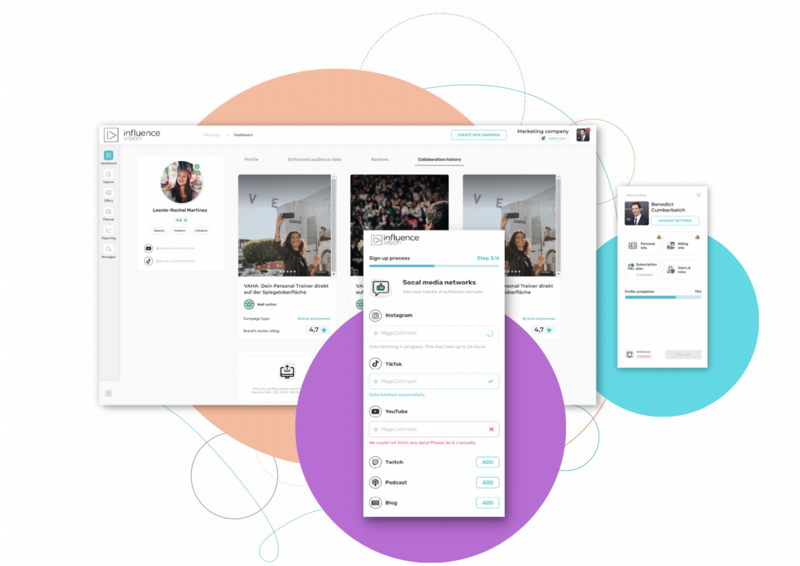
Google Analytics All in one – influence.vision
Brandwatch is a handy all-rounder tool to support Influencer-Marketing campaigns and the management of influencer relations. It offers a platform to find, analyse and successfully work with influencers.
SprinklrThe tool enables you to search for influencers based on various criteria such as target audience, engagement rate and industry, provides comprehensive data and analysis to evaluate the performance of influencers and thus identify the best possible partnerships.
Influence.vision also provides campaign management features, including the ability to plan, create and publish content with influencers. It supports your company in communication and collaboration with influencers and provides a central location for organising campaigns. You can not only create matching briefings for the campaign in advance, but also view and evaluate reports afterwards: Metrics such as reach, engagement, sales and ROI can help to better judge the effectiveness of your marketing activities.
Overall, Influence.vision simplifies the process of Influencer-Marketing by a large margin: It assists in identifying suitable influencers, helps with campaign management, facilitates success measurement and offers a holistic solution for collaborating with influencers.
influence.visionHere's how it can work: Best practices for collaboration with Influencers and the use of UGC in marketing campaigns
Influencer meets Social Media meets Hashtag.
. This was also the case with car manufacturer BMW, luxury shoe brand Louboutin and company GoPro.
The fans and followers of BMW are encouraged to use the special hashtag
#BMWRepost
when posting pictures of their cars. This has two different effects: On the one hand, it generates attention for the BMW drivers within the car scene, on the other hand, a lot of content is created for BMW itself – and that completely without cost. Results of the hashtag search #bmwrepost. Screenshots via Instagram.
A similar principle is also pursued by Louboutin. As part of a campaign, the shoe manufacturer selected some posts from all contributions published under the hashtag #somethingrouge, which were posted on the company's account – a true honour for every shoe lover and a lot of potential picture material for Louboutin. According to Medium.com, Louboutin could increase its User Engagement by a whopping 26% by doing this.

The 'Photo of the Day' campaign by camera manufacturer GoPro also generated strong User Generated Content. Thus, GoPro motivated users to share particularly impressive photos and published a user post every day that was posted under the hashtag #GoPro.
Of course, these campaigns work especially well, because the respective companies can benefit from their already existing reach. However, in cooperation with influencers, this approach also offers a great chance for smaller brands to gain more awareness and successfully generate User Generated Content. Especially in connection with a competition, many users can be convinced to create content for a brand that was previously unknown to them. You can, for example, hold a monthly draw for a prize among all users who use a certain hashtag for their content or organise a photo or video competition.
Long story shortFew things are as important for a successful social media appearance as User Generated Content – it helps build a committed community, promotes brand loyalty and is perceived by users as particularly authentic and credible. In addition, it provides valuable insight into the needs and desires of your target group, can serve as a source of ideas and innovations and can also be implemented at particularly low cost.
With the targeted use of Influencer-Marketing, UGC can be promoted and become higher quality. Here, the choice of the right influencers, clear guidelines and expectations and good communication between your company and the respective cooperation partners are decisive in order to sustainably improve the quality of your UGC.
Overall, both User Generated Content and Influencer Generated Content give your company the opportunity to generate high-quality content, strengthen the brand image, better understand your target audience and boost engagement on your social media channels.
Long story short
Kaum etwas ist für einen erfolgreichen Social Media Auftritt so wichtig wie User Generated Content – er hilft beim Aufbau einer engagierten Community, fördert die Markenloyalität fördert und wird von User*innen als besonders authentisch und glaubwürdig wahrgenommen. Zudem bietet er wertvolle Einblicke in die Bedürfnisse und Wünsche deiner Zielgruppe, kann als Quelle für Ideen und Innovationen dienen und außerdem besonders kostengünstig umgesetzt werden.
Durch den gezielten Einsatz von Influencer-Marketing kann UGC zusätzlich gefördert und qualitativ hochwertiger werden. Dabei ist die Auswahl der richtigen Influencer*innen, klare Richtlinien und Erwartungen sowie eine gute Kommunikation zwischen deinem Unternehmen und den jeweiligen Kooperationspartner*innen entscheidend, um die Qualität deines UGC nachhaltig zu verbessern.
Insgesamt bieten sowohl User Generated Content als auch Influencer Generated Content deinem Unternehmen die Möglichkeit, hochwertige Inhalte zu generieren, das Markenimage zu stärken, deine Zielgruppe besser zu verstehen und das Engagement auf deinen Social Media Kanälen zu steigern.