Table of contents
- What does "customer interaction" mean and when is it used?
- Why is it important to find the right customer interaction for your customers?
- Is there a difference between digital and personal customer interaction?
- What types of customer interaction are there?
- How can companies integrate customer interaction into their marketing strategies?
- 7 tips to help you address your customer correctly
- 4 common mistakes in customer interaction and how to avoid them
- Conclusion
Customer expectations have been repositioned in the course of digitalization and have contributed to companies transforming their outdated technology structures into flexible solutions. At the same time, the costs of paid marketing are continuously increasing, which puts the importance of first-party data and data-driven customer interaction even more into focus.
Customers are regarded as the center of a company's strategies, whose views must be adopted and interpreted, which leads to companies increasingly adopting an outside-in view in the market. Customers act from the outside on the company as a decisive force, and they expect an individual and unique experience.
The graphic shows the difference between the described outside-in perspective and an inside-out view, in which influence is exerted on the market through entrepreneurial decisions and measures.
It's all the more important that you
target your customers specifically along the
customer journey and develop them into loyal customers.
Customers today expect customized solutions for their behavior and products and product recommendations tailored to them. This is also referred to as the "Age of the Customer", which describes customers as the central control in the market.
The high demands of consumers on companies are increasingly shaped by the digital and global world. New possibilities of comparability, accessibility, and flexibility are offered, as a result of which the loyalty towards a company has to be hard-earned. The customers can decide for themselves when, where, and how they want to receive a product.
It is therefore important to align your organizational structure and communication with your customers and strategically address them.
The following text will discuss the different possibilities for establishing successful customer communication and show how you can avoid mistakes.
What does "customer interaction" mean and when is it used?
If a customer is addressed for the first time regarding a brand, product, or service, this is referred to as a so-called first point of contact. This can happen in different ways, such as through a campaign by the brand itself, through stories about a person, or publications on social media. The first point of contact is a crucial driver for the perception of a product or brand. Often, decisions about the future relationship and commitment to a product, brand, or service are made here. Companies invest a lot of money and effort in their communication measures, as they can significantly contribute to the company's success later on.
At the first point of contact, you can already gather first information about your customers, which can later contribute to more efficient customer communication. After the first point of contact, it is important to familiarize your customers with your products and solidify their interest.
A consistent customer focus and 360-degree customer care during the entire journey and at every point in the lifecycle are of high importance here and contribute to the success and satisfaction between a company and its customers. The diagram below shows only a few of the many touchpoints, which can arise between customers and companies and ensure a situation-appropriate customer approach.
What is important here is to form different sections according to the life phase of the customers which are defined on the basis of activity and purchasing behavior. Crucial here is to know the customers accurately and to understand their behaviors and characteristics, in order to implement targeted communication based on their requirements and needs. This can come into play in the form of personalization or by addressing customers in their preferred communication channel. All in order to finally develop them to loyal customers. The type of communication can be quite different and is based on the orientation and target group of a company, whereby the aforementioned communication channel plays an important role.
What are the most important elements of successful customer interaction?
The crucial factor for successful customer interaction is to know the customers exactly and to identify their needs at an early stage. With the help of digital data, it is now possible to create
specific selections and play out
targeted content. Customers want to feel personally addressed and catered to according to their interests. In order to cater to individual needs, it is first necessary to form
customer segments. These are usually composed of the
sociodemography, behavior patterns, and needs of customers. Only by identifying these elements can targeted customer interaction and specific services be offered.
The timeliness and especially the quality of the data from (potential) customers are crucial to the success of the segments. Only a comprehensive data collection, analysis, and processing ensures strategic communication based on segments and selections.
Which brings us to the most important basic ingredient for successful customer interaction...
Data. The availability of data allows a
high degree of accuracy. This is also referred to as the
analytical CRM. Based on the data collected,
customer acquisition and retention measures can be developed and implemented. Not only segments and behavior patterns of potential and existing customers can be identified, but the value creation potential can also be calculated through analytical CRM.
Digitalized processes can make the analytical CRM predict the entire lifecycle. The accuracy of the prediction is determined by the available data. New possibilities can thus be created. You get the opportunity to act more individually and to collect data on your customers in almost all areas of life, process it, and use it for marketing and communication models. This is also referred to as "Predictive Marketing" – the prediction of customer behavior, which is covered by artificial intelligence. This allows for a more accurate and predictive measurement of campaigns, their effectiveness, and success in various channels.
The planning made possible by data gives companies improved customer care and interaction, as well as measurement and optimization possibilities. However, the customer perspective must always be taken (Outside-In). The best data is of no use to your company if you do not process it strategically and in the sense of customer centricity in the customer journey.
But how can successful customer interaction within the customer journey be achieved?
One previously mentioned building block is CRM analytics. The second important aspect is the customer experience. Successful customer experience is achieved through the formation of a unified customer experience through interface management and targeted communication adding to a positive customer experience.
The customer lifecycle management enables a 360-degree view of customers and provides them with a successful customer experience throughout the entire cycle via individual customer contact. Here, all available touchpoints and communication channels are included and both the purchasing behavior and general information of the customers are analyzed. Thus, here as well, it is necessary to take the customer's perspective and to consistently align oneself with their needs. The visual presentation emphasizes the center of customers, upon which all other strategies are built.
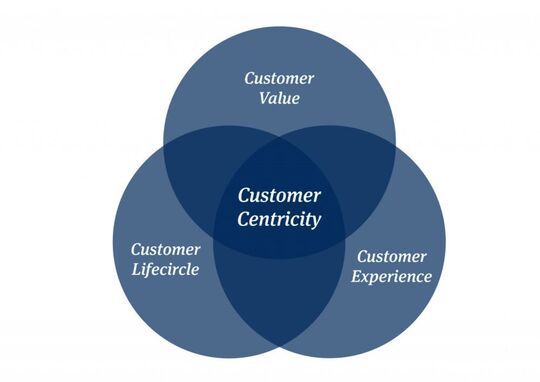
The experience that customers have with a brand can be positively influenced throughout the entire customer journey through communication mechanisms. Communication can strengthen the relationship with a brand, emotionalize it, and influence the development of loyal customers. Loyal customers are not only loyal to the brand and buy more from it, they can also act as brand ambassadors and thus serve as multipliers of marketing activities. Their own willingness to buy is not only increased but also that of the people around them. A positive customer experience can be achieved through the use of social networks by, for example, strengthening the feeling of belonging through communities and cooperation.
Continuous re-design of customer interaction is another driver. In a fast-paced world, it is necessary to continuously engage your customers with relevant and creative content and to break up traditional processes that customers have tired of.
Why is it important to find the right customer interaction for your customers?
Finding the right customer interaction is crucial because it
directly influences the success of a company. Based on the
best CRM software customer data can be used more accurately and customers can be addressed accordingly. This allows companies to
understand the needs and preferences of their customers, use internal resources more efficiently, and reduce costs.
To build a long-term profitable customer relationship (customer acquisition), intensify it (customer development) and maintain it in the long term (customer retention), many measures and continuous communication are needed. Customer experience and correct customer interaction are crucial for customer satisfaction and contribute to strengthening customer relationships, maximizing sales potentials, and improving the brand image. This approach moves away from just transactional actions and towards emotional actions.
But nowadays this is not easy. Customers are not only increasingly skeptical about what happens to their data, but also the level of comparability is increasing. The easy and quick access to research possibilities about products and companies is also increasing. All of this results in demanding customers, who not only need to be convinced of a company and product but also need to gain trust in it through customer interaction.
Winning the trust of customers can be achieved in several ways
The right communication is a big lever here. It enables companies to convey their messages clearly and convincingly, leading to better understanding and greater acceptance by customers.
Therefore, the quality of the content is also important. Contents must be well structured and understandable, as well as have easy handling, which is personalized to the customer. At the same time, you should always gain the attention of your customers and evoke emotions in the first few seconds. The correct customer interaction enables companies to convey content that is relevant to their target group. At the first point of contact, a personalized customer service can be available, which collects the customers through partly automated processes and shows that their needs and wishes have been understood. These initial customer experiences can directly gather positive customer experiences which contribute to an emotional bond between customers and companies and as shown below enable the satisfaction of customers.
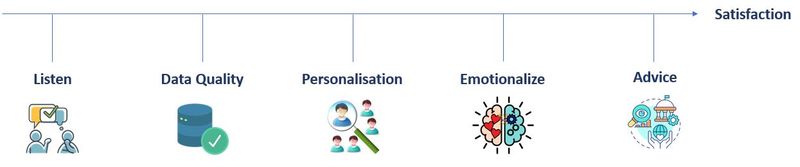
Customized customer interaction can increase sales and the conversion rates, as customers are more likely to buy products or services that meet their individual needs. Also, a differentiating feature from competitors can be emphasized by offering them a unique and attractive experience.
Is there a difference between digital and personal customer interaction?
There is a huge difference between digital and personal customer interaction today. For a digital customer interaction purely digital channels are used, such as emails, social networks, websites, blogs, or apps. Through the use of artificial intelligence and data analytics the communication can be adjusted to the customer's behavior and the conversion rate triggered by it can increase interactions. Artificial intelligence enables digital customer interaction to interact with customers at any time and on any day of the year. Likewise, customers can be addressed at their preferred time slot.
When are your customers active?
Mostly after work? Then the content is played out to them in the evening. For this customer interaction, no personal contact is necessary. Through automated processes, customers are easily collected
at their preferred time via
their lead channel. We are also talking about "Customer Convenience" here since comfortable interaction is guaranteed for customers. Once these processes are established, they hardly incur more costs and can achieve a high reach
. The big difference to personal customer interaction is the connection that is built with customers at a personal level.
Personal customer interaction lives from interactions, eye contact, and intensive exchange with a strong personal relationship.
But it can also be done through a letter in writing or on the phone. A closer bond can be established through this direct exchange. However, personal customer interaction is usually associated with a higher time and cost expenditure. While the digital focus is of the utmost importance, the
personal contact should not be neglected
in a 360-degree customer approach, especially as it is perceived as increasingly appreciative and special in the course of digitalization. What types of customer interaction are there?
There are various types of customer interaction. With the digital age, new types are constantly being added and the number of interaction possibilities increases. The most common types of customer interaction, which you probably all know, are:
- Personal communication
- E-mail marketing
- Social media
- by mail
- or via advertising
Let's start with personal communication. Personal communication takes place via direct interactions face-to-face or also over the phone, in conversation. Body language and the way you have a conversation is decisive here. Different is E-mail marketing. Here, the subject line, the first lines, and the visual presentation are especially important in order to arouse the interest of the customers. Social media, on the other hand, use platforms like Facebook, Instagram, Tiktok, and Snapchat to pick up customers with emotionalized content using images and videos.
In postal mailings another factor is added to the types of communication: the haptic feeling. This distinguishing feature can be very time- and cost-intensive and the degree of personalization is only possible to a limited extent. Also, when designing mailings, it is important to ensure that they are relevant to the customers at first glance in order to make it from the mailbox into the apartment at all. The sustainability aspect should also be considered, as this type of communication is tied to natural resources.
Also advertising can reach customers as a print medium. However, it can also be placed on TV, radio or online. Advertising can be widely spread this way but also be controlled and played out specifically through digital segmentations. As you can see, all types of customer interaction are very different. Although the various types of customer interaction can have a positive impact on your company through cross-channel actions, a red thread should be maintained in your customer interaction and the various contents. Also, it must be taken into account, for which target group which approach is most effective.
Through digitalized processes, customer interaction can act omni-channel and create individual customer experiences. Customer needs can be transported and processed to companies in real time. To be successful in the different types of communication, you should know which market segments you want to address and what added value the segment has for your customer group.
How can companies integrate customer interaction into their marketing strategies?
Companies can integrate customer interaction into their marketing strategies by working with CRM systems
that collect customer information, recognize individual preferences and behaviors of customers, and shape personalized interactions. What is important here is the measurability of CRM processes, to identify the course, goals, and deviations and to exploit improvement potential. Building on this, the possibilities of various communication channels like social media, email marketing, and print communication can be used to specifically address preferences and needs individually. For example, this can be controlled using automated processes and tools to reach the customers at the right time, in the preferred channel, and create customer experiences with emotionalized content. Marketing strategies are implemented in many companies online, as well as offline at the point of sale. Here, the uniform communication plays an important role. Customers should consistently feel well catered to, and find a seamless customer interaction
. In the form of A/B testing various forms of customer interaction can be compared and the effectiveness can be made visible in order to enable constant improvement of communication. Through these tests and through direct customer feedback, you can quickly identify which type of communication your customers prefer. This also helps you to constantly take the customer perspective (Outside-in), to increase the understanding of your own customers, and to build long-term relationships. By combining all of these elements and a targeted marketing strategy, you will establish effective customer interaction, develop your customers into loyal customers, and be able to acquire new ones.
7 tips to help you address your customer correctly
1. Know your target group
You should not only understand but also know your target group's needs, interests, and problems in order to respond to them specifically. You should show your target group the benefits of your product and ideally solve a problem for your customers. Observe not only your industry but also other industries. What customer needs can you identify? What trends? What moves your target group?
2. Type of communication
Formulate clear and precise messages, which are easy to understand. Avoid technical jargon, unless necessary. Keep your communication consistent, both in tonality and in branding. This builds trust. Also, make sure you are communicating at the right and customer-accepted touch points. Provide an authentic overall image with transparency, to gain the trust of your customers and potential customers. You can also play to your customers after the purchase with cross-selling offers. Here customers are suggested a suitable or complementary product to the purchase they have made. You can use not only the traditional path through sales but also marketing automation and analytically based product recommendations for this.With the help of predictive analytics, based on data analysis, you can calculate what potential customers might like and what communication appeals to them the most, which brings us to tip three.
3. Personalization through data
Friendly and personal interaction
can help you establish a closer relationship with your customers and potential customers. This can be achieved, for example, by using the name of your customers . Additionally, generated data about your customers help you to form segments, to hit the right interaction in real time. Use your data specifically to interact with customers personally. Furthermore, with the help of Predictive Analytics CRM
you can make more accurate statements for future customers based on the behavior of previous and existing customers and play to them personally. CRM systems enable tracking of individual actions and can thus address customers specifically and shape communication accordingly. This results in efficient, relevant, and personal communication.
4. Evoke emotions
Through emotionally charged content, feelings can be triggered, which can create a strong connection between a product and customers. Emotions should play an important role in your communication strategy, as they can be decisive in the decision-making process of customers. The customers feel more connected to a product, for example, when emotions such as joy, compassion or laughter are evoked by a story. Also, the product stays more in memory through emotional communication. Do you remember a good campaign? Then it certainly was loaded with emotions.
5. Communication channels
In principle, it is very important that you use the right channels to reach your target group. Always consider where your customers are. With the constantly emerging interaction possibilities in networks, on platforms, and in apps, new possibilities for communication with customers are also being created again and again. Here, a distinction is made between the direct path via chat, live chat or telephone and indirect communication such as via blogs or review portals.
A good strategy is to use a channel mix, because even if your existing customers do not currently use the channel of your choice, you can acquire new customer groups. Also, cross-channel action contributes to being able to pick up your customers everywhere and develop them along the entire customer lifecycle.
6. Customer Experience
The customer experience takes as a basis the general knowledge about your customers as well as in which phase of the customer lifecycle they are currently in and what they expect next on the journey. The goal is to create special experiences and differentiating features on the entire journey of customers with their customer experience through the creation of creative customer interaction presented at the right time, over the right channel. A good customer experience also means sparing your customers a huge flow of information and enriching them with relevant content.
7. Customer Service
The basic need for customer service should always be to have happier customers at the end of the contact than before. They do this with positive and understanding communication. Many customer service requests are resolved automatically. However, if personal contact is involved, it is important to listen attentively to customers, understand their needs, and accept feedback. In the case of automated processes, this information is ideally stored and evaluated. A quick response to customer inquiries is very important and is expected today.All of these are measures to ultimately develop and retain loyal customers. It is a combination of perfect interaction with customers and data-based communication that builds a long-term relationship with customers.
4 common mistakes in customer interaction and how to avoid them
1. Incorrect communication
Often there is an effort to provide customers with plenty of information in the hope that this will positively influence their purchasing decision. However, a too complex or complicated message can have the opposite effect, as customers tend to switch off or even lose the credibility and trust in the product. Information should above all be true and substantiated. Also, by the correct customer interaction be precise and to the point.
Similarly, too specialist communication can lead to losing the customers, as they do not understand the information important to them. It is therefore very important to know the language of your target audience and use it. A uniform tone, which carries the company outward across all channels, is relevant for the image of a brand. But beware: A standardization of communication is not good since you are no longer individually addressing the needs, interests, and demographics of your target group. Avoid impersonal or generic messages, and use personal contact or address individual interests with personalized content.
2. Misconducting customer feedback
Often little to no customer feedback is obtained or worse – it is ignored. However, your customers can play a crucial role in improving and adjusting your communication strategy. You should try to address customer wishes,to design your customer journey as individual and attractive as possible.
Instead of helping customers, often attempts are made to extract performance-enhancing measures from them. For example, during customer support inquiries from customers, up-sell offers are discouraged as they do not feel personally supported, but perceive it as though they were a pure source of money for the company. A close, personal contact showing that you are taking the time to address their request and not trying to profit from their problem is the right approach here.Your customers are an important source of continuous improvement and the perfect customer interaction - use them!
3. Missing personalization
As pointed out in the previous point, an excessive focus on sales can harm your relationship with customers. They can quickly feel pushed and distance themselves. It is important in this context that you communicate with your customers sensitively and personally understanding their needs and offering them products or your service tailored to them. The personalized customer interaction can gladly be enriched with emotional content to, as already mentioned, bond customers with your brand. As already explained, Data is the key to personalized offers and communication. Every company wants to get away from the spray-and-pray approach and move towards communication that is explicitly tailored to the customer. An important factor here is also the communication channel, which leads us to the next and last point.
4. A misconduct with communication channels
Picking up customers in their preferred channel and addressing them where they feel most comfortable should be the task of every company. Too often, however, data is not used to find out the customer's preferred channel. Also, companies often lack the customer perspective to constantly re-analyze their target group and to address customer needs with targeted communication. As already explained, it is important to play out content on the personally preferred channel, but at the same time to maintain a multi-channel presence and to show brand presence across different channels. Relying on just one channel would be careless. Mistakes can usually be avoided with simple methods and quickly contribute to higher customer satisfaction, more revenue, and ultimately loyal customers. So it is important to always question your actions and get feedback from all sides.
Empfehlenswerte CRM Tools & Softwares
Insgesamt haben wir auf OMR Reviews über 250 CRM-System-Anbieter gelistet, die dich im Customer-Relationship-Management (CRM) unterstützen können. Schau also auf OMR Reviews vorbei und vergleiche die CRM-Tools mithilfe der authentischen und verifizierten Nutzerbewertungen. Hier sind einige Empfehlenswerte:
Conclusion
Customer data is considered the most valuable commodity of the 21st century. It contributes significantly to better communication with customers. With well-defined goals based on sufficient and well-prepared data, scatter loss can be avoided and customers can be addressed in a personalized manner. This, in turn, has a direct impact on the success of the company.
But what good is data if we don't use it?
So let's use it to create a valuable customer journey for our customers, to transform customer communication together with digitized processes, and to develop loyal customers.