Table of contents
- You get stuck on your phone, wasting minute after minute and before you know it, an hour has gone by. You start to panic, skip breakfast and sprint to the train in a rush to somehow make it to the office in time. There you start your laptop, open your email program and the first colleague comes in
- These figures alone, quite apart from the health factors, clearly show how important the issue of
- “no“
- Everyone in the company must take
- self-management
- Onrise
- Fazit
Our working world has changed drastically in recent years. The Corona pandemic was a catalyst for remote & hybrid work, flexibility and new working models. All of these things bring many benefits when it comes to compatibility, individualization or even meeting our own needs.
But where there is light, there is also shadow. We live in an era of constant availability, our working world is as dynamic as never before, work and private life are merging more and more and a “I have done everything“ no longer exists. We often feel exhausted and lose ourselves. Our day is determined by emails, chat messages through various tools, calls and other interruptions.
We are constantly in a reactive mode, busy all the time, yet without really being productive and actually just putting out fires, as they say in many companies.
A study by the “New Work Innovation“ from 2022 confirms this in alarming figures: The so-called knowledge workers are interrupted in their work on average every 4 minutes, they spend a total of 1.5 days per week in meetings and try to multitask about twice an hour.
Self-leadership is a crucial competence to deal with these opportunities and challenges of the new world of work and according to Dennis Fischer it is also one of the nine most important future competences. The importance of this competence has developed into a decisive factor for success and at the same time for health. And this not only for individuals, but also for companies.
If we really want to get our tasks done, move topics forward, achieve our goals and stay healthy, we need to learn to lead ourselves. What is self-leadership and why is it important for companies?
Imagine your alarm clock is ringing in the morning, you pick up your phone first thing, see the incoming push messages, be it from Instagram, LinkedIn, WhatsApp, emails and Co., and start reading them. What happens?
You get stuck on your phone, wasting minute after minute and before you know it, an hour has gone by. You start to panic, skip breakfast and sprint to the train in a rush to somehow make it to the office in time. There you start your laptop, open your email program and the first colleague comes in
“Can you just...“
, while you are actually answering an email, you help her, a call follows and so on. Before you know it, it's evening, you didn't really achieve anything today, even though you were constantly busy. You go home unsatisfied and stressed. Anyone who can lead themselves well, experiences this far less. People who can lead themselves well, act proactively, take personal responsibility, have clarity about their own needs, strengths and also (life) goals. Because self-leadership is far more than just a toolbox. It consists basically of the two areas self-reflection
and on the other hand, to be motivated and healthy in the long term and therefore also to be able to contribute the necessary performance to the company. Because employees who can lead themselves well, are clearer and faster in achieving goals, take care of themselves and their own needs and know what they need to effectively apply all their abilities at work.In a world full of distractions and opportunities waiting for us, we need people who can lead themselves and therefore also manage the flood of work, the interruptions and the blurring of boundaries, without burning out. What advantages does promoting self-leadership offer for employees and the company?
The study by the “New Work Innovation“ mentioned in the introduction not only looked at how often people are interrupted at work, but also at the costs this causes for companies. These amount to €58 billion per year in German companies just due to interruptions. The most common cause of interruptions is email or chat notifications, in companies that use such tools.
self-leadership
and self-management is in today's world and what a huge difference the development of this competence has on companies.Companies that specifically support their employees or offer the possibilities of 1:1 coaching, team coaching
, group programs or training on self-leadership and development of this competence will see a decisive difference in company success.
How can companies promote a culture of self-promotion?Self-leadership can only be lived if it is accepted by the manager, in the team or in the company at all. Because self-leadership also means accepting a
“no“
or a “I will get back to you later“. It means not getting an answer to a chat message or email within a few minutes and not demanding that these channels be always open and, in the worst case, still send push notifications with every new input. This culture of constant availability promotes constant interruptions, prevents productive work and inhibits good self-leadership. It also means accepting deep work phases
involving employees in goal setting and giving them the freedom to plan their time and approach to achieving goals themselves, without micromanagement and without control. For this, clear expectations, clear framework conditions, resources for further training, open communication and also time for self-reflection are needed. An environment that cherishes autonomy and personal responsibility will strengthen the self-leadership of employees. How can managers support their employees' self-leadership?Managers were, are and always will be role models when it comes to work and culture in a team. This means specifically that managers should live this form of work described above. It is much more likely that employees will also dare to disable their push notifications, switch off their email and chat program, say no, schedule deep work phases and act proactively.
Everyone in the company must take
responsibility
for themselves and this includes the manager as well as every single employee. For self-responsibility is a key word in relation to the new world of work and also in relation to the topic of self-leadership. What different self-leadership methods and techniques are there?The methods of self-leadership can also be divided into self-reflection and
self-management
A weekly reflection of your own week helps you to recognize what is already going well and where there is potential for adjustment. Questions could be:
What did I succeed particularly well this week? What did not work well this week?
- What are the learnings I draw from it and what will I do instead?
- Knowing your own time thieves:
- The inner drivers are a model from transaction analysis. These are patterns that have developed in childhood, through the environment and experiences. If lived positively, they support us. If lived negatively they can cost us a lot of time and in the worst case make us sick. A free test can be found
here. In addition, there are other time wasters such as too many appointments, procrastinating too often, not saying no enough and many more. Here too, it is worth reflecting regularly on where your time goes.
Energy management: Our own energy is finite, it depends on our daily form and also the tasks have an influence on how much energy you have left afterwards. The Neo Narrative provides a
free template that supports you to reflect on how much energy your tasks cost you. Once you are aware of this, you can actively include these insights in your daily planning.
Circle-of-Influence: Stephen Covey presents the concept of circle-of-influence in his book “The 7 Habits of Highly Effective People“. It's about using targeted self-reflection to differentiate between the areas of life we can influence and those we can't. The three areas he distinguishes are:
Circle of Concern: Here are the things we have no influence on, but which we often occupy our thoughts with.
- Circle of Influence: In this area, we can't make decisions but at least we have influence on our own actions.
- Circle of Control: Here we can both make decisions and directly influence things.
- A conscious engagement with this helps to reduce our own stress, set our goals carefully and guide our focus. Goal setting:
Good self-leadership always deals with our own goals in life, both professionally and privately. Because only those who are conscious of their own goals can act proactively and take steps that contribute to achieving these goals.
What are the things that are really important to you?What do you want to achieve in these areas?
- In a year?
- In a month?
- And what are the concrete steps that will contribute to this in the coming week?
- Once you have dealt with yourself, it is about creating a good framework for yourself and having good methods at hand to organize your day-to-day life. This is where the area of
- self-management
comes into play. Let's start with the good old lists. Whether analogue or digital, it is very helpful to have an overview of which tasks, also projects are pending and what else is buzzing around in your head. Braindump:
Focused work is not only difficult because we are exposed to external distractions. Also the inner distractions, our thoughts, cause us not being able to work concentratively. To avoid giving too much room to these distractions and distract you too long from your actual work, “Braindump” helps. A list where you write down all your thoughts that come into your mind. By writing it down, your mind is kind of emptied and your thoughts are saved. This habit is an essential part of good self-leadership. At the end of the day you can look at your list and sort these thoughts by to-dos, ideas, emotions etc.
The good old to-do list: For your weekly planning it is helpful to make a list with all tasks that are pending during the week. These tasks can then be sorted by priorities and can be included in the daily planning. We will come to that in a moment. Don't forget to include both professional and private to-dos here, both of which are part of good self-leadership. Also the
specific formulation of the task like for example Finish quote for self-leadership training and send it to Carlo. Through the specific formulation you can start right away and don't have to think first about what the keyword offer meant.Project list: Make a list of your upcoming projects incl. goals. Also here a prioritization of the projects should be done and concrete steps derived, for example with the question: What can I do this week to get closer to my project goal? What are the next concrete steps? This again results in tasks for your weekly planning.
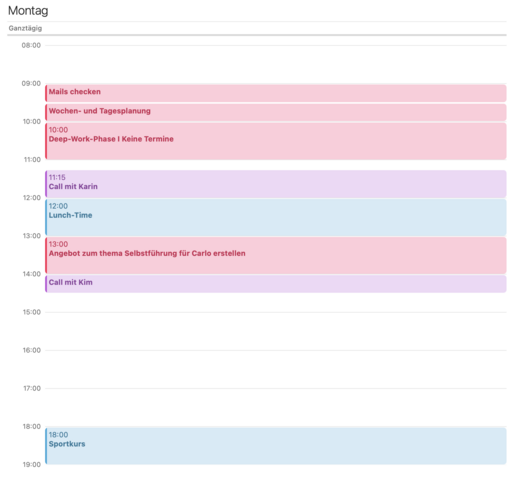
Daily and weekly planning: When the tasks are clear, a daily and weekly planning can be done. It is especially important to include times for mails, routine tasks and deep work phases as well as breaks, buffer times, sports and personal things. The different building blocks can be entered in the calendar and could look like this:
This will also help you reflect on what worked well and what didn't work well at the end of the week.A good overview is also provided by a
Kanban board
. The method is from agility and can be adapted perfectly for your own self-leadership. Tasks can be visualized here. A classical Kanban board contains the columns
Backlog (tasks that have not been started yet),
Doing (ongoing tasks) and
Done (all completed tasks).
“If you say yes to anything, you must say no to something else.“ - Sean Covey
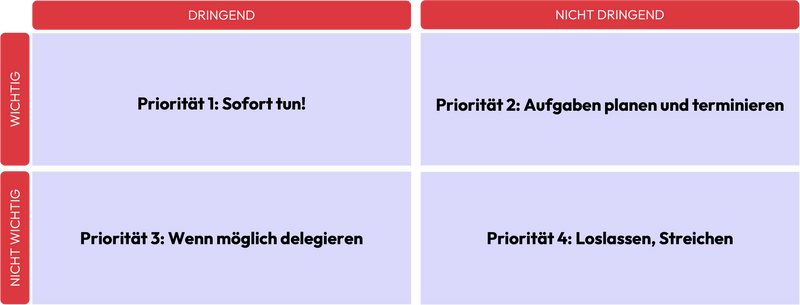
The Eisenhower Matrix
can support you in prioritizing your tasks. It helps you to decide how urgent and important your tasks are and to bring them into a sensible weekly structure: One technique that can support you in focused work is the Pomodoro Technique
For more focus:
Onrise
Activate airplane mode
Notes
Trello
7 Habits of Highly Effective People by Stephen Covey
- Deep Work by Cal Newport
- Tiny Habits by B.J. Fogg
- Conclusion
- Self-leadership is one of the most important skills in our changing and fast-paced work world. Those who train their self-leadership can switch from a reactive to a proactive mode. Resulting in a life in harmony with their own needs, less stress and the achievement of personal and professional goals.
Empfehlenswerte HR Tools & Softwarelösungen
Weitere empfehlenswerte HR-Software-Anbieter kannst du auf unserer Vergleichsplattform OMR Reviews finden. Dort haben wir über 500 HR-Softwares für kleine und mittlere Unternehmen, Start-Ups und Großkonzerne gelistet, die dich in allen Bereiche des Human Resource Managements unterstützen. Also schau vorbei und vergleiche die Softwares mithilfe der authentischen und verifizierten Nutzerbewertungen:
Fazit
Selbstführung ist eine der wichtigsten Kompetenzen in unserer sich wandelnden und schnellen Arbeitswelt. Wer seine Selbstführung trainiert, kann von einem reaktiven in einen proaktiven Modus wechseln. Wodurch ein Leben im Einklang mit den eigenen Bedürfnissen, weniger Stress und die Erreichung der persönlichen und beruflichen Ziele gelingt.


