Table of contents
- SEO: What was that again ...?
- And PPC – that was …?
- Overview: Differences between SEO and PPC
- The strengths and weaknesses of SEO
- Yes, it's true: SEO takes its time.
- Many advantages make Pay-per-Click advertising a very popular digital marketing strategy. First, there is its speed.
- There's really no such thing as a free click!
- What business goals am I pursuing?
SEO and PPC are two of the most crucial disciplines in digital (performance) marketing. They share the same "simple" objectives – Traffic, leads, conversions –, however, in practice, they are distinctly different.
In this article, we discuss in detail the topic SEO vs. PPC.
Our guest author Christian Stenger from Moccu explains to you the significant differences and respective advantages and disadvantages.
Recommended SEO Tools
You can find more recommended tools SEO-Tools on OMR Reviews and compare them. In total, we have listed over 150 SEO tools (as of December 2023) that can help you increase your organic traffic in the long term. So take a look and compare the software with the help of the verified user reviews:
SEO: What was that again ...?
The aim is to position content for important key terms – i.e., “keywords” – as prominently as possible on search engine result pages (SERPs).
SEO unlocks the potential in online search, by bringing visitors and thus potential customers to your own website through improved placements (“organic rankings”).
Examples of the main tasks and areas in SEO are:
- Keyword research: Finding out what people are searching for on the web.
- Content audits: Inventory and qualitative evaluation of a website's existing content.
- On-Page SEO: Improvement and expansion of your own content for the visitors.
- Off-Page SEO: Building trust and authority through links from other websites.
- Local SEO: Building organic visibility within a region.
- Technical SEO: Measures to facilitate search engine bots' code scanning.
Through SEO, brands benefit in terms of their
- online presence
- popularity (“Brand Awareness”)
- Performance (acquisition of website visitors and leads)
- credibility (as organic search results enjoy high trust)
- Authority
Professional search engine optimization is a recognized path to sustainable success in international online search. This means, especially with Google.
According to Statista, Google's average market share in July 2023 was 83% worldwide (Desktop) and 95% (Mobile). The market share in Germany is
similarly high.
Also in 2023, we can therefore say: The primary focus in SEO is on improved Google rankings.
And PPC – that was …?
PPC, short for "Pay-per-Click" (payment per click), is an online advertising format where you usually pay individually for every click that falls on an ad you have placed (nomen est omen).
Good to know: “SEA” and PPC are not the same.
PPC and SEA, i.e.
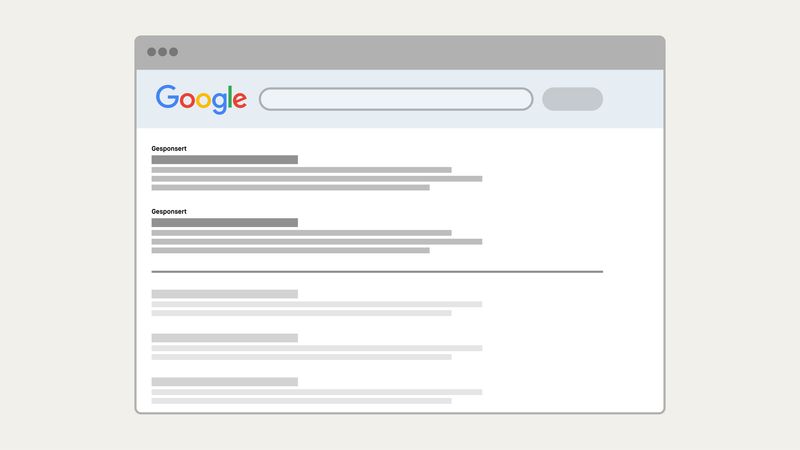
“Search Engine Advertising”, are occasionally used synonymously. But the term SEA specifically refers to "sponsored" results (Ads) in the search engines. To appear in a SERP in a visible ad position as possible, you bid on relevant keywords. For instance, ads usually appear at the top on Google:
Besides SEA, Pay-per-Click also includes paid advertisements on
- social networks like Facebook, Instagram, Tiktok, Reddit or LinkedIn ( “Social Media Advertising, shortly “SMA”)
- Video & Streaming Platforms like YouTube, Spotify, twitch or Disney+
- Shopping Platforms like Amazon, classified ads or eBay
- App Stores like those of Apple, Google or Microsoft
- thousands of partner sites for “Display” ad formats, like those offered by Google, Amazon or Microsoft, for instance
PPC allows businesses of any size
- the targeted promotion of their own products and services
- the quick purchase of paid traffic
- the purchase of increased brand visibility
- a cross-platform approach (with corresponding budget)
Despite all the options, many companies actually start with SEA, specifically with
Google Ads. This is due to the very high level of awareness, the (supposedly) uncomplicated set-up, and Google's aforementioned market dominance.
But PPC is so much more than search engine ads: PPC opens hundreds of opportunities for online advertising and offers targeted and quick results. More on that later.
Overview: Differences between SEO and PPC
In practice, the two disciplines are distinctly different. The key differences up front in the overview:
|
|
| Organische, nicht bezahlte Ergebnisse |
Bezahlte Anzeigen |
| Langfristiger Prozess, kann Wochen bis Monate dauern |
Schnelle, fast sofortige Ergebnisse |
Direkte Kosten fallen in der Regel nicht für den Traffic an,
aber mögliche Kosten für Dienstleistungen und Tools |
Kosten pro Klick, abhängig von Wettbewerb
und Branche |
| Ergebnisse erscheinen in den organischen Suchergebnissen |
Anzeigen erscheinen meist oben auf den
Suchergebnisseiten (SEA) oder plattformabhängig
an dafür reservierten prominenten Positionen |
| Schwierigere Vorhersage und Kontrolle des Traffics |
Direkte Kontrolle über Budget, Zielgruppe und Keywords |
| Änderungen brauchen Zeit, um sich auszuwirken |
Anzeigen können in Echtzeit angepasst werden |
Einmal erreichte Rankings können ohne ständige
Investition anhalten |
Traffic stoppt, wenn man aufhört zu zahlen |
| Erhöhte Sichtbarkeit durch qualitativen Content |
Erhöhte Sichtbarkeit durch finanzielle Investition |
| Beeinflusst durch Suchmaschinen-Algorithmen |
Beeinflusst durch Budgets und Gebotsstrategien |
These significant differences also entail the specific advantages and disadvantages of both disciplines. We will now look at them in detail to provide you with a better basis for the question “When SEO, when PPC?”.
The strengths and weaknesses of SEO
The advantages SEO offers (plus: a bit of math)
Search engine optimization is considered a long-term, sustainable, and cost-efficient strategy. The first important pro argument (which must not be missing in any SEO advantage list) is:
Organic clicks from the SERPs are considered “free”.
This does not mean that SEO optimization costs nothing. Rather, it means that you – unlike PPC – do not have to pay individually for each user who finds your website organically on Google and clicks on your result. Therefore, the more organic clicks your website achieves, the more SEO pays off.Let's say you have spent 10,000 EUR for the SEO optimization of several guide articles and thanks to
Cost per click | 10 |
1,000 € | 100 |
100 € | 1,000 |
10 € | 10,000 |
1 € | 20,000 |
0,50 € | 100,000 |
0,10€ | 10k, 20k, 100k, … clicks are completely realistic when you have once achieved valuable top rankings. This is connected to the next big SEO-advantage: Sustainability. |
Top search engine rankings are usually a long-term success.
SERPs change constantly, but our experience shows that search engines tend to stick to compelling content. Especially rankings in the top-3 are often quite stable and do not immediately disappear if you need to postpone or shift the focus of SEO optimization for resource reasons.
In other words, SEO-induced visibility and traffic gains rarely disappear overnight. And since we are already talking about “gains”, we come directly to a third crucial point:
SEO can be budgeted and has
nothing to do with economic “blind flight.”You need only two values to achieve financial clarity about the value of the completed SEO work: the number of organic clicks of a keyword for the period X (#KlicksKW) and the average CPC (“Cost per Click”, i.e., click price) of the relevant keyword (ØCPCKW).
This allows you to calculate the Content Ad ValueKW at any time, a value that says how much budget it would have taken to buy the achieved traffic of the same height with PPC.
The SEO formula for the Content Ad Value is:
#KlicksKW X ØCPCKW = Content Ad ValueKW
When you have the Content Ad Value, you can then determine the total profitability of your SEO traffic in the next step. The formula for this would be beyond the scope here, but you will find a detailed guide in the article on
Further advantages of SEO in the quick overview
:Organic top rankings still receive the
- most clicks.SEO is virtually
- infinitely scalable, whereby the budget does not necessarily have to increase.For just about
- every conceivable industry, every business model, and every niche, suitable keywords can be found with realistic ranking prospects.SEO can cover all stages in the
- Conversion Funnel, from Top-of-Funnel (TOFU) to Bottom-of-Funnel (BOFU).Precise tracking through tools like Google Search Console, Bing Webmaster Tools, and Google Analytics 4 allows high transparency and targeted optimization.
- There are also countless tools
- from third-party providers that help with the work (partly for free) – for example , , Sistrix or Ryte.Screaming Frog SEO SpiderSEO helps with SeobilityBrand Building
- , as users place high trust in organic top results.So is there nothing to criticize about SEO? Let's say – almost nothing.Why even SEO is not perfect
Honest confession: SEO is, for all its love, a complex and laborious task that also requires some flexibility. And … above all … patience!
Yes, it's true: SEO takes its time.
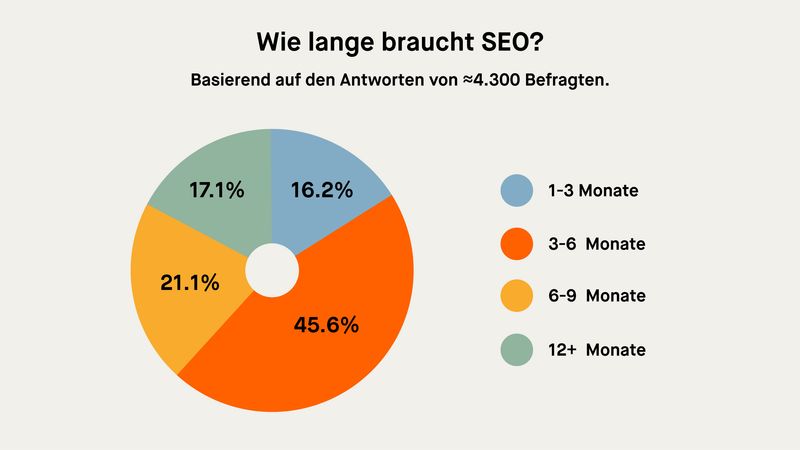
Before implemented SEO measures start to visibly take effect, it can take up to a year. It can also be faster, but three to six months are indeed typical as SEO waiting time:
Source:
AHREFS Blog: How long does SEO take?
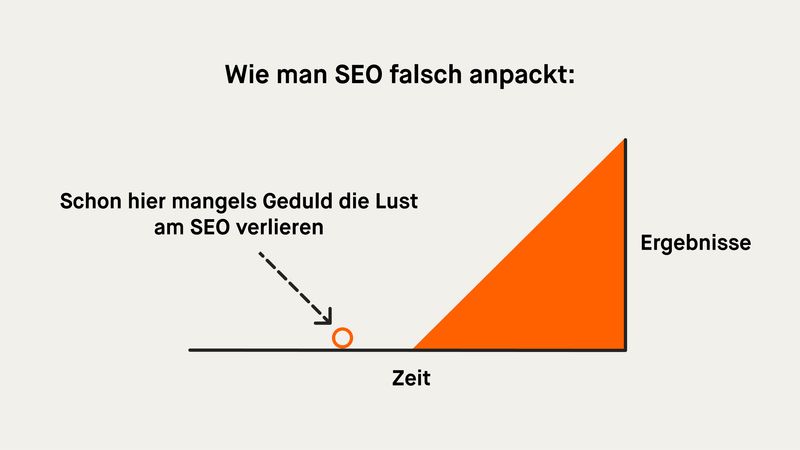
You should definitely keep this delay in mind – or better yet: your boss. Because companies often fall into the trap of not even giving their SEO team enough time. A graphic that nails this dilemma:Source: Andrew Holland @LinkedIn: RIP to the ROI of SEO (PART 2)
The (initial) slowness is not the only hurdle of Search Engine Optimization, but definitely the most visible one in everyday practice. We are certain that many SEO managers and consultants could sing a song about it – as well as about the following limitations.Further SEO weaknesses in quick overview: Creating content with real ranking chances is and remains
hard work
- ; SEO is not self-running, does not have a 100% success guarantee, is never “complete” – and as a result, is not “free” in the actual sense.Not all companies can handle SEO in-house
- , often the participation of several specialists, including developers, is needed, because SEO no longer takes place in isolation and has itself become a wide field.Primarily, SEO often targets the increase of brand awareness
- , it again requires specialists to turn website visitors into actual leads and customers.The ranking algorithms
- and SERPs can change at any time, of course also to the disadvantage of one's own content (a current extreme case would be Google's upcoming AI-enhanced search engine called “SGE”).It is true that many SERPs are permanently dominated by internet titans
- (Amazon, Chip.de, Wikipedia, …) – and not always rightly so.Thus, we have a fairly accurate picture of the chances and risks around professional search engine optimization. High time we became better acquainted with PPC marketing.The strengths and weaknesses of PPC
The opportunities in PPC marketing
Many advantages make Pay-per-Click advertising a very popular digital marketing strategy. First, there is its speed.
PPC measures offer you virtually immediate results.
Unlike SEO, your invested PPC money immediately translates into impressions and traffic. Between campaign launch and measurable results, you usually only have to wait for a short time.
This makes PPC attractive for many marketing scenarios, including:
Product launches
and
- portfolio adjustments (general product promotion)Exposure for newly founded companies
- limited, temporary, and seasonal offers
- Product and content-user tests
- Supporting PR (e.g., for white paper publications)
- quick responses to unexpected publicity
- Hand in hand with speed comes a second great advantage: control.PPC gives you almost unlimited control, combined with targeted targeting.
Whether ad texts and design, budget and bid adjustments, ad run times or
A/B testing
. Thanks to numerous
Targeting-parameters, you can segment in great detail, depending on the platform, for example by age, gender or interests, by browser, end device or display resolution – or even by individual features like “Checkout abandoned”, “former website visitors” or “has already bought from us”.
Add in the incredible range of ad formats
(the OMR-
Guide to the most important Google and Meta ads is just an appetizer), there are suitable PPC solutions for virtually all budget sizes and business scenarios. And speaking of budget …
A speciality à la SEA: High “Quality Scores” improve your return.The marketing management wants to achieve the maximum return with its existing budget. Google Ads and Microsoft Advertising (Bing Ads) provide a tool for this: the
“Quality Score”
, or short QS. We explain the
Quality Score of Google Ads, to you briefly. With this value between 1 (bad!) and 10 (awesome!), Google tells you how high the quality of an ad with its corresponding landing page is rated to the target keyword.
The Quality Score of Google Ads includes the following parameters:Expected click-through rate (CTR)
Ad relevance (how well does the ad text fit the user intent and landing page)
- Quality and user experience with the ad landing page
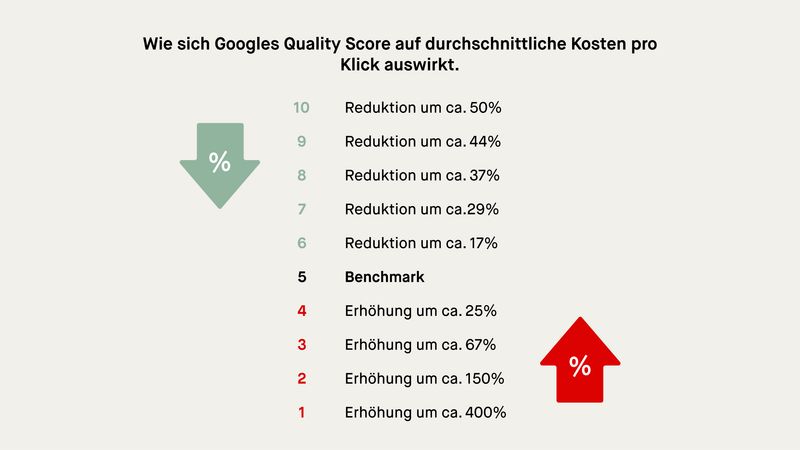
- Simplified said: If you optimize your ads and landing pages accordingly and achieve a high QS, your chances of ad display in Google's top spots
- increase
while your average CPC simultaneously decreases. The concrete percentages vary, but it comes down to the following principle:Source: Store growers: Google Ads Quality Score: Holy Grail or Overhyped Metric?
The QS is relevant because by now other PPC platforms have adopted the model (like Bing Ads, LinkedIn, Facebook, and Amazon). The QS thus gives valuable insights into optimization potentials in PPC and helps to achieve the goal of achieving the highest possible ROAS (“Return On Advertising Spend”) within the budget. Win-win!So we have checked off speed, targeted control, the vast number of possibilities, and potential return optimization. But there is more.In the quick rundown the further advantages of PPC:
Charging for clicks instead of impressions – thereby
lower scatter losses
- Thanks to precise data measurement
- , you always have the most precise overview of the campaign success at any timeContinuous optimization to lower costs and increase returns
- Very good scalability
- – budget adjustment possible at any timeGuarantee for top positions (e.g., with SEA still before the SEO results, even in the
- era of AI direct responses)Visibility also with "hard to rank" keywords, especially with highly commercial and transactional topics
- From a certain point, ads often run on auto-pilot
- ; the increasing AI and machine learning integration now allows a high level of automation.Sounds all unbeatable, right? So where's the catch …?The limitations of PPC
Even with the marketing strategy PPC, there is a lot to consider. Even some of the strengths we mentioned earlier can turn out to be weaknesses:
There's really no such thing as a free click!
And unlike SEO, the price per click over time – if at all – only slightly improves, since models like the Quality Score only have a limited effect.
- Unlike SEO, there is no sustainability. "PPC works immediately", of course applies in
- both directions: As soon as you turn off the cash tap, your traffic acquisition ends immediately. Selecting suitable approach and setting everything up correctly is not easy. The variety of formats, platforms, and payment strategies are great, but they can overwhelm smaller companies.
- PPC management is time-consuming and complex – especially for SMEs and smaller operators.You need
individualized approaches
”), but this is not reliable all the time. Experience shows: Automation does not make PPC less, but only
different complicated.
For reasons like these, companies often employ external agencies and service providers
for PPC management. This usually works – but it's obviously more expensive. Not everyone can afford such expenses in addition to the regular click prices.Spoiler Alert: Not everyone will love your PPC ads (i.e., click them).PPC rarely contributes to brand reputation because, at the end of the day, it is still advertising. Even in 2023, advertisements are not at the top of the popularity scale and are often ignored. Have sponsored InMail messages on LinkedIn ever annoyed you? Then you know what we mean.
Studies by both
Sistrix
and
Backlinko, conducted separately, almost unanimously found that Google's organic top positions have a “Click-through-rate” (CTR) of an average of 27-29 % – but the Google ad at the first ad position only has about 19 %
. Numbers that reflect the relative unpopularity of ads well.
Thus, despite their prominent placements, ads still generate a percentage considerably less traffic than the organic top rankings –
an estimated over 70 % of all internet clicks
are assigned to the organic top results quite “classically”:Source: FirstPageSage: Google Click-through-Rates (CTRs) by Ranking Position in 2023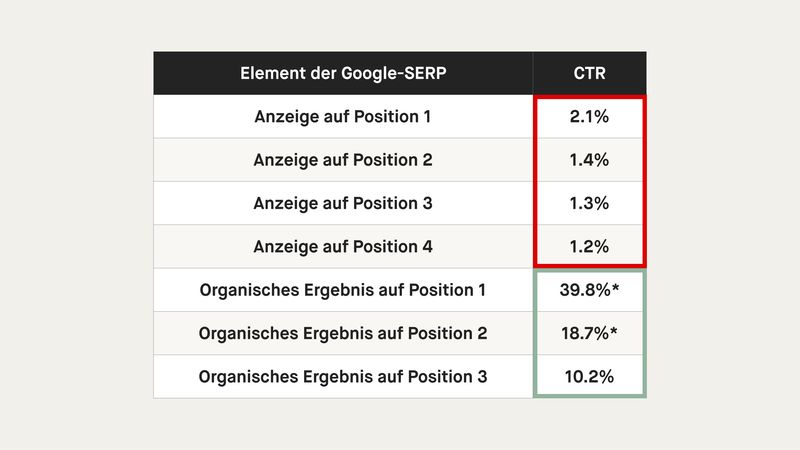
more sustainably
.Source: Andrew Holland @LinkedIn: Why Brands don’t grow with PPC
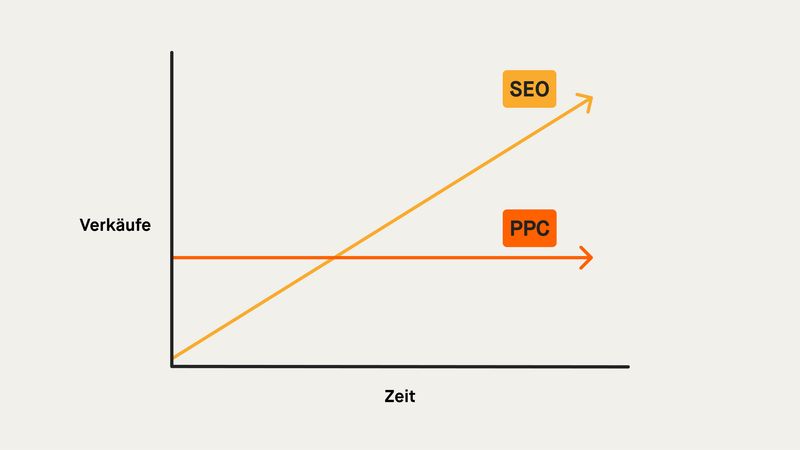
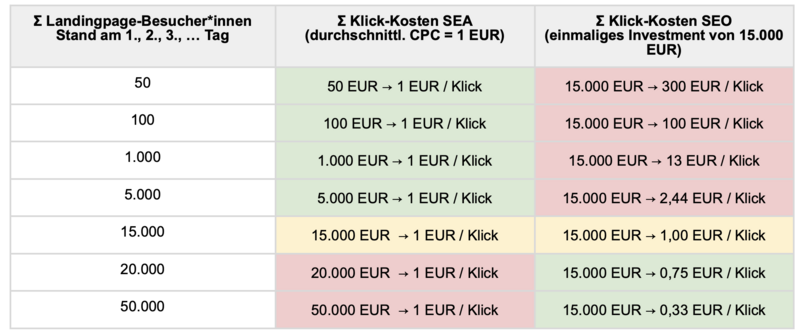
You will increasingly have to shoot more money into PPC. This collides with your limited budget. Although, thanks to increasing ROAS, it may increase, but you are still faced with: a limited number of ad slots; a limited potential for achievable clicks; margins minus Assuming a constant click price of €1, SEA in the example has the edge only until the number of 15,000 visitors is exceeded. After this break-even point, SEO wins.
Thus, we have dealt with some of the significant PPC limitations we think are important – but not all of them yet.
What you should consider in PPC advertising:
PPC often does not work particularly well with informational keywords
(W-questions).
- Especially in SEA, click prices in some industries and for some keywords can be rather high; the costs very much depend on demand and can increase at any time.
- Strategically, PPC campaigns can be easily copied and outbid by competitors; such “bidder wars” with other advertisers additionally increase the cost of ads.Each channel has its own
- restrictions and advertisements cannot be placed for all topics, which limits the range of PPC opportunities for some industries.PPC is ignored by the
- organic algorithms of all platforms and does not reflect on digital authority (a currency that will become increasingly important for brands especially in the upcoming AI era
- ).Thus, we have learned a lot about the advantages and concerns of both disciplines. Hopefully, this has made it clearer to you where the two disciplines stand in the “contest” SEO vs. PPC – a good basis for your digital marketing mix!Conclusion: SEO “vs.” PPC in online marketingIt should have become clear: Neither SEO nor PPC solutions are perfect on their own.Whether you tend to follow SEO or PPC strategies depends on your marketing goals, your budgets, and of course, your time planning.
The characteristics of SEO and PPC mentioned above help you to answer important marketing questions like the following with "this is more of an SEO job or this is more of a PPC job":
What business goals am I pursuing?
What budgets are available to me (permanently?)?
Am I in a hurry for leads? Or do I have room for a slower, but more sustainable strategy?
What leads and conversions do I need and how many leads in total?
- Is my brand already known or does it still need to be so?
- Am I striving to establish myself as an authority in my industry in the long run?
- Am I serving a global, national, or local market?
- What are my competitors doing and how do I set myself apart from them?
- etc.
- The opportunities in the SEO and PPC areas each provide you with their own solution approaches for these questions.
- We have seen: Search engine optimization helps you gain sustainable organic visibility and credibility, but it's rather a “slow burner.” Pay-per-Click, on the other hand, provides you with quick results and immediate visibility to your target audiences, but is less effective in the long run.
- It is a real art to take these strengths and weaknesses into account when choosing and distributing marketing measures. Those who acquire it quickly realize: The answer is rarely only SEO or PPC –
- but a combined strategy that generates synergy effects
.
Because that is the actual, “secret” answer to the question “SEO or PPC”: In the best case, the two disciplines do not stand irreconcilable to each other, but complement each other. You can also find out what this looks like in practice directly from us – in our
sister article on the integrated SEO and PPC strategy.Have fun (continuing) reading! ;-]
Denn das ist die eigentliche, „geheime“ Antwort auf die Frage “SEO oder PPC”: Im besten Fall stehen sich die beiden Disziplinen gar nicht unvereinbar gegenüber, sondern ergänzen einander. Wie das in der Praxis aussehen kann, erfährst du ebenfalls direkt bei uns – in unserem
Schwestern-Artikel zur integrierten SEO-und-PPC-Strategie.
Viel Spaß beim (weiter)lesen! ;-)


