Table of contents
- What is Social Commerce?
- Types of Social Commerce
- Who is the target audience for S-commerce?
- These are the advantages and disadvantages
- 3 Examples of Successful Social Commerce
- Social Commerce on TikTok
- How to Get Started with S-Commerce
- Conclusion: Social Commerce is Possible Even on a Small Budget
More and more Germans are shopping on social media. According to a
study by GroupM, the number of people spending money via Instagram and similar platforms is steadily increasing.
Social media platforms are therefore not just networks for exchanging with fans and acquaintances – thanks to so-called “
social commerce,” they are also shaping the way people shop online and are important drivers of your e-commerce success.
We’ll explain what this form of online retail is all about – including helpful social commerce examples and tips for your business.
What is Social Commerce?
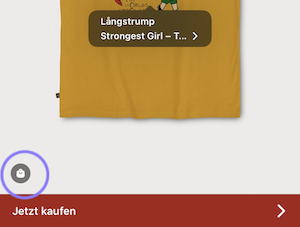
A bag icon on Instagram posts or ads reveals that products are linked.
Social commerce (also:
S-commerce) is a form of
e-commerce in which the entire shopping experience – from product discovery to research to purchase – typically takes place directly on a
social media platform. Instead of being redirected to an external online shop, users can discover and purchase products and services in their feed, in stories, or through special “shop” tabs – often without having to leave the app. However, this depends on the
platform: while users in Germany can complete their purchase directly in the
TikTok Shop app, on Instagram and Facebook, for example, they are redirected to your online shop. What social commerce looks like in detail depends heavily on the channel being used for selling.
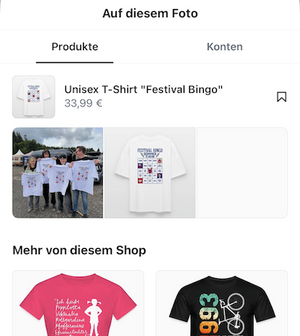
Clicking on the bag icon takes you to the linked items and shows you more product suggestions from the provider.
Spreadshirt via InstagramThe focus is on social interaction, recommendations from friends or influencers, and a seamless, entertaining
customer journey.
With S-commerce, you integrate your products and services – depending on the platform – naturally into your content, creating an online shopping experience that stands out from traditional shopping.
Types of Social Commerce
Although social networks are the main component of S-commerce, this form of online retail is generally about factors such as communities and social interaction – e.g., with influencers.
Common types of social commerce, in addition to native solutions like TikTok or Instagram shops, include...
- Peer-to-peer sales on online marketplaces like Etsy, Kleinanzeigen, or Facebook Marketplace.
- Curated shopping lists like Pinterest boards or Amazon storefronts.
- Live shopping events.
- Shoppable augmented reality filters like AR shopping lenses on Snapchat.
- Crowdfunding via platforms like Kickstarter or StartNext.
By the way, social commerce is different from
social selling: the latter is about building relationships with potential customers via social networks and getting them excited about your brand. If you practice effective
social selling (e.g., on LinkedIn), it can be a driver for your S-commerce.
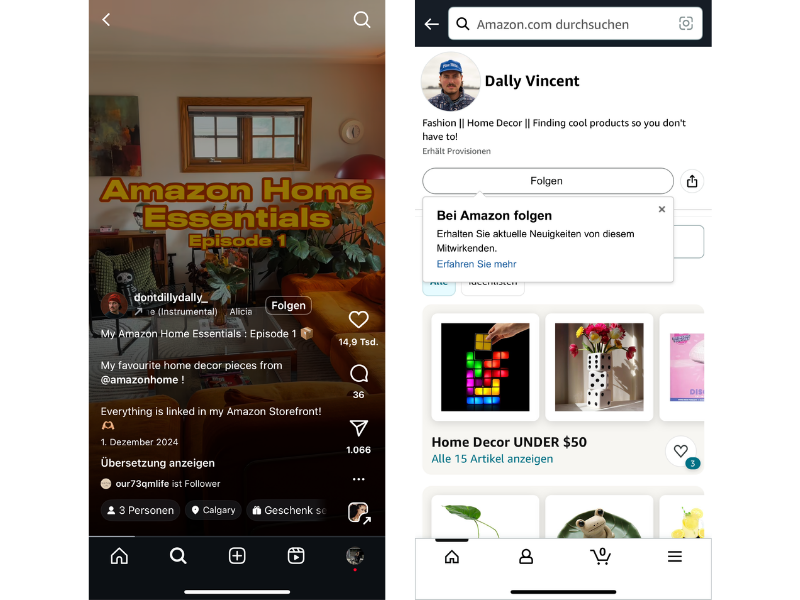
The interior influencer dontdillydally_ points to his Amazon Storefront in an
Instagram reel.
Who is the target audience for S-commerce?
Whether or not you should rely on social commerce naturally depends on your target audience. Online shopping via social media is especially popular among
Gen Z and millennials – that is, those born from about 1980 onward. According to a
report from the Influencer Marketing Factory, social media is the most important source of shopping inspiration for 97% of Gen Z respondents.
Although increasingly unpopular with young people,
Facebook is still relevant: you can also use the platform’s Marketplace for social commerce – reaching users well over the age of 30.

“For Gen Z and Gen Alpha, social media has long become a product search engine, while traditional online shops are losing relevance. Social commerce tools are therefore essential to enable a seamless customer journey from inspiration to purchase within a single platform.”
– Nora Staudt, Vice President Marketing at Spread Group
These are the advantages and disadvantages
The target audience fits, and you're already active on the relevant platforms or planning to be? Could S-commerce be something for you? Here are the most important advantages and disadvantages of social commerce:
S-Commerce Advantages | S-Commerce Disadvantages |
|---|
High reach: You reach many users with your business, can attract new customers, and inform your community about new products or services without (expensive) detours. | Strong dependency: You become dependent on the rules and algorithms of the platforms, which can unpredictably impact your revenue. That’s why social commerce shouldn’t be the sole part of your sales strategy. |
Seamless shopping experience: You simplify the buying process for your customers significantly, leading to fewer abandoned purchases. Users can also make spontaneous purchases they might not have actively searched for. | Low purchase intent: You need to grab the attention of users who are primarily on the platform for entertainment, not shopping. |
Authenticity: You benefit from credible recommendations from friends or influencer marketing and thereby strengthen trust in your brand. | Loss of customer data: You give away valuable buyer data to the platform, making your own future marketing more difficult. However, through redirects from Instagram and YouTube, the insights still land with you as usual. |
Direct customer engagement: You can communicate directly with your community and build a personal relationship with your customers. | High effort: If you use the wrong tools, maintaining your product catalogs can require a lot of manual work. (Though with the right shop system and strategy, that’s a different story.) |
Opportunities for small brands: As a small business or startup, you can achieve high visibility even on a limited budget and remain competitive. | |
3 Examples of Successful Social Commerce
You’ve probably stumbled upon linked products on Instagram, discovered the shop tab on TikTok, or bartered with people in your area via Facebook Marketplace. Our social commerce examples show you what’s possible:
Social Commerce on Instagram
Whether you set up an
Instagram shop, benefit from the reach of relevant influencers, or use shopping ads to gain new customers – the Meta-owned platform is especially suitable for lifestyle brands. You can showcase clothing, accessories, or furniture perfectly here and even benefit from
user-generated content (UGC) from your community. Instagram is also exciting for creators who want to
sell their merch via the platform.
This article is complemented by <strong>external content</strong> from <strong></strong>.
components.ConsentLayer.text
I consent to external content being displayed to me. This allows personal data to be transmitted to third-party platforms. Privacy policy
Spreadshirt shows how it’s done: the provider of customizable products shares various items in its feed on Instagram and links them directly via the shop function in its posts.
Social Commerce on TikTok
TikTok Shop is the social media newcomer of the year: here, users can browse for products like in a virtual shopping mall, get inspired – and buy directly without leaving the platform. The focus is on product recommendations from trusted creators and brand offerings. Set up your own TikTok Shop and reach potential buyers through
livestreams, where influencers present your products.
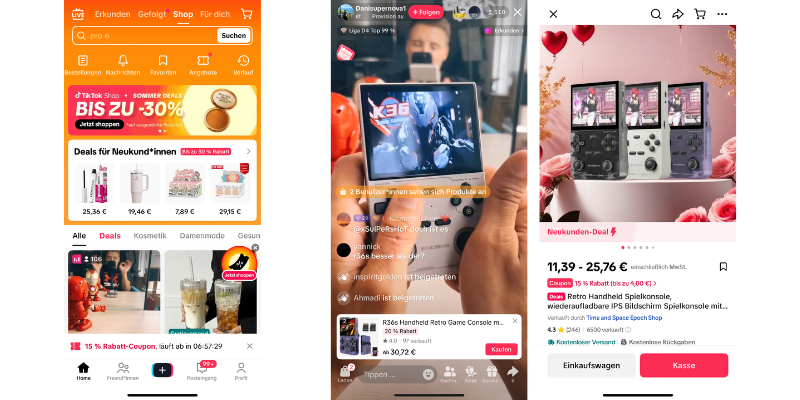
TikTok has offered extensive shopping options directly in the app since 2025. Users can search for products (left) or discover items featured in livestreams and videos (right) that are linked in the content.
Social Commerce on YouTube
No overview of social commerce would be complete without the classic video platform: on YouTube, you can also benefit from strong communities and high reach – either as a brand or through successful creators.
Especially practical: platforms like
Spreadshop allow you to link your shop with your channel. This way, you can create an appealing
merch shelf, like creator
Kim Hoss does on YouTube. Fans are directed to individual Spreadshops via the platform and can complete their purchases there.
This article is complemented by <strong>external content</strong> from <strong></strong>.
components.ConsentLayer.text
I consent to external content being displayed to me. This allows personal data to be transmitted to third-party platforms. Privacy policy
In addition to these social commerce examples, there are many other ways for brands or creators to sell products on social media. Not to be underestimated are Snapchat’s augmented reality features, for example: let users try on sunglasses in the app or show them how furniture would look in their home. Streaming platforms like Twitch can also be important S-commerce channels – according to GroupM, recently every second user there has spent money.
How to Get Started with S-Commerce
Step 1: Identify relevant platforms for your target group
Analyze your audience and find out where they are active. Do you offer furniture, decor, or DIY items? Then it might be worth connecting with influencers who can include you in their popular Pinterest shopping lists. Your opportunities are nearly limitless thanks to different channels and active communities.
Step 2: Develop a content strategy
Even the best products are worth (almost) nothing without compelling content. It’s important that users can find your items at all – and that your content guides them to purchase. So, think about a suitable
content strategy for your brand to implement targeted social commerce. Also ensure your products have descriptive texts and include all necessary information.
Step 3: Get help from the right tools
Social commerce is only half as fun without the right
tech stack. Choose tools that match your needs to be especially successful.
For example,
Spreadshop offers everything from one source: you can create a personalized
online shop, customize over 250 products with your designs, and showcase your creations on Instagram, Facebook, or YouTube. By linking your shop to these platforms, users can buy from you directly via the platforms.
The best part? Your Spreadshop is completely free, the provider handles customer service, and thanks to
dropshipping and
print-on-demand, you don’t need to commit financially or store any inventory. You also set your own margin – only the base price for the products goes to Spreadshop.
Conclusion: Social Commerce is Possible Even on a Small Budget
In the USA and China, social commerce is already commonplace. And in Germany, buying and selling via Instagram, TikTok, and others is becoming increasingly relevant. Although some features are (still) not available in this country – with TikTok Shop at the latest, German users can now shop directly via social media. Other platforms, thanks to smart integrations (e.g., via
Spreadshop), at least redirect your customers straight to your online store. This way, the social media shopping experience is almost seamless – and saves you one thing above all: endlessly high advertising budgets.