Table of contents
- Your company also needs an AI strategy
- Implementing strategy with Salesforce's AI
- Data Black Box AI tool? How the Salesforce AI works with your data
- Getting started with Salesforce's AI
- Not a self-starter, but hard-working colleague
100 million users within two months: What TikTok achieved in nine months and Instagram in two and a half years,
ChatGPT reached shortly after its launch at the end of November 2022. Since then, the helpful chatbot and AI topics in general have become indispensable from our everyday life. It’s obvious that software providers are increasingly relying on Artificial Intelligence to make our daily business a bit more pleasant.
One of them is Salesforce – and not just since
ChatGPT: The all-rounder for CRM has long integrated AI features into its products and thus, for example, has been supporting its users since 2016 with
Salesforce Einstein. However, the GPT technology from OpenAI is also creating innovations here and is expanding the
Salesforce Marketing Cloud with additional helpful AI functions.
So far, the new AI features of the Salesforce Marketing Cloud have been tested in a closed pilot program with selected customers. Some functions will be rolled out over the next few weeks and months. We’ll tell you what is already possible and what you can look forward to.
Your company also needs an AI strategy
GPT stands for Generative Pre-trained Transformer which, simply put, represents the ability to process huge amounts of data and learn from it. We have explained this a bit more thoroughly in our online seminar on AI tools. This ability opens up entirely new possibilities for various areas of life and work compared with traditional AI, which was also able to make data-based predictions on a smaller scale. And because many people out there have already recognized this, your company should also be based on artificial intelligence as soon as possible so as not to be left behind. Because working with AI brings many advantages for your business, for example by …
- …increasing your productivity
- …simplifying workflows
- …helping to establish new business models
- …supporting the creation of new customer experiences
- …bringing new tools and skills
- …developing new product strategies for you
As is the case in many situations, the same applies here: Preparation is everything. If you want to get the most out of artificial intelligence, you should first develop a solid strategy. Because the fields of application for AI are large. It helps to deal with the possibilities in advance and find out in which areas of your company artificial intelligence can support at all. An essential cornerstone here is your data: In order for your company to effectively use AI, you must ensure that all relevant data are available and well prepared. In addition, your employees are an important part of the strategy. They must be familiar with artificial intelligence – and trust it. When integrating AI into your operational processes, you should therefore provide your team with the tools it needs for the new work, and educate them about both opportunities and risks.
Implementing strategy with Salesforce's AI
Artificial intelligence is becoming increasingly important in a business context. With its help, marketers can focus more on strategic topics by simplifying and accelerating manual processes using AI. The Salesforce Marketing Cloud also offers you a whole range of AI features. The latest and upcoming innovations around Salesforce Einstein in particular open up entirely new possibilities for communication with your customers. For example, create compelling campaigns in no time that match the interests of your customers without having to deal with complex segmentations.
Here's how:
- Chat directly in the Salesforce Marketing Cloud with Einstein or use the convenient Slack integration. Here you can, for example, ask which products from your inventory you should advertise to boost your sales.
- The AI will then suggest suitable products based on previous sales figures that you should introduce to your customers.
- Use this information for the next command and let the AI create an appealing campaign around the suggested products. If you sell shoes, the prompt could for example be: "Create a summer campaign for shoes for customers who have bought winter shoes."
- The Salesforce AI then does exactly that and presents you a campaign draft in the Campaign Assistant – including campaign goal, target group or target segments and KPIs.
- In the Campaign Assistant you can adjust the campaign and for example expand it with additional elements. With the help of AI, you can create complete customer journeys.
- Based on your entries, the Salesforce AI designs customer mailings that you can also adjust and for example add directly in the tool AI Images.
- Once everything fits, all you have to do is click on "Send".
The Salesforce AI relieves you of many steps and provides you with the basis for effective campaigns within a few minutes. In particular, the creation of target group segments normally takes a lot of time. By working intelligently with data (keyword: data strategy), it knows which customers you can reach best how, where and when. You generally have the final say: Before an email goes out, you can (and should) check all content and goals and adjust them if necessary.
With the help of the Salesforce AI, you can ...
- …boost your creativity: It doesn't take everything away from you and it certainly won't replace you. But as in other areas as well, it provides you with helpful input and inspiration.
- …work more efficiently: Especially time-consuming tasks that just have to be done can be well delegated to Einstein. This leaves more capacity for other things.
- Get the most out of personalization:The AI knows based on your data what your customers need to be satisfied. From optimal shipping times to individual product suggestions, you offer your customers well-rounded experiences – and faster, easier, and more effective than without AI.
Some AI features will be rolled out to all users of the Salesforce Marketing Cloud over the next few weeks and months. In the pilot version, you can already use the automated segmentation creation. The Email Content feature is coming in the fall of 2023, and after that, the Typeface partnership is still ahead of you, which lets you generate AI graphics directly in the tool.
In addition to ethical and moral concerns, many people rightly wonder what actually happens to the data they enter into tools like ChatGPT. This is important in light of high data protection standards, especially in a business context. Therefore, you should handle data sensitively and not reveal any personal or company-internal data to your AI tools. But then, how should the Salesforce AI know which of your customers last bought winter shoes? Simple answer: By accessing your data.
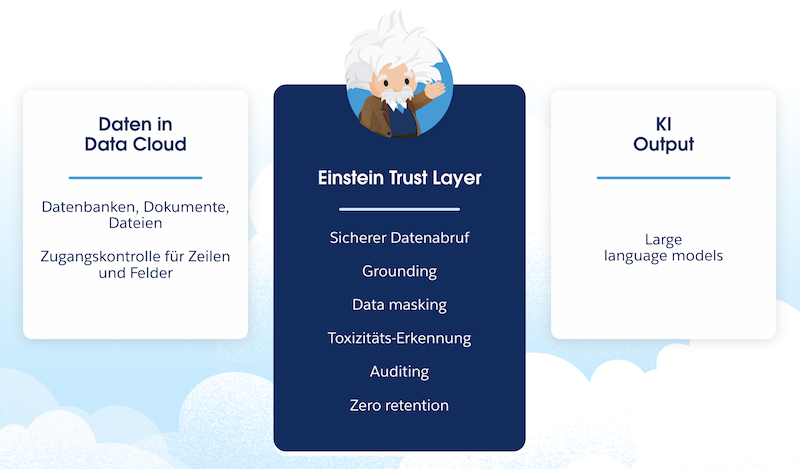
The Salesforce AI needs data to be able to work effectively. This is assured by a special feature of Salesforce Einstein. Graphic: Salesforce
To ensure this data doesn’t end up with OpenAI or other AI providers, an interface ensures discretion: The Einstein Trust Layer ensures that your data doesn’t go outside in all processes and still empowers the AI to work effectively. To do this, it masks all data before it goes to the AI. This keeps personal information safe and artificial intelligence creates its suggestions based on placeholders. In addition, the Einstein Trust Layer offers the following features for your data security and your work with the Salesforce Marketing Cloud:
- Grounding: Your prompt is enriched and optimized with data from the Salesforce Data Cloud or other connected data sources.
- Toxicity detection:So you don’t send out questionable content, the Salesforce AI checks it carefully in advance. And you ultimately have the final say.
- Auditing: Your team can trace at any time who has used the AI and what results have come out.
- Zero Retention: You probably know from ChatGPT that your prompts, histories, and results are stored in the tool. The Einstein Trust Layer prevents exactly this from happening and deletes prompts after the application from the system.
Besides all of this, you are the gatekeeper: There are no self-running algorithms in the Salesforce Marketing Cloud that simply create and send campaigns. What happens, happens based on your inputs and will only be sent once you click on "Send" after the final check.
Getting started with Salesforce's AI
Once you have thought out an AI strategy for your company, it’s time to implement it. One of the most important foundations for the success of the strategy is the correct handling of data. Your company probably collects plenty of data as well. However, you should know how best to use this data. First, develop a first-party data strategy and merge all data as centrally as possible. This way, not only can the Salesforce AI better access it, so can all teams. This step involves some (time) effort, but always pays off.
By consolidating your data and making it accessible to everyone in the company, your teams maintain a much better overview of your customers. The
Data Platform from Salesforce can help with this. With it or other CDPs, marketing, sales, and customer service can work more effectively and efficiently, which opens up new possibilities for customer retention. For example, you can prevent customers from still seeing the products they have already purchased in ads. This is not only annoying, but also causes unnecessary advertising expenses.
Once everything is prepared, the Salesforce AI can get started and support you in your tasks. By the way, to develop a feel for the many possibilities, you should engage with the entire range of AI features in the Salesforce Marketing Cloud. The Send Time Optimization now ensures that messages are sent at the right time. Open rates are therefore as high as possible. With Einstein Recommendations, you can also integrate individual cross-selling offers into your emails. In this way, you present your customers with suitable products, making your mailings significantly more relevant.
Not a self-starter, but hard-working colleague
Press a few buttons and sit back? That’s not (yet) possible. It doesn’t seem like artificial intelligence is going to replace all of us any time soon, and that’s a good thing. However, you shouldn’t underestimate its rapid development and the many possibilities it already provides. The saying “innovate or die” is especially fitting in this context. Engage with AI, take advantage of its benefits, and optimize your daily business this way. Along with a strict view of the data used, you should also keep an eye on the AI itself: What it delivers is usually a good draft for your further work. At the same time, its results can only be as good as the commands and data it works with. If you want to use the Salesforce AI purposefully, the database must be correct – whether in the Salesforce Data Cloud or in other tools. Then there is not much standing in the way of a successful cooperation.
Do you want to learn more about the possibilities that AI in the Salesforce Marketing Cloud holds? Then you should watch the free webinar from the tool provider where Salesforce answers further questions about its new and upcoming AI features. 

