Table of contents
- These are the top 7 PIM systems on OMR Reviews
- What is a PIM system?
- How do PIM softwares work?
- Conclusion: The right PIM system for every need
The "Single Source of Truth" of the e-commerce world
Have you ever wondered why the small snippets in clothes never have typos and contain all relevant information? Washing instructions, materials, country of manufacture and much more are preserved there. Imagine a huge e-commerce store like About You, which sells tons of various clothing each year and has to store and pass on all data to external parties like suppliers. A single person probably wouldn't manage this, setting several people on task would be inefficient. This is where a Product Information Management System (PIM) comes into play.
It collects all information about a company's products in one place. These are, besides the internal aspects, also a relevant source for customers who want to know as much as possible about products before they make a purchase decision. Since there are many different places where such information needs to be delivered – online shop, social media appearances, website, print media – a PIM system also takes care of channeling it correctly.
The tasks of a PIM system are therefore complex and even small e-commerce providers should not forego it. We will show you which
Product Information Management Tools are the best and devote ourselves to the extended information content of the PIM system definition.
Recommended Product Information Management (PIM) Software
On our comparison platform OMR Reviews you can find more recommended Product Information Management (PIM) tools. We present over 80 solutions that are specifically tailored to the needs of companies and brands that require efficient product information management. This PIM software offers comprehensive support in all aspects of product information management. Take this opportunity to compare the different software solutions, drawing on authentic and verified user reviews:
These are the top 7 PIM systems on OMR Reviews
| Tool name | Price | Trial version | Suitable for |
|---|
| entitys.io | from €890 per month | Free demo version | Mid-sized and large B2B manufacturers |
| Pimcore | from €8,400 per year | Free trial | Companies with complex data structures, developers |
| mediaSolution3 by Goodson | On request | Free demo version | Mid-sized companies (B2B) |
| ATAMYA | from €599 per month | 1 month (free) | Mid-sized to enterprise |
| Akeneo | from €25,000 per year | Free trial | Omnichannel retailers and brands |
| ANTEROS | from €650 per month | Free demo version | Mid-sized to enterprise with complex product data |
| mediacockpit | On request | Free demo version | Manufacturers and retailers of all sizes with large volumes of product data |
Highlight Box
The selection of tools is based on our OMR Score. The ranking is determined by the average rating and the number of ratings up to a specific point in time. The more positive votes, the better the result reflects general satisfaction. This score is intended to help you with your decision-making.
1. entitys.io
entitys.io is a cloud-based PIM system specifically designed for mid-sized and large B2B manufacturers and retailers. Alongside classic PIM functions, it offers machine learning tools for data processing and a flexible export engine for various sales channels.
Features:
- Machine learning tools for data processing
- Flexible export engine for marketplaces and sales channels
- Integrated user and permissions management
- Rich text editor for content creation
- Versioning and content archive
Suitable for: Mid-sized and large B2B manufacturers and retailers who need to integrate complex product information.
entitys.io pricing: Starter from €890.00/month (3 users, 5,000 SKUs, 1 language); Advanced from €1,590.00/month (10 users, 50,000 SKUs, 5 languages); Professional from €2,490.00/month (25 users, 100,000 SKUs, 10 languages)
What OMR Reviews ratings say:
| Strengths | Areas for improvement |
|---|
| Intuitive user interface and easy operation | The range of options can feel overwhelming at first |
| Responsive Customer Success team | Occasional challenges during onboarding |
| Flexible adaptation to specific requirements | Some users would like simplified data source consolidation |
"The tool's flexibility is especially convincing, and the user interface is intuitive." – Markus Seyer, Eichinger Industrie GmbH
2. Pimcore
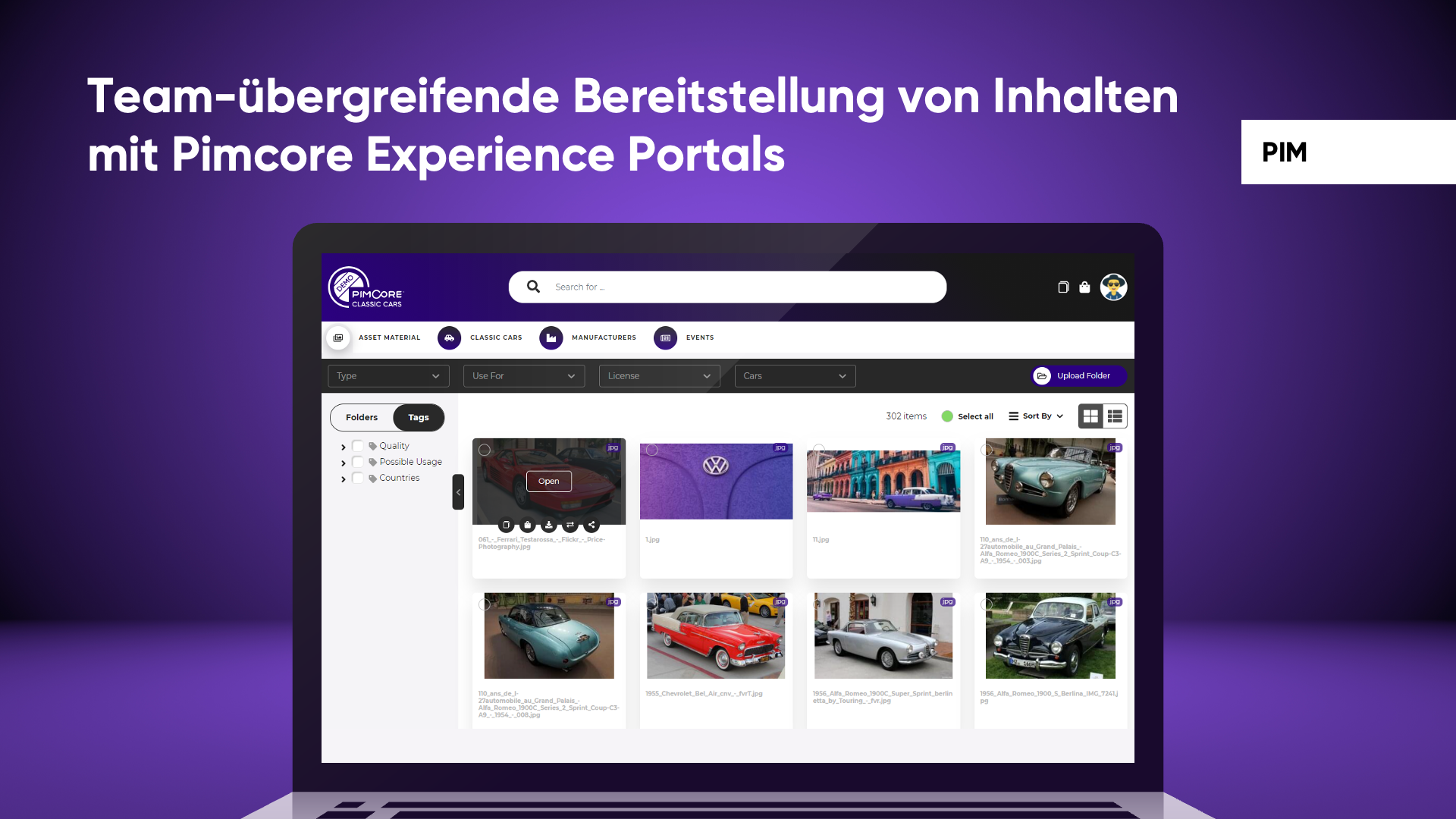
Pimcore is a platform that centrally unites PIM, MDM, DAM, and other data management functions. Its open-source foundation and API-first approach enable high flexibility and the elimination of data silos for a personalized customer experience.
Features:
- Combination of PIM, MDM, DAM, and CDP
- Workflow automation
- Pimcore Copilot (AI assistant)
- API-first architecture for seamless integrations
- Customized asset portals
Suitable for: Companies looking for a flexible open-source solution for complex data structures, as well as agencies and developers.
Pimcore pricing: Community Edition: Free (open source); Professional: €8,400.00/year (secure platform, incl. PIM/MDM/DAM)
What OMR Reviews ratings say:
| Strengths | Areas for improvement |
|---|
| Enormous flexibility and customizability of data models | Steep learning curve for new users |
| Open-source nature and no license costs in the Community Edition | High complexity ("monster" in both a positive and negative sense) |
| Centralization of product data, assets, and content | Performance depends heavily on clean data modeling |
"Pimcore is a real professional tool for me — plain in look, but unbeatable in performance." – Tim, Contorion
3. mediaSolution3 by Goodson
mediaSolution3 is a modular PIM solution developed for mid-sized companies to make product communication efficient and media-neutral. It combines central data maintenance, automated distribution to various channels, and connection to e-commerce platforms.
Features:
- Central data storage (mS3 PIM)
- Automated distribution to print, web, and apps (mS3 Publish)
- Connection to e-commerce and ERP (mS3 Commerce)
- Granular permissions management
- Automated validation rules for data quality
Suitable for: Mid-sized companies that need a scalable solution for central data maintenance and multichannel publishing.
What OMR Reviews ratings say:
| Strengths | Areas for improvement |
|---|
| High stability and reliability in everyday use | User interface sometimes feels outdated and less modern |
| Logical structuring of complex product ranges | Initial setup and data migration can be time-consuming |
| Competent, solution-oriented support | Performance with very large datasets could be optimized in places |
"mediaSolution3 doesn't score with looks, but with reliability, logic, and structure." – Ricarda, UDO BÄR GmbH
4. ATAMYA
ATAMYA Product Cloud is a cloud-native platform with an API-first architecture, designed for modern product information management in omnichannel commerce. It offers features like smart data onboarding and AI-assisted content creation to capture and enrich product data efficiently.
Features:
- Cloud-native and microservices architecture
- Smart data onboarding with AI-assisted text recognition
- AI-assisted content creation (e.g., ChatGPT integration)
- Translation management with DeepL integration
- BPMN-compliant workflow management
Suitable for: Companies from mid-sized to enterprise that focus on e-commerce, marketplaces, and scalability.
ATAMYA pricing: Basic from €599.00/month (1 user, single business domain)
What OMR Reviews ratings say:
| Strengths | Areas for improvement |
|---|
| Flexible configuration without programming | User interface feels "classic" in some places |
| Fast integration thanks to API-first approach | Filter functions not yet fully intuitive |
| Strong support and collaborative partnership | Some features still in development (roadmap) |
"Fast, simple, efficient!" – Torben, Arboro GmbH
5. Akeneo
Akeneo is a PIM and PXM system focused on the quality and precision of product data to create efficient product experiences across all channels. It offers features such as shared catalogs and automation to shorten time-to-market.
Features:
- Shared catalogs for collaborative data use
- Automation and governance functions
- Digital asset management
- API and numerous integrations
- Data quality insights
Suitable for: Omnichannel retailers and brands wanting to shorten their time-to-market and optimize product experiences.
Akeneo pricing: Community Edition free (on-premise installation); Growth Edition from $25,000/year (SaaS, for small companies)
What OMR Reviews ratings say:
| Strengths | Areas for improvement |
|---|
| Very user-friendly and intuitive interface | Asset management has room for improvement (e.g., filters) |
| Large ecosystem and strong community | Complex initial implementation for enterprise features |
| Flexible adaptation to various e-commerce platforms | Product model functions could be improved in places |
"Akeneo is a PIM system that lets me create a product experience." – Raphael Redder, valantic
6. ANTEROS
ANTEROS by INCONY centrally combines product information (PIM) and media (DAM) in a ready-to-use system. Besides efficient data maintenance, the system offers quality checks, AI functions, various exports, its own web shops and portals, and 100% automation of data sheets, catalogs, and labels.
Features:
- Integrated PIM and DAM
- AI-assisted data enrichment
- Quality management with quality gates
- Multilingualism and translation support
- Print-on-demand for catalogs, price lists, and labels
Suitable for: Mid-sized specialists to international corporations with complex technical product data, especially in automotive aftermarket, electrical/electronics, and construction/HVAC.
ANTEROS pricing: Entry from €650.00/month (unlimited users, integrated DAM); Professional, Advanced, and custom plans on request
What OMR Reviews ratings say:
| Strengths | Areas for improvement |
|---|
| Flexible data model for complex, variant-rich product structures | Interface looks somewhat dated at first glance |
| 100% automated print/data sheet generation | Higher tiers only available on request |
| Competent, solution-oriented INCONY support | Some initial familiarization with your own data structures required |
"With ANTEROS, it's already possible in the standard version to process and maintain very complex product data." – Marco, MC-Bauchemie
7. mediacockpit
mediacockpit by Bertsch Innovation is a PIM and DAM software that centrally stores, enriches, and classifies product data and media. As a single source of truth, it distributes product information to all relevant channels — online shop, social media, catalogs, dealer portals.
Features:
- Centralized management of all product-related content
- Time savings through automated workflows
- Scalable for very large volumes of product data
- Integrations with ERP, CRM, and other systems
- Channel management for consistent communication
Suitable for: Manufacturers and retailers of all sizes and industries that need a flexibly configurable PIM/DAM, including for very large volumes of product data.
mediacockpit pricing: On request
What OMR Reviews ratings say:
| Strengths | Areas for improvement |
|---|
| Very flexible, freely configurable data model | Interface is functional but not always clear |
| Stable performance even with very large data volumes | Custom adaptations require programming knowledge |
| Granular role/permission concept and change history | No publicly communicated pricing |
"The data model is freely configurable, and whatever can't be solved through configuration can usually be achieved through programming." – Ines, Ex Libris AG
What is a PIM system?
A Product Information Management System like is the central source for information on all products of a company. This includes logistical, technical, marketing-relevant, and other product data. All information can be retrieved by all departments and external partner companies. The data is maintained from all places that are dependent on the information. This includes product management, production, purchasing, customer support, marketing, and sales. A PIM system manages, configures, structures, translates, and enriches all product information.
As soon as you hire a new production company for your
online shop, you can provide it with a quick onboarding so that production can start work immediately. On the other hand, if you are expanding your web shop, you can hire an agency to translate your product details by simply connecting the agency to your PIM system.
How do PIM softwares work?
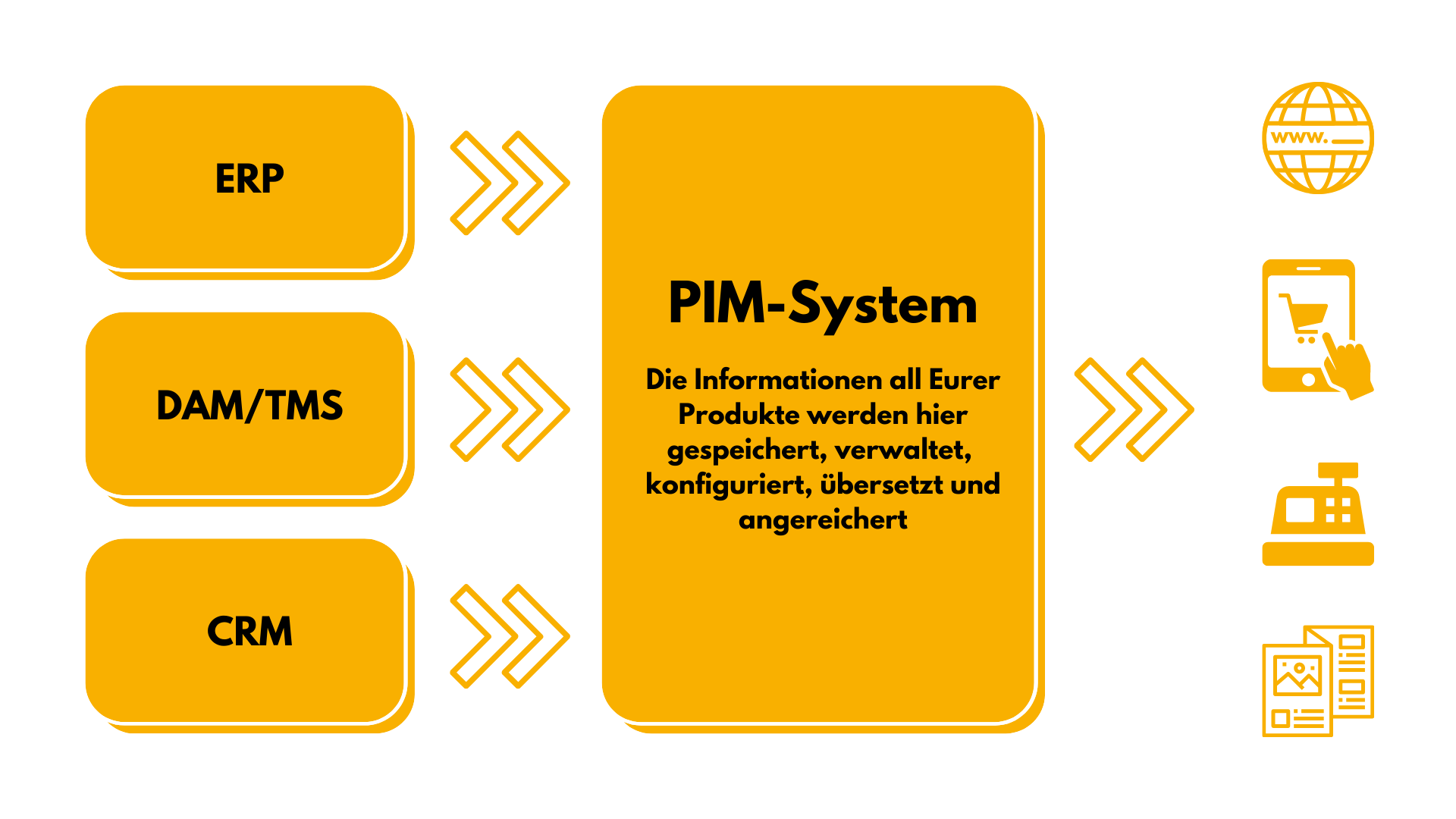
A PIM system is responsible for that.
Product Information Management Solutions are the crucial point in the information supply chain. Correct use saves time, promotes workflows, and increases the satisfaction of your customers.
The work of a PIM software therefore looks like this:
- Input: The PIM system is fed with all manufacturer texts, videos, images, and other product data from ERP software, DAM software, CRM systems, TMS tools and from suppliers.
- Maintenance: Then the PIM system is enriched with further data. Usually by the product management, the production, the purchase, the marketing, and the customer service.
- Use of data: The last step involves the use of data at various internal locations and in public communication. The product information has a big influence on the customers' point of sale and should therefore appear abundantly on the website, in the online shop, other internet appearances, catalogues and print media.
Empfehlenswerte Product Information Management (PIM) Software
Auf unserer Vergleichsplattform OMR Reviews findest du weitere empfehlenswerte Product Information Management (PIM) Tools. Wir stellen über 80 Lösungen vor, die speziell auf die Bedürfnisse von Unternehmen und Marken zugeschnitten sind, die effizientes Produktinformationsmanagement benötigen. Diese PIM-Software bietet umfassende Unterstützung in allen Aspekten des Produktinformationsmanagements. Nutze diese Gelegenheit, die verschiedenen Softwarelösungen zu vergleichen und dabei auf authentische und verifizierte Nutzerbewertungen zurückzugreifen:
These benefits are offered by PIM tools, which is why you as an e-commerce company should use a PIM solution
- Quick access for all departments to all product information
- Efficient onboarding for new partners
- Acceleration of work processes
- A safe place for the most important product data
- Allows a high quality content of information
- Saves many resources that would be required to use Excel spreadsheets or other tools to keep the information up to date
- Allows all departments to work more efficiently
- Reduces complaints and increases customer satisfaction, as they have more product details available before purchase
- Promotes earlier reaching of the customers' point of sale
- Prevents the dissemination of false information when stored in different formats, in different places
- Accessible via cloud for every employee
- Many different formats can be stored: Meta-data, images, videos, audios, texts, technical information, marketing data and more
Conclusion: The right PIM system for every need
The range of PIM systems shows that a suitable solution exists for every company size and requirement. While tools like entitys.io score points especially in the B2B mid-market with an intuitive interface and fast onboarding, platforms like Pimcore and Akeneo offer great flexibility for complex data structures and growing product ranges through their open-source and omnichannel approaches, respectively. ATAMYA impresses with a modern cloud architecture and AI integration, while mediaSolution3 stands as an established solution for stable multichannel publishing in the mid-market. ANTEROS sets standards particularly in technical industries such as automotive, electrical, and construction/HVAC through the tight integration of PIM, DAM, and print engine, while mediacockpit impresses with a freely configurable data model, even for very large volumes of product data. Ultimately, the deciding factor is the balance between the desired flexibility and the implementation effort.
Disclaimer: All prices and features are based on publicly available information from the respective product pages (as of: July 2026). Changes by the providers are possible.