Table of contents
- AI-ready vs. agent-ready: What the difference actually means for B2B retailers
- What is the Agentic Commerce Protocol (ACP) – and what is it not?
- ACP, UCP, MCP and AP2 compared: The protocol stack for Agentic Commerce explained
- The Agentic Commerce Maturity Model: 6 stages, from invisible to autonomous
- How is product data made agent-ready for Agentic Commerce?
- Governance in Agentic Commerce: How AP2 mandates ensure accountability and control
- Which tools and providers can help you get started with Agentic Commerce?
- What is the most effective first step for B2B companies in agentic commerce?
Agent-ready rather than just AI-ready: in the field of Agentic Commerce within B2B retail, this distinction determines whether your company is even noticed by AI agents making independent purchasing decisions, or whether it simply remains invisible to them. Many retailers and manufacturers have invested in AI visibility over recent months: structured data, better product descriptions, optimisation for ChatGPT, Gemini and the like. That’s what it means to be AI-ready. However, whether a shop can actually work with agents that independently compare, negotiate, order and pay is an entirely different matter. In this article, I’ll show you the maturity model that will help you find out in just a few minutes which stage your company is currently at.
AI-ready vs. agent-ready: What the difference actually means for B2B retailers
An AI-ready shop provides clear information, whilst an agent-ready shop supplements this information with secure and executable functions. The key difference lies between information processing and the ability to take action.
AI-Readiness primarily describes the ability of a digital offering to be found and interpreted by AI systems. To achieve this, retailers optimise product pages, guides and FAQs with unambiguous product names, structured data and schema markup. Added to this is Generative Engine Optimisation, or GEO for short. The term Answer Engine Optimisation (AEO), which is sometimes used synonymously, refers to the optimisation of content for AI-based search and answer systems such as ChatGPT, Gemini, Perplexity and others.
GEO and structured data increase the likelihood that an AI system will describe products correctly or include them in a recommendation. However, they do not yet enable a reliable transaction.
In a B2B context, agent-ready also means that a procurement agent on the customer’s side can automatically retrieve framework agreements from your system, identify tiered pricing and trigger repeat orders. This is precisely what makes Agentic Commerce more complex in a B2B context than in traditional retail business.
For example, a buying agent needs answers to the following questions:
Is the product available in the required quantity?
What is the price applicable to the relevant customer account?
Does the item meet the required technical standards?
What is the delivery time for this specific destination?
Is the agent permitted to initiate the purchase on their own initiative?
Does the order require a cost centre or additional approval?
In B2B trade in particular, this information is often subject to change. Customer-specific product ranges, tiered pricing, framework agreements, credit limits, minimum order quantities and role-based models cannot be reliably deduced from general product descriptions. AI agents require up-to-date data, defined interfaces and verifiable authorisations to handle this.
AI-Readiness is therefore primarily a goal relating to visibility and interpretation. Agent-Readiness, on the other hand, refers to an operational capability. In my view, companies should assess both goals separately within their
AI strategy, but ensure that they build on one another from a technical perspective.
What is the Agentic Commerce Protocol (ACP) – and what is it not?
The Agentic Commerce Protocol (ACP) standardises communication between an AI agent and a retailer’s backend during a purchase, without leaving the chat. OpenAI and Stripe developed the protocol for the Instant Checkout feature embedded in ChatGPT and published it as an open standard.
Using ACP, an agent can exchange structured checkout information, request orders and process responses from the retailer. Technically, ACP consists of several modules: a Cart and Feed module for the product catalogue and shopping basket, a Checkout module for the actual completion of the purchase, a Delegate Payment module through which payment tokens are securely transferred between the buyer, agent and the company, and a Delegate Authentication module which, e.g. via OAuth 2.0, ensures that the agent is authorised to act on behalf of the buyer. It is important for legal classification that the merchant generally remains the Merchant of Record – that is, the party legally responsible for the sale, for paying VAT and for handling refunds and customer service – even if Stripe or another payment service provider handles the processing in the background. This clarity is one of the reasons why numerous Shopify merchants now offer Instant Checkout in ChatGPT without having to abandon their existing payment and tax processes.
This division of roles is relevant to the strategic assessment. Agentic Commerce does not automatically mean that retailers hand over their business logic or customer relationships to an AI platform. A checkout protocol transmits the intention to purchase and the information required for the purchase. Decisions regarding acceptance, price, stock and fulfilment continue to be made by the retailer’s commerce backend.
However, ACP does not fulfil all the requirements for agent-based trading:
The protocol does not correct incomplete product data.
It is not a substitute for an ERP, PIM or order management system.
It does not define the entire internal approval process for B2B procurement.
It does not guarantee visibility in agent-based product recommendations.
It does not transform an outdated product feed into a real-time interface.
Instant Checkout is therefore simply the outwardly visible transaction layer. Underlying this are product data, identities, business rules, payment authorisation and governance.
ACP, UCP, MCP and AP2 compared: The protocol stack for Agentic Commerce explained
ACP and UCP describe commerce processes, MCP provides data and functions for AI applications, and AP2 documents the authorisation of an agency-initiated payment. The protocols fulfil different tasks and can complement one another within a commerce architecture.
Protocol | Main task | Key question | Implications for traders |
|---|
MCP (Model Context Protocol) | Connecting AI applications with data and tools | What data and functions is the agent permitted to use? | Makes internal information and actions available to agents |
ACP (Agentic Commerce Protocol) | Coordinates the purchase and checkout process between the agent and the retailer | How does the agent pass a purchase to the commerce backend? | Supports agent-based checkout processes, including Instant Checkout in ChatGPT |
UCP (Universal Commerce Protocol) | Standardising commerce functions across all channels | How do platforms, merchants and payment service providers communicate? | Covers checkout, orders, identity and other e-commerce components across all platforms |
AP2
(Agent Payments Protocol) | Proving the intention and authorisation of a payment | Who authorised the purchase, and under what conditions? | Provides authorisation and auditability for agent-based payments |
The Model Context Protocol (MCP) was originally developed by Anthropic and is not specifically designed for e-commerce. An MCP server can provide resources and executable tools in real time, such as a stock enquiry or a quotation function. However, MCP does not specify how a shopping basket, checkout or order must be structured from a technical perspective.
The Universal Commerce Protocol (UCP) was developed by Shopify in collaboration with Google and covers the entire lifecycle, from product search through comparison to payment, and operates on a discovery principle: merchants and agents publish their respective capabilities, and the system calculates the overlap. It standardises building blocks such as checkout sessions, order updates, payment processing and identity linking. Businesses can integrate with UCP via traditional APIs, MCP or Agent2Agent.
The Agent Payments Protocol (AP2) was developed by Google, has since been handed over to the FIDO Alliance, and adds a layer of trust and proof. Cryptographically signed digital mandates document which action a user or a company has authorised. An Intent Mandate records the original purchase intention; a Cart Mandate confirms the exact items and price once approved; and a Delegated Task Mandate allows automated purchases under predefined conditions. This chain of mandates is of particular interest for B2B procurement processes because it maps out a traceable approval workflow, as is required by procurement departments in any case.
The Agentic Commerce Maturity Model: 6 stages, from invisible to autonomous
I distinguish between six progressive maturity levels in the Agentic Commerce Maturity Model, ranging from ‘invisible to agents’ to ‘autonomous trading partner’. I currently see most B2B companies as being between Level 1 and Level 2.
Level of maturity | Description | Key feature | Typical signal |
|---|
0 | Invisible | No structured data; bot access partially blocked | Agents either cannot find products at all or find them incorrectly |
1 | AI-ready | Machine-readable data, schema markup, GEO-optimised content | AI systems quote you, but link to the website |
2 | Real-time capable | Product data accessible in real time via, for example, the MCP server | Agents can check the latest availability and prices |
3 | Agent-ready (Basis) | ACP/UCP checkout integrated as a purchase enquiry | An agent prepares the checkout; a member of staff approves the order and payment |
4 | Agent-ready (Governance) | AP2 mandates, clear Merchant-of-Record rules, monitoring | The agent completes purchases within the scope of clearly defined limits |
5 | Autonomous trading partner | Agent-to-agent negotiation | Both agents coordinate demand, supply and terms, and conclude transactions independently within the scope of their mandates. Human intervention is required only in exceptional cases or when authorisation limits are exceeded. |
In the context of B2B trade, Level 5 works in practice as follows, for example: a purchasing agent monitors stock levels in the customer’s ERP system and, should stocks fall below a threshold, automatically triggers a reorder in the supplier’s system under an existing contract, without the need for an email or phone call. How such autonomous decision-making capabilities can be seamlessly integrated into existing enterprise systems is described in more detail in the article on
Agentic AI in ERP systems. My personal assessment: Level 5 is still the exception today, but it is the goal towards which the entire protocol development of ACP, UCP and AP2 is working. Any B2B provider that is not currently aiming for at least Level 3 will, in the long term, cede precisely these automated order volumes to competitors who invested earlier.
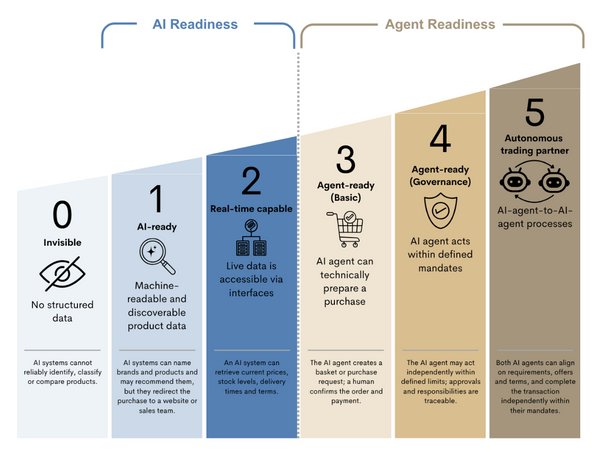
Figure 1: Agentic Commerce Maturity Model – from AI-ready to agent-ready
Source: Own illustration
How is product data made agent-ready for Agentic Commerce?
Product data is agent-ready if it is structured, consistent and accessible in real time via an interface. Free-text descriptions written for humans are not sufficient for an AI agent. An agent does not compare products based on advertising texts, but rather on attributes such as price, availability, dimensions, certifications, delivery time, reviews, etc.
This starts with the basics, such as GTIN or EAN as unique identifiers and Schema.org markup for product data, continues with consistent attribute names across ERP, PIM and online shops, and culminates in an integration that is immediately updated even when prices or stock levels change. Traditional feeds, synchronised once a day, are often no longer sufficient for agents. An analysis by Gartner illustrates the cost of poor data quality: according to the analysis, it incurs average costs of at least 12.9 million US dollars per company per year. At the same time, information gathering in B2B commerce is increasingly shifting towards AI-supported systems: according to Forrester, 94 per cent of the business buyers surveyed already use AI in the purchasing process. This makes the quality of the product data provided a competitive factor. For an agent who compares several suppliers in a matter of seconds, a data gap immediately becomes a deal-breaker, not just a factor leading to a lower ranking.
In my view, data readiness is therefore the least glamorous but most important investment on the path to becoming agent-ready, even before any protocol decisions are made, and it is not a one-off import task either. The article on
AI-supported product data quality describes in detail how product data quality can be systematically improved with the help of AI, for example through automated attribute enrichment and quality control in modern PIM systems.
In B2B commerce, a product data audit should check at least the following fields for completeness, accuracy, consistency, uniqueness and timeliness:
unique product ID, GTIN or manufacturer’s part number
standardised technical attributes, including units
compatibilities, alternatives and exclusion criteria
certificates, standards and safety documents
customer-specific price and contract status
stock, delivery time and delivery area
minimum quantity, packaging unit and pricing tiers
data source, update time and responsible role
Governance in Agentic Commerce: How AP2 mandates ensure accountability and control
Governance determines whether a sale concluded by an agent can be clearly attributed to a specific party from a legal, financial and organisational perspective. Without clear rules on authorisation, liability and escalation, agent-based commerce remains a risk rather than a reliable sales channel. This applies to B2C, but is even more critical in the B2B environment, with its framework agreements, approval processes and audits.
A B2B procurement agent could, for example, reorder consumables up to a specified amount from suppliers who have already been approved. A new product, an unknown merchant or a price exceeding the tolerance limit, on the other hand, triggers an approval process. AP2 mandates can technically document such authorisations. With its mandate model, AP2 addresses three questions:
Authorisation – have the users really granted the agent this specific authorisation?
Authenticity – does the agent’s enquiry actually reflect the person’s intention?
Accountability – who is liable if something goes wrong?
Without a robust answer to all three questions, I would not recommend that any company allow automated orders above a certain value threshold. In addition, clear escalation procedures are required: UCP explicitly provides for a ‘handover’ to a human agent when an agent reaches their limits. However, the company must still define the operational policy and the decision-making rules derived from it itself.
For this purpose, enterprise-level agentic AI requires a machine-readable set of rules. Key components include:
roles and identities for users, agents and traders
permitted product ranges, suppliers and maximum amounts
approvals in the event of discrepancies or uncertainty
separate read, write and payment rights
tamper-proof transaction logs
time-limited and revocable authorisations
protection against prompt injection and manipulated product data
responsibilities regarding unsuitable purchases and complaints
Governance is therefore not merely an IT issue, but a management task. Regulatory frameworks such as the EU AI Act must be taken into account from the outset, rather than being imposed retrospectively – a key point which is also explored in greater depth in the article on the
AI strategy for businesses. For larger organisations seeking to transition AI projects from the pilot phase to live operation, it is also worth looking at structured process models, as described in the article on
AI consultancy for enterprise organisations. In this context, the interplay between data architecture, processes and guidelines plays a greater role than any individual technology decision.
Getting started rarely requires a single Agenic Commerce tool, but rather a robust combination of four building blocks: a database that can be accessed via an MCP-compatible backend or a feed; a checkout integration for ACP or UCP (usually via the existing payment service provider); a monitoring system that makes agent traffic visible in the first place; and governance. Ready-to-use software is now available for all these building blocks, though it differs in practice in terms of, for example, model independence or data sovereignty.
When evaluating solutions, open APIs, granular authorisation models, documented data sources, logging support and observability are more important than a convincing demo. The reversibility of automation is also relevant. Organisations must be able to deactivate processes, halt transactions and return responsibilities to staff.
What is the most effective first step for B2B companies in agentic commerce?
The most effective first step is almost always to clean up and organise your own product data, because every subsequent stage of maturity builds on this, and the effort pays off immediately in terms of traditional visibility and GEO rankings. Only then is it worth discussing a specific checkout protocol.
Specifically, I recommend that B2B companies follow this sequence over the next 90 days:
Assessment (weeks 1–2): Honestly assess product data, schema markup and current visibility in AI responses using the tiered model above.
Ensure data readiness (weeks 3–6): Standardise attributes; set up a real-time feed or MCP connection for at least one product category.
Pilot with a checkout protocol (weeks 7–12): Test ACP or UCP on a manageable product range, including clear governance rules and a value limit for automated purchases.
That’s what sets apart a company that’s just talking about Agentic Commerce one year from one that’s already generating revenue through it. For me, that is precisely the crux of the whole maturity model: it’s not about reaching the highest level as quickly as possible, but about consciously deciding which level is actually the right one for your business model and your customer base, and then properly underpinning that decision technically and organisationally, rather than leaving it to chance.


