Table of contents
- The Green Marketing Definition
- Advantages of Green Marketing
- What are the disadvantages of Green Marketing?
- What is the difference between Green Marketing and Greenwashing?
- Best Practices for Green Marketing
- Think ahead. Think with. For the company and for the consumers. To truly change something in the long term is an ambitious endeavor that is not achieved within a few days. Instead, persistence, patience and motivation are required here.
- With green marketing, as with everything in the company - innovation and further development are important and necessary in order to be sustainably successful in the long term.
- (ESG)
- Green marketing, as a
Environmental protection, sustainability, fair trade, organic, regional, permaculture, working conditions, circular system, deposit, recycling ... the list is long with things that a "good" company needs to take care of if it wants to convince its customers in a sustainable purchase decision (#play on words).
The change in values in society, or perhaps even just the social pressure to be more sustainable and to deliberate, not only reflects in personal lifestyle, but also in the way companies market their products and services. Green marketing, as an approach that focuses on ecological sustainability, is becoming increasingly important.
The Green Marketing Definition
Green marketing, also referred to as sustainable marketing or green marketing , is an approach in which companies market their products and services, considering environmental impacts, social responsibilities and ecological factors. It is about creating conditions within the company, to promote and develop environmentally friendly products and practices, while at the same time sharpening consumer awareness of environmental issues.
As a company, you can ask yourself: how sustainable is my product, the manufacturing processes, the logistics? And at the same time: What is really important to my customers and how do I implement sustainable advertising?
Green marketing is primarily about advertising and communication measures, sustainability marketing strategies, as opposed to CSR (Corporate Social Responsibility).
Implement your green marketing on environmental and resource protection, because as a company with your "undertakings" you want to ensure that you have no negative or even a positive impact on the environment. Do human and employee rights belong on your agenda within and outside your company? Very good - do good and talk about it!
Corporate Social Responsibility also takes it upon itself to commit to social engagement, to counteract corruption and lobbying, and to provide maximum transparency.
Good green marketing strategies can in turn lead to the development of new sustainable products and rethinking processes or company values.
Who again is this sustainability? Read for example the OMR Reviews on the topic Sustainability Management.
Advantages of Green Marketing
Green marketing companies have the advantage that they can beneficially work on their brand image. Clear, honest statements, transparency, even when things are not running so green and even the cooperation with credible partners or other companies, suppliers, even the right customers contribute to the authenticity of your brand. And that also makes your green marketing strategy successful.
In the best case, you must compete less - you have one or more sustainable USPs, which may even ensure that consumers buy more loyally and even accept higher prices, because they trust your brand and your products and have made their contribution to sustainable shopping through you.
Despite initially higher investments to become green, higher profits can be made over time - loyal consumers, innovative and efficient products and production ...
To find out what is important to your online customers, you can take a look at the best marketing analytics tools and try them out.
What are the disadvantages of Green Marketing?
If you polarize too much in your Green Marketing Strategies, the addressees may feel motivated and engaged instead of feeling rebuffed and cornered - changes in (buying-) behavior are hard and may encounter resistance. Moreover, sustainability is very subjective and everyone has their own limits - do I pay attention to the fiber of my sweater or even to the cultivation and the certification or even to the production conditions in the respective country.
Disadvantageous examples of green marketing are when your communication is directly linked to sales promotions. Then, consumers have the feeling that you only want to sell, rather than sincerely mean your sustainable thoughts.
In the worst case, your green marketing strategy is still perceived as greenwashing!
What is the difference between Green Marketing and Greenwashing?
In contrast to strategic green marketing, greenwashing usually only promotes a sustainable(er) aspect of a company or a product. For example, reusable packaging for a product that is itself not sustainably and fairly produced or that does not pay attention to responsible business partners.
Greenwashing is also about the relation of green marketing costs to financial investment in environmental protection: higher advertising expenditures for a green image instead of change processes for a better socio-ecological responsibility is just greenwashing.
Best Practices for Green Marketing
A true green marketing best practice case is, for example, the
mission of Fritz-Kola to use locally bottled reusable glass bottles instead of plastic or cans.
"Kiss my glass: the new glass refill" - because Fritz-Kola doesn't want to produce waste. This applies to the products as well as to everything around it.
More reusable bottles, less plastic is the goal for the entire beverage market. With a new Fritz partner, a highly efficient bottling plant was opened in Eilenburg near Leipzig, and transport routes were shortened.
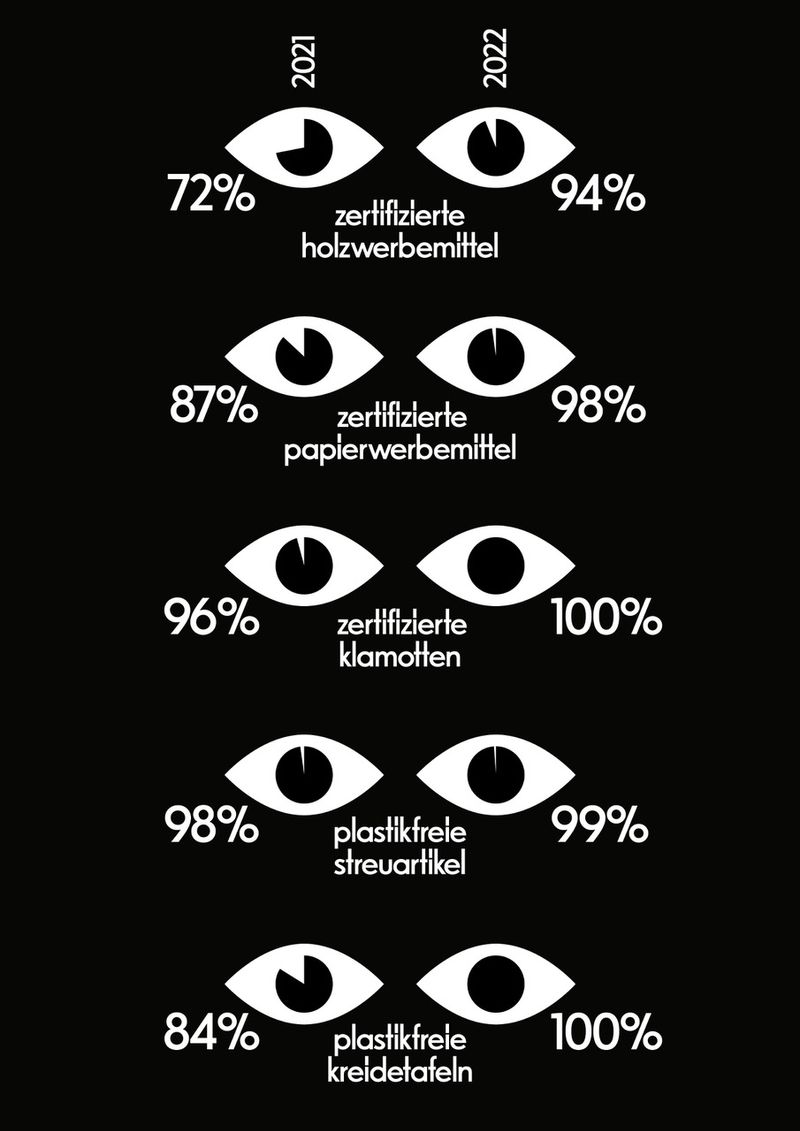
With the Fritz initiative PFAND GEHÖRT DANEBEN, the company has been drawing attention to the situation of deposit collectors for years. More than one million people in Germany are actively collecting deposits - the majority in addition to their regular job. Further interim targets by 2025, which Fritz-Kola communicates and wants to implement, are:
- 20% less water, heat and electricity per bottle (currently -11%, -4% and +11%)
- 90% organic certified raw materials for our products (excluding sugar; currently 67%)
- 100% sustainable mobility of the fritz people
- Over 95% sustainable advertising materials
At Textilwerk, every home textile can be ordered at any time thanks to on-demand production, but only what is purchased is actually produced. The online shop features different designs from over 120 selected artists, which are printed on various fabric qualities at the partner company in Poland and sewn into the ordered home textile by permanently employed seamstresses. The on-demand production makes it possible to handle the existing resources appreciatively and moderately.The
Green Software concept refers to the approach of making software development and use more environmentally friendly and sustainable. By optimizing code, managing data efficiently and using energy-efficient algorithms, the software's energy consumption can be reduced. At the same time, software solutions can help optimize the cooling requirements and load distribution in data centers. By using virtualization, hardware utilization can be increased, which reduces the number of physical servers and thus leads to less resource consumption. Read more about
sustainable IT procurement in another OMR Reviews.Which strategies for Green Marketing are helpful?
Think ahead. Think with. For the company and for the consumers. To truly change something in the long term is an ambitious endeavor that is not achieved within a few days. Instead, persistence, patience and motivation are required here.
Full transparency
- In an opaque industry in the example of Textilwerk, the company wants to give customers a clear overview. In the future, every step of production should be traceable, until the product has arrived in its new home. This applies from yarn for seams to packaging. How followfish for home textiles! And even if not all processes within your company are sustainable yet, the path to this can be communicated openly and honestly.Building a cycle
- Highest quality and certified raw materials make it possible for textiles / electrical appliances / carpentry work / etc. to bring long-lasting joy.But the 'after' is also important and you can think about how your products can get into another cycle within your company. Up- and recycling projects may be on the list of ideas as well as second-hand shops.
You can of course rethink this internally for workflows or other work and logistics processes.
Keep the higher goal in mind –
What is your vision? Set high goals and adjust your standards. Let's discuss this using the example of packaging for natural pralines. Starting with cardboard boxes and deep-drawn inlay made of cornstarch (which still looks like conventional plastic), the packaging was completely converted to food-grade cardboard. Here you can pay attention to how certified the paper fiber and the coating is and where it is produced and manufactured – in Germany or in Asia, with container delivery. If you first "only" implement the cardboard packaging, that's also good and at the same time you can continue to talk about your goals of becoming even more sustainable.What do companies need to pay extra attention to in Green Marketing?
Empfehlenswerte Marketing Analytics Software
Auf unserer Vergleichsplattform OMR Reviews findest du weitere empfehlenswerte Marketing Analytics Software. Dort haben wir über 90 Tools für kleine und mittlere Unternehmen, Start-Ups und Großkonzerne gelistet, die dich in allen Bereichen der Verwaltung, Evaluierung und Kontrolle von Marketingmaßnahmen unterstützen. Also schau vorbei und vergleiche die Softwares mithilfe der authentischen und verifizierten Nutzerbewertungen:
With green marketing, as with everything in the company - innovation and further development are important and necessary in order to be sustainably successful in the long term.
Engage
all stakeholders and let them participate in your green marketing strategies. Perhaps even prepare how the green vision can be implemented in practice and in detail. Not only consumers, but also teams and colleagues struggle with changes.Check out our article on OMR Reviews about
Successful Customer Journey
.Which tools can be used for Green Marketing?
(ESG)
Environment, Social, Governance – stand for the major goals of our time: environmental and climate protection (Environment), social cohesion (Social) and good and sustainable corporate governance (Governance). With the
App, all
Code Gaiarelevant key figures
for environmental or ESG reports can be collected, analyzed and optimized in one place. In a second step, sustainability reports, including fact sheets or ESG reports, can be created in PDF or Word format at the touch of a button., is a Climate Intelligence and supply chain platform to decarbonize the supply chain. The platform automates time-consuming processes and saves costs – from data collection to monitoring and engagement, companies receive extensive information to manage and implement their climate goals in the supply chain.
The Climate Choiceis a mobility management tool and offers a smart tool to manage employee mobility, account for it tax-compliant, and be able to reward sustainable mobility behavior.
Mobikois a digital Carbon-Action-Platform that covers the corporate carbon management process from beginning to end. The tool especially enables the optimization of the ecological and economic footprint along the entire supply chain by automatically matching the emissions profile with highly effective & cost-effective decarbonization solutions on the market.
CozeroWith the web-based software
users receive an individual tool with which all flights, journeys and transportations of a company can be recorded intuitively and easily, in order to be able to compensate them at the point of choice and with the desired project.
CO2mpensioConclusion
Green marketing, as a
response to the growing issue of sustainability, is gaining relevance. Transparent communication, social engagement, and clear values are key in building an authentic brand image. Companies should not only rely on environmentally friendly products, but also consider the entire life cycle and integrate innovative approaches like recycling and second-hand options.The road to sustainable success requires clear visions and continuous development. Smart tools and apps can support companies in pursuing environmental goals and reporting transparently about their progress. Green marketing should not be just a marketing strategy, but a comprehensive
company philosophy that drives changes in thought and action, thus becoming a positive force for the economy and society.sein, die Veränderungen im Denken und Handeln vorantreibt und so zu einer positiven Kraft für die Wirtschaft und Gesellschaft wird.


