Table of contents
- Phase 1: Determine Measurable Business Goals
- Phase 2: Identify Target Group(s)
- Once you have created one or more target customer profiles (buyer persona), the next step is to use various tools and try to understand the needs and intent of a search for information through search engines or social networks.
- At this point, your digital marketing strategy uses the tool of content marketing. Content marketing is important because it is the process that decides which type of content to publish when and where. I prefer to do this step before launching and running a campaign because it is more efficient to prepare the content pool in advance rather than having to do it each time you launch the campaign.
- Search engine optimization is one of the most effective digital marketing strategies, but it has its pitfalls. The work takes time. Unlike other digital marketing strategies, it can take 4 to 6 months for a SEO campaign to see results. That's a long wait period, which is why most decision-makers initially focus on other, supposedly quicker channels (e.g., Facebook ads, Google ads).
- But not all advertising channels are created equal. Based on your previous analysis (Phase 2 and 3), you now need to decide which platforms are best suited for your target audience.
- This is referred to as “retargeting” or “remarketing”. With retargeting, you can show specific ads to users who have visited your website but have not yet converted.
- It is best to evaluate your campaigns using metrics (KPIs) and other metrics. The key metrics for any type of online marketing campaigns are:
- The graphic design tool supports you in creating individual pieces of content for your online marketing strategy, by providing you with thousands of templates for whitepapers, social media posts, and co.
- Then you start with SEO. SEO is the most effective digital marketing channel, but not the fastest. While you wait for your SEO to deliver results, you can start testing paid advertising channels by running test campaigns with relatively smaller budgets
In fact, it is the same digital marketing strategy that we have employed over the years to make our own business and those of our clients successful with online marketing. If you want to learn how to increase your reach and boost your traffic with an effective online marketing plan, this online marketing strategy example is just right for you.
A
digital marketing strategy is an action plan that describes how one or more online marketing channels are used to reach a specific target group. It includes a series of steps to accomplish specific online marketing goals. Strategic online marketing is important because it helps you achieve your business goals using your online marketing. The person responsible for developing and implementing the online marketing strategy should usually be the company's Digital Marketing Manager or an external consultant.
These are the phases to consider when developing an effective online marketing strategy:
- Define measurable business goals
- Identify target group(s)
- Understand needs and search intent
- Create content pool
- Start with SEO
- Use paid advertising channels (Ads)
- Retargeting and personalization
- Evaluate, Analyze and Optimize
Phase 1: Determine Measurable Business Goals
The first step in developing an online marketing strategy is to define your business goals. In other words, determine what you want to achieve with digital marketing. All the goals that you set must be measurable and specific. Because the great advantage of digital marketing is that all actions are measurable. So you should create your online marketing plan with specific milestones and goals.
Some typical goals include:
🎯 Increase brand awareness
🎯 Increase organic traffic
🎯 Increase sales closures
🎯 Gaining Email Subscribers
🎯 New requests via social media
The above points are a good starting point, but still too vague. Strategic online marketing goals should therefore be further specified:
🎯 Increase brand awareness through:
- Increase Facebook followers to 10,000
- Reach through Facebook Ads to 400,000
- Increase YouTube video views to 10,000
🎯 Increase organic traffic:
- Improve rankings for keyword “XY”
- New Blog Article for keyword “XY”
- Update existing blog articles with keyword “XY”
A good way to set measurable goals is the top-down approach. Start by defining your business goals and translate them into online marketing goals to help you reach your business goals.
Phase 2: Identify Target Group(s)
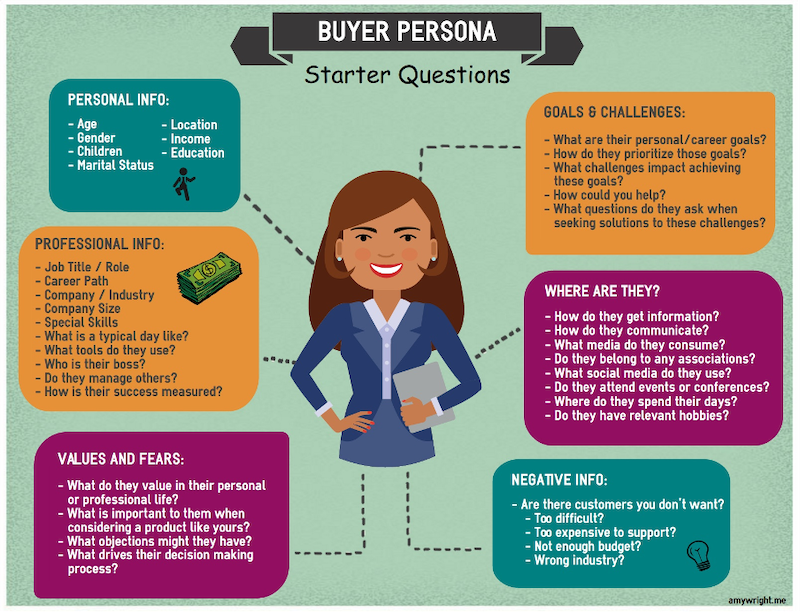
The second step is to identify your target audience. In other words, define exactly who you want to address with your campaign. It is not incorrect if some marketers consider this the first step of the process. The definition of the target group should definitely take place at an early stage, before you initiate the next phase of your marketing strategy.
What does it mean to identify a target audience? Define precise characteristics of people who might be interested in your product. In identifying the target audience, you should consider points such as:
🕵️♀️ Location / Country
🕵️♀️ Age Group
🕵️♀️ Gender
🕵️♀️ Education Level
🕵️♀️ Marital Status
🕵️♀️ Profession
🕵️♀️ Interests
The exact details depend on your industry and the product or service you want to market with your online marketing strategy. A good way to start creating buyer personas is to analyze the data that may already be available to you. For this, check your Google Analytics Reports, Google Ads Reports, Facebook Insights, Facebook Campaign Data, and draw initial insights from them. Another good option is to interview people within your target group to enrich your target group definition with valid results.
Buyer Persona Framework
Phase 3: Understand Needs and Search Intent
Digital Sales Funnel
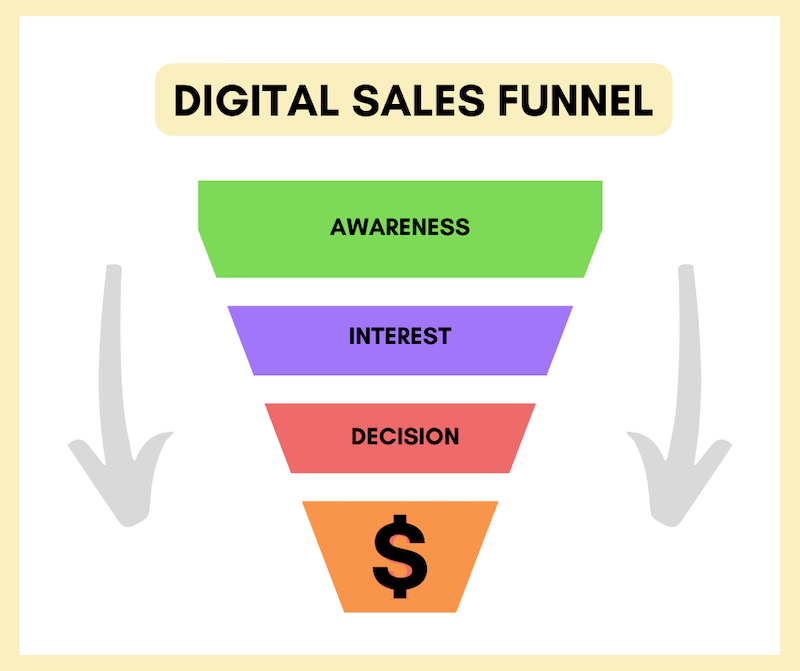
There are two approaches to managing this process. The first is to take a typical digital sales funnel and determine what your target audience is interested in at each stage. The second method is to take the various personas you created above and create a separate sales funnel for each. I recommend this method because it makes it easier to design and implement special digital marketing campaigns for each target group.
To better understand this, I would like to illustrate two examples:
An agency provides digital marketing services for small businesses and also offers online courses. People looking for a service have a completely different intent and thus a different profile than those who want to book an online course.There can also be differences within target groups in the same market segment. Digital marketing beginners have different training needs than experienced marketers and thus the buyer persona also deviates.
So if you analyze each buyer persona individually, you can create a more accurate plan of how your content, your product, or your service can help solve the problems and needs of your ideal customers.
So, what is search intent all about? Let's take a look at that:
In digital marketing, the needs of users are expressed through search queries. When users enter search queries on Google, they have certain intents, and if your product or your service does not match these intents, your digital marketing strategy will fail. That's why it's important to start keyword research from the beginning and capture all topics, keywords and phrases throughout the customer journey, from first contact to sale.
Phase 4: Create a Content Pool
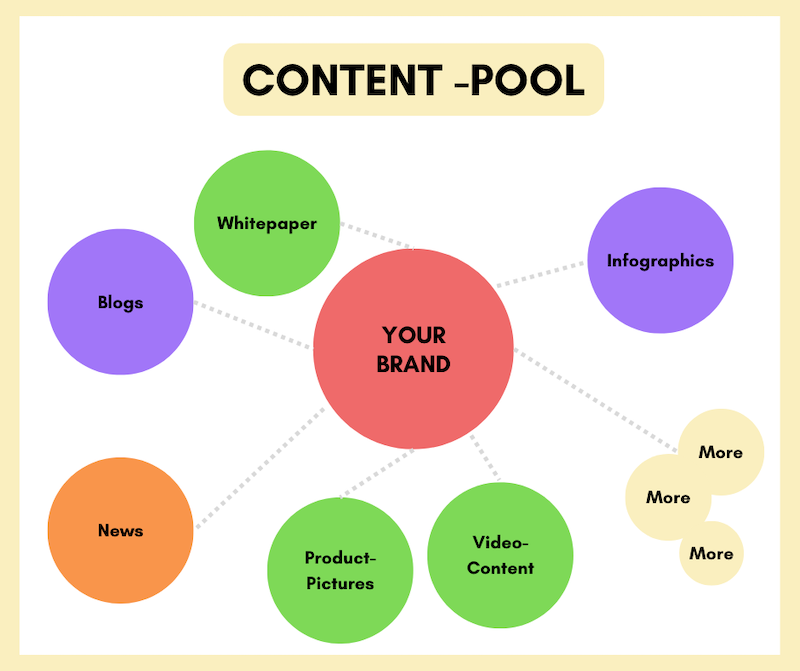
The next strategic step is to create a content pool. You now know your target group and their needs. So now it's time to create different types of content that you can use in your campaigns. Digital content for your online marketing strategy can be blog posts, infographics, images, videos, podcasts, whitepapers, and anything else you can publish on your website or social media.
At this point, your digital marketing strategy uses the tool of content marketing. Content marketing is important because it is the process that decides which type of content to publish when and where. I prefer to do this step before launching and running a campaign because it is more efficient to prepare the content pool in advance rather than having to do it each time you launch the campaign.
Example Content Content Pool
If you follow the individual phases in the order described (set goals, create customer personas, determine needs and search intentions), you definitely have all the information you need to work on your content pool.
Phase 5: Start with SEO
A strategic decision that can positively impact your online marketing activities is an early start with search engine optimization (SEO).
Search engine optimization is one of the most effective digital marketing strategies, but it has its pitfalls. The work takes time. Unlike other digital marketing strategies, it can take 4 to 6 months for a SEO campaign to see results. That's a long wait period, which is why most decision-makers initially focus on other, supposedly quicker channels (e.g., Facebook ads, Google ads).
It is a good approach from a superficial perspective, but a common mistake is that they forget about SEO and only come back to it when they realize that they cannot build a successful online marketing campaign based solely on paid advertising. A better strategy is therefore to use a part of the marketing budget for SEO from the beginning. At the same time, you can start running paid campaigns and other channels to gather important information for your SEO measures.
This way, you'll reach a point faster where most of your traffic and sales come from SEO, and you'll rely less and less on paid ads, absolutely sustainable.
Now you can start with SEO:
SEO is an extensive topic. Search engines consider hundreds of parameters before deciding which web pages should be displayed for a particular search query in the results.
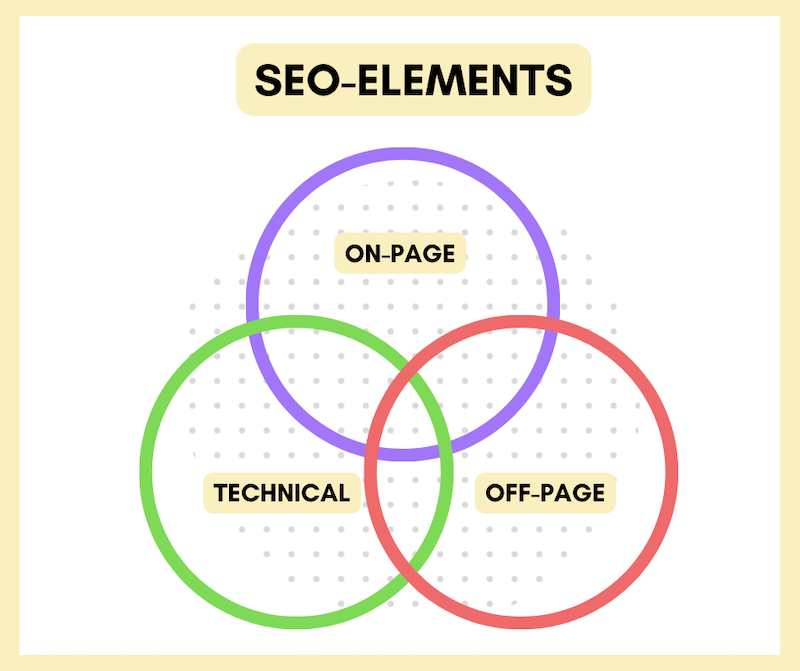
To simplify some of this complexity, SEO can be divided into three core disciplines: technical SEO, on-page SEO, and off-page SEO.
SEO Core Areas
Each process is responsible for optimizing your website for a set of parameters, which then lead to higher placement within the search results and more visitors.
SEO and a good ranking are important because the majority of search traffic is distributed to websites that appear in the first 5 positions of the search results. So if you want to get traffic from search engines, you should appear at the top for search terms related to your topics or at least on the first page.
The best way to start with SEO is a step-by-step approach:
🚀
Step 1:
Check your technical SEO and make sure search engines can easily access your content and index and read it. This is important as any issues in this phase can have catastrophic consequences for your SEO efforts.🚀 Step 2:
Optimize your content for search engines. In Phase 4, you created content that meets the needs of the users. Before publishing, you absolutely need to make sure that the content is SEO-optimized.This means giving the search engines the right signals (through the titles, descriptions, headings, etc.) so they can better understand your content. 🚀
Step 3:
Promote your website and content using backlinks. One of the most important SEO ranking factors is how other websites on the internet “think” about your website. If other relevant websites trust your website and express this trust through a backlink, it is a strong signal for Google that your website deserves to appear in the top spots.If you have never dealt with optimizing your website for search engines, you should definitely include this in your online marketing strategy and get SEO experts or external agencies on board.Phase 6: Using Paid Advertising Channels (Ads)
When you are planning an effective online marketing strategy, you should be aware that you will need to spend a certain portion of your marketing budget on PPC marketing (paid ads).
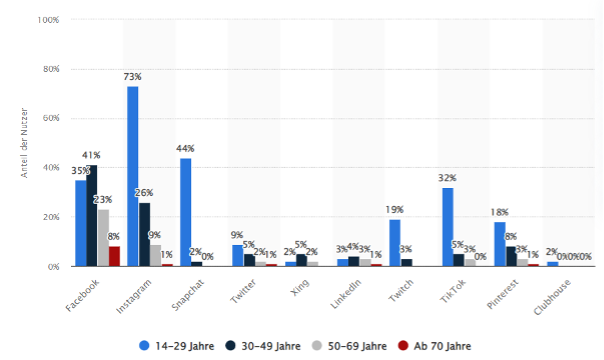
In the following table, you can see how the share of social media platform users is distributed by age groups in Germany in 2021:
Source: Statista 2022
Always start with test campaigns
The best way to find out which platforms you should include in your digital marketing strategy is to run test campaigns.
A test campaign, at worst, only wastes a little bit of budget and at the same time gives you enough data to make an informed decision.
A common mistake made by online marketing managers is to blindly use all their budget on one channel because it is trending, without testing all available channels or considering them.
Here is a list of the most popular advertising platforms you can use to reach your potential target audience.
Facebook Ads
- ideal for almost all types of businesses. Works better for B2C. One of the best platforms for increasing brand awareness.
Instagram Ads - suitable if you want to reach younger target groups, up to about 50 years old.
Twitter Ads - business-oriented. Good for informing your community about updates and company news.
Linked Ads - primarily business-to-business focused. Ideal for specifically targeting decision-makers.
Google Ads - One of the most reliable platforms for bringing targeted traffic to your website through paid search ads.
Google Display Ads - For retargeting purposes and to reach your target audience across various Google products (e.g., YouTube) and thousands of websites that participate in Google AdSense.
Bing Ads - Not as powerful as Google, but a good alternative for bringing more traffic to your website.
Phase 7: Retargeting and PersonalizationUp to now, all the strategies mentioned above have to do with how you can reach more people, but it is equally important to target users who already know your brand, but are not yet customers.
This is a very effective technique that has higher conversion rates and lower CPA (cost per action) than other marketing techniques.
The “Rule of 7” (established by marketing professionals in the 1930s) states that potential customers are more likely to convert when they see or hear an ad at least seven times.
It is not surprising that this rule still holds true today, and remarketing is the way to implement it. The most popular platforms for running remarketing campaigns are Facebook and the Google Display Network.
Re-targeting Theory
The concept is simple. You connect your website to Facebook and Google by inserting a code provided by the platforms (e.g., FB pixel) into your website.
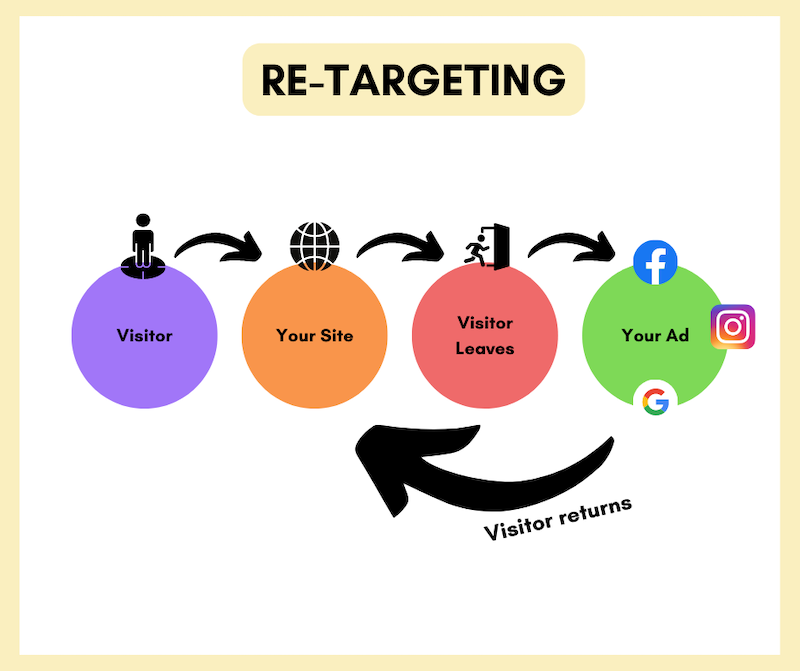
Then you create custom audience lists (Custom Audiences) that contain exactly the people who have visited your website but have not converted.
In the next step, you create campaigns and ads that are shown to these users when they surf on Facebook or visit other websites on the internet.
To make remarketing more effective, you can also add the element of personalization. Instead of treating all visitors as one group, you can add rules to show different ads to people based on the actions they performed on your website.
For example, you could create a retargeting campaign for people who have added an item to their shopping cart but have not paid. To incentivize them to come back and complete the process, you can offer them discount codes through the retargeting ads to make the purchase after all.
Indeed, retargeting should be a strategy that you include in your online marketing strategy from the very start. This way, you are maximizing the return on your spend for paid advertising.
Phase 8: Evaluate, Analyze and Optimize
Digital marketing is a very dynamic industry. The “rules” are constantly changing and it is extremely important that you regularly analyze, evaluate, and optimize your online marketing strategy to stay effective and ultimately successful.
It is best to evaluate your campaigns using metrics (KPIs) and other metrics. The key metrics for any type of online marketing campaigns are:
💡 Number of website visits
💡 Cost per click
💡 Cost per conversion
💡 Click-through rate
💡 Number of conversions
💡 Time on website
💡 Bounce rate
💡 Reach & Impressions
💡 Return on Invest (ROI)
If you have a good analysis system and can track these data for each of your strategy campaigns, making informed decisions will be easier.
Don't forget that a part of your evaluation should be looking for new channels to include in your strategy and thus be able to expand it.
It's always a good idea to take a look at your competitors' strategies and find out which elements of their strategies you can incorporate into your marketing mix.
These tools help you with planning, implementing and controlling your online marketing strategy
We have put together a few tools for you at the end that can help you achieve your goals, among other things:
The graphic design tool supports you in creating individual pieces of content for your online marketing strategy, by providing you with thousands of templates for whitepapers, social media posts, and co.
The tool offers features such as crawling and on-page analysis of your entire site, insights into Google rankings including competitive comparisons, a backlink analysis and link-building tools, as well as continuous monitoring and reporting.
The Adobe Experience Manager combines digital asset management with the efficiency of a CMS to assist you with designing, managing and optimizing the digital customer experience across all channels.
Hootsuite is a social media suite that combines different functions in one tool. Apart from automating post schedules, Hootsuite provides important KPIs and analytics for campaigns and also includes social listening and monitoring functions.
The tool offers 'Predictive Bidding' which automates Amazon Ads, allowing you to choose revenue or click maximizing bid strategies, for example, and be assisted by scientific machine learning technology.
With the tool, you can draft, design, personalize and intelligently send email and SMS campaigns to selected recipients.
Conclusion: How to develop a successful online marketing strategy
A good online marketing strategy is a plan that describes in detail how you can use different digital marketing channels to achieve your business goals. To create an effective digital marketing strategy, you first need to define objectives. Then, by conducting research, yo determine the characteristics and needs of the people you want to reach with your campaigns. Once you have this information, you translate it into content marketing content, always keeping in mind the needs of the target audience. The creation of the right kind of content that meets the needs of the users is a crucial factor for success.
Then you start with SEO. SEO is the most effective digital marketing channel, but not the fastest. While you wait for your SEO to deliver results, you can start testing paid advertising channels by running test campaigns with relatively smaller budgets
Once you have found out which channels contribute most effectively to your business goals, you can focus on these and scale the campaigns. In addition to generating traffic to your website, you also need to incorporate other strategies for converting traffic into customers, such as retargeting. At regular intervals, you should evaluate and optimize your strategy to include new traffic sources and possible trends. And always remember: a vision without strategy will always remain an illusion.
Dann beginnt man mit SEO. SEO ist der effektivste digitale Marketingkanal, aber nicht der schnellste. Während Ihr darauf wartet, dass Eure SEO Ergebnisse liefert, könnt Ihr damit beginnen, bezahlte Werbekanäle zu testen, indem Ihr Testkampagnen mit vergleichsweise kleineren Budgets durchführt
Sobald Ihr herausgefunden habt, welche Kanäle am effektivsten zur Erreichung Eurer Geschäftsziele beitragen, können Ihr Euch auf diese konzentrieren und die Kampagnen skalieren. Neben der Generierung von Traffic auf Eurer Website müssen Ihr auch andere Strategien zur Umwandlung von Traffic in Kunden einbeziehen, wie beispielsweise Retargeting. In regelmäßigen Abständen solltet Ihr Eure Strategie bewerten und optimieren, um neue Traffic-Quellen und mögliche Trends einzubeziehen. Und denkt stets daran: Eine Vision ohne Strategie wird immer nur eine Illusion bleiben.
 Canva
Canva Seobility
 Adobe Experience Manager
 Hootsuite
 ADFERENCE
 Brevo
Brevo


