Table of contents
- Half the industry is rebuilding its pricing model right now
- The seat is losing its role as the lead currency
- When agents do the work, a different budget pays
- Discovery is becoming the new bottleneck
- Prices that no machine can read get replaced
- Conclusion: Pricing is no longer a standalone project
153 software providers told us how they price AI today and what changes they plan to make over the next twelve months. To this end, we worked with our colleagues at hy and Appinio to analyze 4,400 software profiles on OMR Reviews and conducted 23 in-depth interviews. The result: The industry is currently fine-tuning its pricing models, while at the same time, the pool of companies included in price comparisons is shifting.
Key Takeaways
- "Per-seat" pricing faces serious competition as outcome- and credit-based metrics gain traction.
- 80% of surveyed companies plan or evaluate a pricing adjustment within twelve months.
- 41% cite AI search as the biggest change in software purchasing, with 76% already adapting marketing strategies.
- 92% of B2B buyers ultimately choose a product that was on their initial list.
Half the industry is rebuilding its pricing model right now
A year ago, the question in most product meetings was: What should our new AI feature cost? Today it is: How do we sell work that a machine does?
The reason lies in the cost structure. Classic SaaS scaled with practically no marginal cost. Every AI interaction costs real money, every single time. Vendors who stick with a pure per-user model end up in a bind: AI reduces the number of seats the customer needs, while the vendor's own token costs eat into the margin.
In private funding rounds, investors pay a median of 21.2x revenue for AI-native architectures, 8.5x for retrofitted AI features, and 5.5x for legacy SaaS platforms.
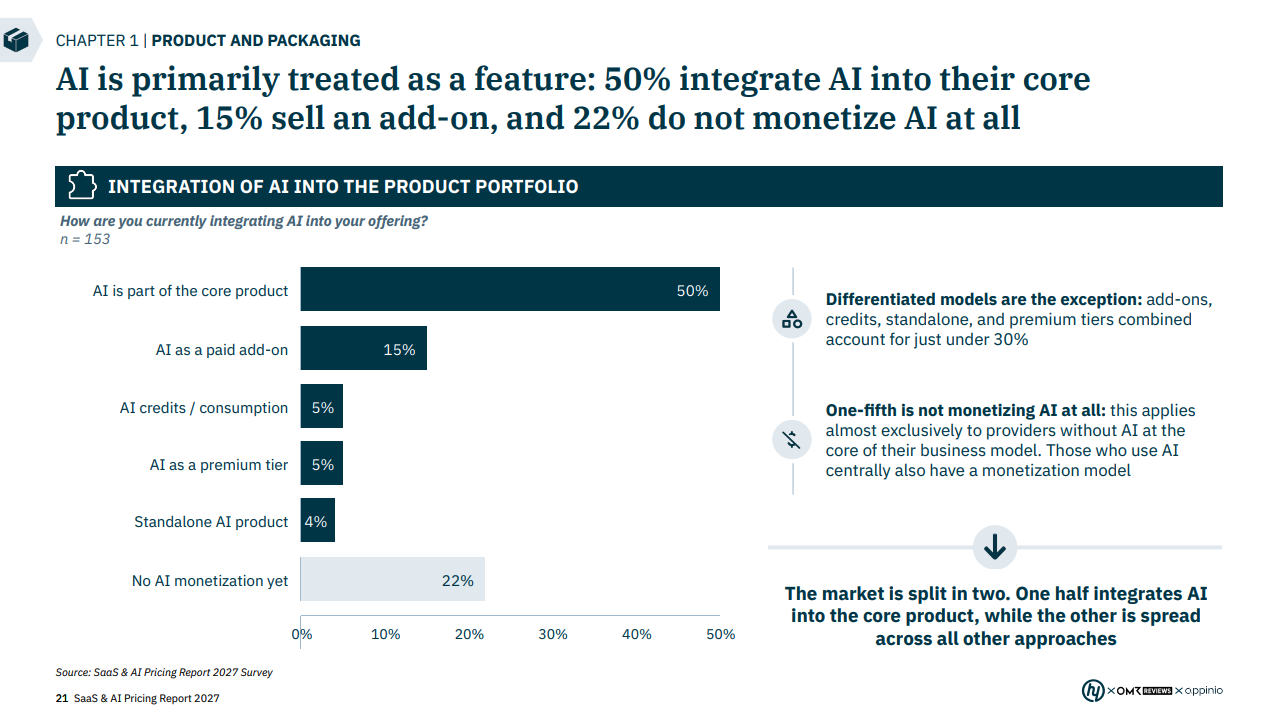
When it comes to packaging, though, reality still looks different: 50% of vendors simply include AI in the core product for free, and 22% don't monetize it at all. Paid add-ons account for 15%, credit models for 5%.
The seat is losing its role as the lead currency
The most interesting number in the report is a before-and-after comparison. We asked how vendors bill today and which metric will matter most in the future.
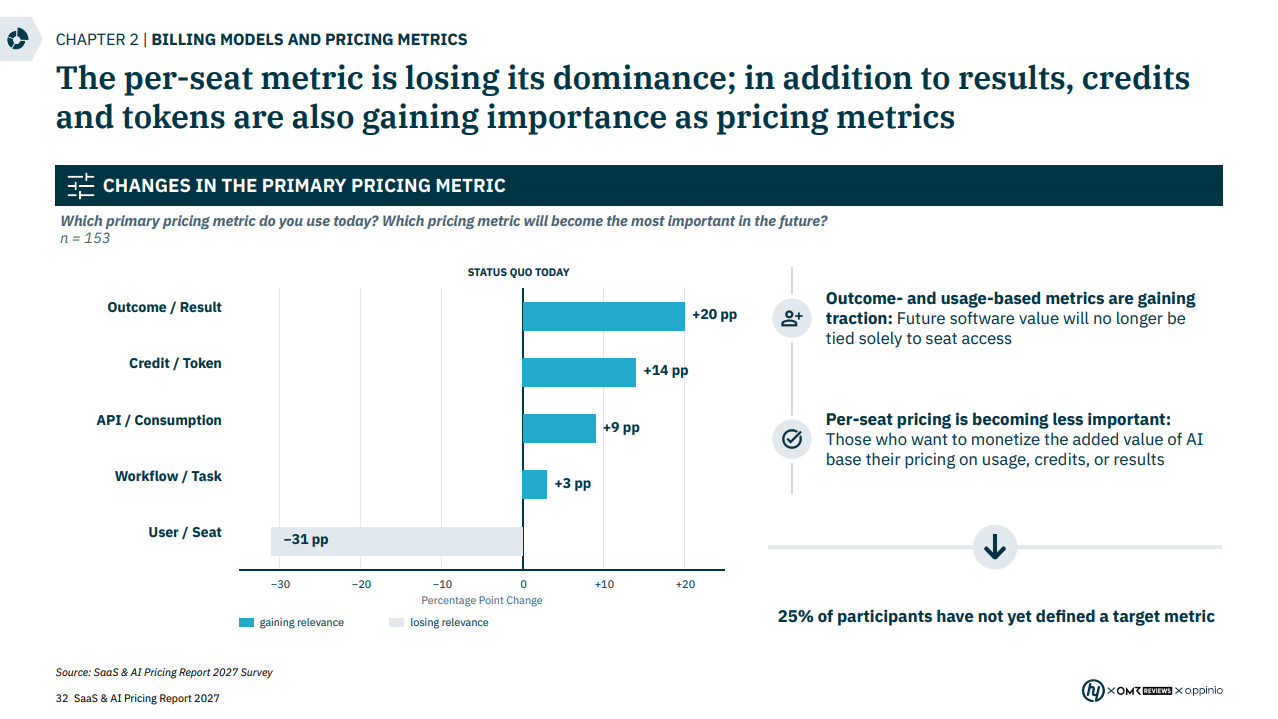
Pure pay-as-you-go still regularly fails in B2B because of the budget logic on the buying side. Nobody likes signing for an invoice with no cap. Hybrid models will therefore prevail: a predictable base fee for access, plus a variable component for AI usage. According to the study, the share of pure subscriptions falls from 46% to 22%.
When agents do the work, a different budget pays
The most interesting lever in the report has nothing to do with price level, but with the pot the money comes from.
An AI feature makes employees faster. It therefore competes within the software budget, against other tools. An agent that takes over a task from start to finish, on the other hand, competes with FTE costs, service provider day rates, and the cost of work left undone. That addresses a different budget.
Anyone selling work instead of access is therefore negotiating in a different league, provided the service can be cleanly defined. How Figma, Clay, Intercom, Microsoft, and Salesforce solve this in practice is covered in the
hy report on SaaS and AI pricing.
Discovery is becoming the new bottleneck
And this is where a development comes in that puts the entire pricing topic into perspective.
We asked the 153 vendors what changes software buying the most. 41% name AI search, with a clear lead over everything else. AI agents as buyers come second at 16%. And it doesn't stop at opinion: 76% say AI is already changing their go-to-market strategy.
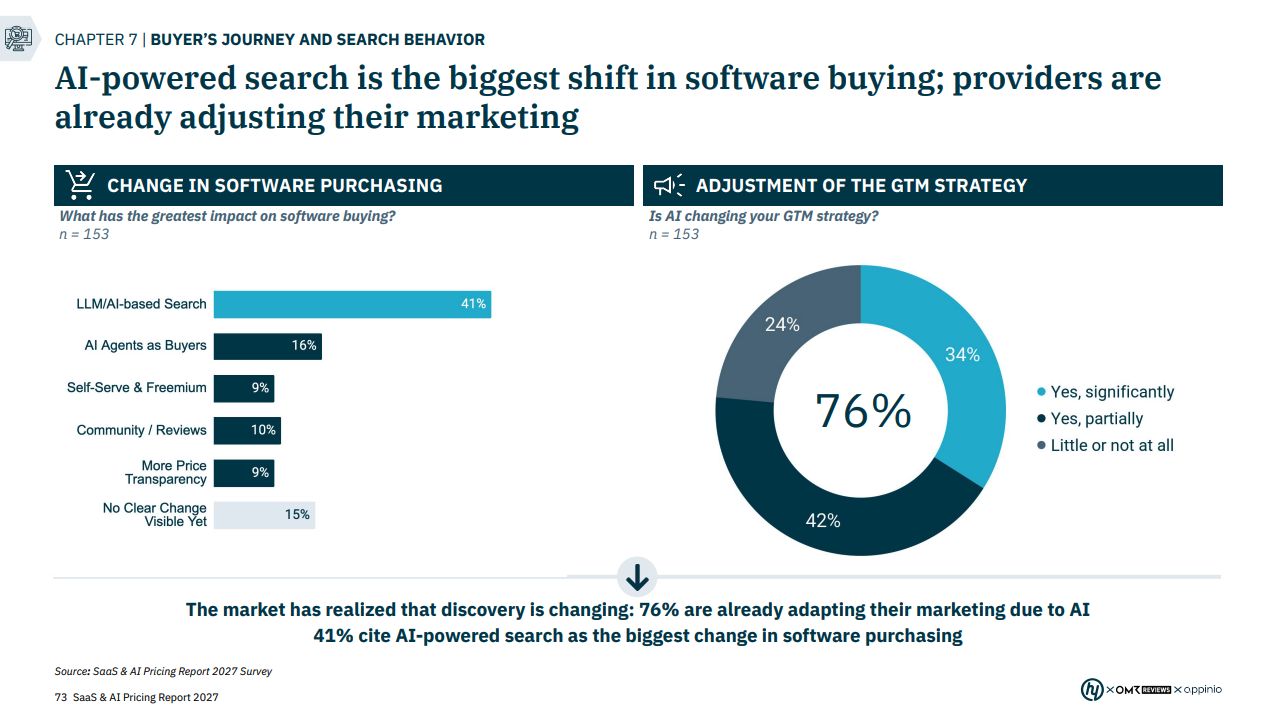
So the market has understood that discovery is shifting. What's missing is execution.
The difference from classic search is not the channel but the quantity. Google shows more than ten results, each of which lists several solutions after the click. An LLM names two or three tools, and there is no second page.
Then there's a number that frames everything else:
92% of B2B buyers ultimately choose a product that was already on their first list. That list is increasingly created in AI systems. If you don't show up there, you never get to the negotiating table.
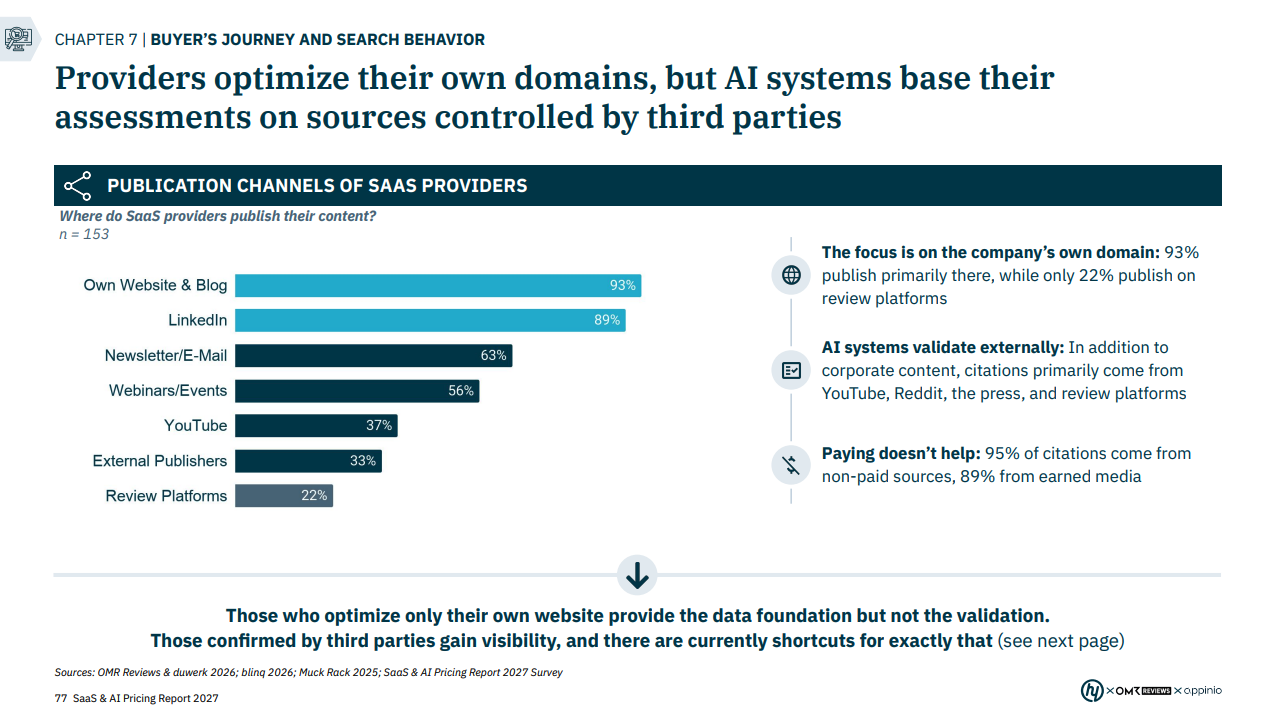
The problem: 93% of vendors publish primarily on their own domain, and only 22% on review platforms (
AI Search Report). AI systems, however, validate externally. According to an
AirOps study, 85% of citations in AI answers come from non-paid sources such as earned media. Your own website provides the data basis, but not the confirmation.
An experiment by
Otterly shows how fragile this state still is: a completely made-up agency ranked third in ChatGPT's recommendations for its category after 14 days, placed via listicles and directory entries. In the short term, AI visibility can be bought cheaply. That is exactly why we expect the systems to weight sources more heavily that can't be built in two weeks.
Prices that no machine can read get replaced
This is where the circle closes back to pricing.
Prices get compared where they are readable. A vendor that doesn't publish structured pricing information doesn't disappear from the comparison. It gets compared using third-party data: estimates, forum posts, and, not infrequently, the page of a competitor who occupies the pricing narrative of their rivals with their own blog posts. "Contact Sales" is not price communication; it is handing it over.
In enterprise, this doesn't have to mean a full price list. Pricing metric, entry price, and package logic are enough to become citable.
Conclusion: Pricing is no longer a standalone project
The report shows an industry rebuilding in three places at once.
The pricing metric determines whether your revenue grows with customer value. As long as you charge per seat while AI reduces the number of seats your customer needs, your revenue grows against the value rather than with it.
The billing model determines whether any margin is left in the end. Every AI interaction costs real money. A pure subscription doesn't absorb that, and pure pay-as-you-go doesn't sell in B2B.
Visibility determines whether you get asked at all. The cleanest pricing model is useless if your product doesn't appear on the AI shortlist.
There won't be one universal AI pricing model. What there will be are vendors who treat product, packaging, and price as one system and keep adjusting it, instead of running one pricing round per year. 80% are planning their next one right now. If you want to push through higher prices in 2027, start this year.
In the free report you get all seven chapters: packaging, billing models, pricing metrics, agents, outcome-based pricing, AI infrastructure, and buyer journey. You also get practical examples from Figma, Clay, Intercom, Microsoft, and Salesforce, plus an eight-step decision framework.
Data basis: Survey of 153 software and AI companies on AI pricing strategy, analysis of 4,400 software profiles on OMR Reviews, and 23 expert interviews, conducted in 2026 by hy Consulting, OMR Reviews, and Appinio. Multiple answers were possible for some questions. Percentages are rounded.